

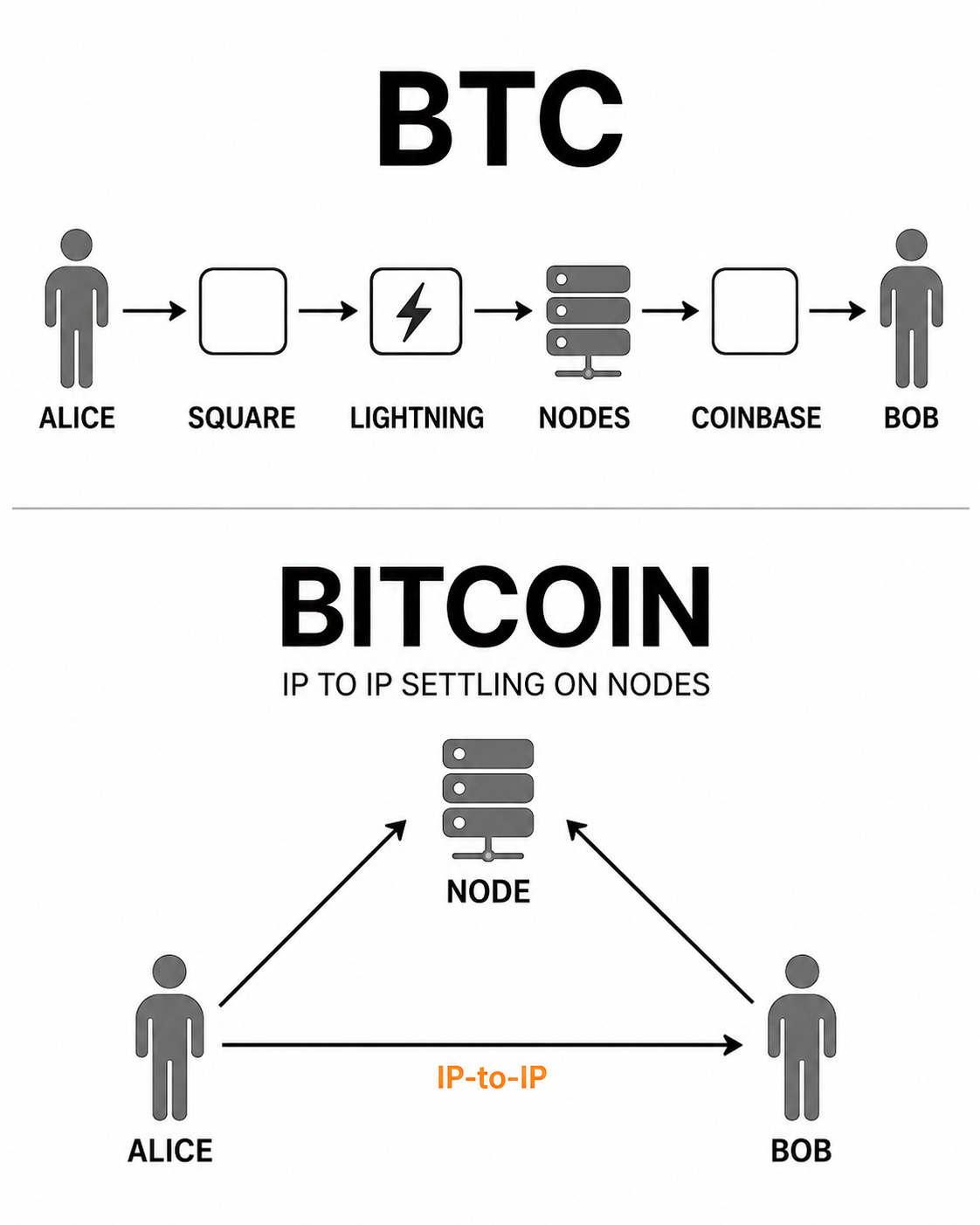
BTC presents itself as direct digital cash, but the practical model has become a relay of intermediaries: Alice to Square, Square to Lightning, Lightning to nodes, nodes to Coinbase, Coinbase to Bob. Bitcoin is different. Bitcoin is Alice and Bob transacting IP-to-IP, with one or both parties sending the transaction to a node for settlement.
Keywords
BTC, Bitcoin, IP-to-IP, peer-to-peer, digital cash, nodes, Lightning, Square, Coinbase, settlement, intermediaries, payment channels, micropayments, electronic cash, Satoshi, transaction propagation, network architecture, commercial banking, payment rails
There is a simple way to expose the fraud of the modern BTC narrative: draw the route.
Do not start with slogans. Do not start with conference-stage folklore. Do not start with cartoon libertarian banking metaphors from people who have never built a banking system, audited one, attacked one, secured one, or understood why commercial settlement exists at all. Draw the route.
Alice wants to pay Bob.
That is the test.
Not “how many people can repeat a catechism about self-sovereignty.” Not “how many influencers can explain seed phrases badly.” Not “how many people can chant that banks are evil while using exchanges, custodians, payment processors, Lightning service providers, hosted wallets, routing nodes, watchtowers, liquidity providers, and fiat off-ramps.”
Just Alice paying Bob.
In BTC, the supposed “simple” system is not simple. It is not direct. It is not even meaningfully peer-to-peer in the form ordinary users are encouraged to use. Alice does not simply pay Bob. Alice touches Square. Square touches Lightning. Lightning touches its liquidity and routing apparatus. The transaction then interacts with nodes in a system constrained by artificial block limits and a fee market that punishes small payments. Bob may receive something through Coinbase, or another exchange, or another custodian, or some wallet provider with its own rails and its own policies. The clean marketing diagram says “sending bitcoin,” as though a coin flew through the air like a paper note handed across a table. The actual user experience is closer to an over-decorated banking maze with orange paint on the walls.
Alice → Square → Lightning → nodes → Coinbase → Bob.
That is not direct.
That is not cash.
That is not the system described as peer-to-peer electronic cash.
It is commercial banking architecture wearing a novelty hat.
The insult is not complexity itself. Complex systems are not inherently bad. Settlement systems, clearing systems, payment-channel systems, network-routing systems, and fraud-control systems all involve layers. The issue is not that BTC has become layered. The issue is that BTC markets its layers as freedom while recreating the very dependency structure it pretends to abolish. It sells the myth of direct payment while making direct payment increasingly impractical for the ordinary user. It tells people they are “their own bank,” then gently escorts them toward services that behave like banks, exchanges, payment processors, hosted account providers, and liquidity gatekeepers.
That is not technological liberation. That is reintermediation.
It is the old system rebuilt badly, with weaker consumer protection, worse usability, higher operational risk, and a priesthood of people insisting that every failure is actually a feature.
Bitcoin is different.
Bitcoin is Alice and Bob.
Alice pays Bob directly. The transaction is sent IP-to-IP. Either Alice, Bob, or both may send the transaction to a node. The node settles the transaction in a block. The network is not a mystical cloud of spectators. Nodes are not passive hobby machines that sit around validating theatre for applause. In the original design, nodes are the competitive systems that create blocks. They perform the economic work. They process, validate, order, and settle transactions. They are not a decorative afterthought. They are the settlement infrastructure.
So the Bitcoin diagram is not a long chain of retail intermediaries.
It is a triangle.
Alice → Bob.
Alice → node.
Bob → node.
That is the distinction.
BTC’s practical payment path expands sideways into institutions. Bitcoin’s payment path collapses into direct exchange and settlement.
The difference matters because the architecture determines the economics. The economics determine the incentives. The incentives determine the behaviour of the system. A system that drives users through intermediaries will not remain a cash system. It becomes an account system. It becomes a platform system. It becomes a permissioned routing system governed by liquidity, channel policy, exchange policy, compliance policy, custodial risk, and fee pressure. It becomes what it claimed to replace.
The BTC crowd likes to pretend that “peer-to-peer” means a user can eventually obtain a record on a ledger after passing through a collection of service providers. That is not peer-to-peer. That is merely digital settlement with extra choreography. Calling it peer-to-peer because a protocol exists somewhere beneath the wrappers is like calling modern card payments “direct merchant settlement” because electrical signals eventually move through wires. The existence of a protocol does not make the user’s experience direct. The existence of a base layer does not make the commercial system built above it peer-to-peer. The existence of an escape hatch does not define the main architecture.
If Alice has to depend on Square, Lightning routing, channel liquidity, nodes constrained by a deliberately throttled base layer, and Coinbase or some similar custodian for Bob, then Alice is not paying Bob in the way Bitcoin was designed to allow. She is using a chain of service providers. She is pushing value through a series of institutional touchpoints. The fact that the branding says BTC does not make the arrangement cash. It makes it a payment network.
BTC defenders will say that users can still transact on-chain. Yes, and a person can still pay for groceries in pennies if they bring a wheelbarrow. The theoretical possibility of direct use is not the same as a system designed for direct use. A design that intentionally restricts capacity, drives fees upward, discourages low-value transactions, and pushes commerce into secondary systems cannot honestly claim that ordinary direct payment remains the central model. At best, direct payment becomes a luxury event, a settlement ritual, or a symbolic act performed to prove ideological purity.
Cash cannot be an occasional ceremony.
Cash must work at ordinary scale.
It must handle small payments. It must handle frequent payments. It must handle commercial payments. It must allow users to transact without forcing them through a widening hierarchy of intermediaries. It must support merchants, consumers, automated services, micropayments, machine-to-machine exchange, and practical settlement. It must be boringly functional. It must move because commerce moves.
BTC chose the opposite path. It chose artificial scarcity of transaction capacity. It chose high fees as a moral virtue. It chose settlement austerity. It chose to make the base system hostile to routine use, then presented the resulting inconvenience as sophistication. When that created the obvious problem that people could not use BTC conveniently for everyday payments, it offered another layer. Then another service. Then another provider. Then another abstraction. Then another wallet that hides the complexity. Then another custodian that saves the user from the burden of using the thing directly.
That is how one gets Alice to Square to Lightning to nodes to Coinbase to Bob.
And after all of that, the same people will sneer at banking.
This is why diagrams matter. A diagram removes the fog. It forces the architecture to confess. BTC marketing wants a picture of two people with an orange coin between them. The picture says: “Look, simple.” But that image is false. It omits the route. It omits the institutions. It omits the dependency chain. It omits the fact that the typical user is not performing a direct electronic cash transaction. It omits the fact that most practical BTC use has been absorbed into exchanges, custodians, payment intermediaries, and channel operators.
A proper BTC diagram should not show Alice handing value directly to Bob.
It should show Alice handing value to Square.
Then Square to Lightning.
Then Lightning to nodes.
Then nodes to Coinbase.
Then Coinbase to Bob.
That is not a criticism of each individual company as a company. Square can provide services. Coinbase can provide services. Lightning can route payments. Exchanges can exist. Payment processors can exist. The problem is the lie that such a structure is direct electronic cash. It is not. It is a payment-service stack. It is a corridor of intermediaries. It is a collection of dependencies. It is banking logic without the honesty to admit that it is banking logic.
Bitcoin does not require that architecture.
Bitcoin was designed so that Alice can transact with Bob directly. The transaction can be communicated directly. It can be sent to a node. Bob can send it to a node. Alice can send it to a node. Both can. The node settles. The system is not improved by pretending that every wallet user must become a node. The system is not improved by pretending that non-mining machines are the centre of the universe. The system works when economically incentivised nodes compete to process transactions and produce blocks. Users transact. Nodes settle.
That is not hard to draw.
It is a triangle.
Alice at one point. Bob at another. Node at the third.
Alice pays Bob IP-to-IP. Alice can send the transaction to the node. Bob can send the transaction to the node. The node settles it. The payment is not a pilgrimage through a chain of custodians and routing providers. It is not a branded obstacle course. It is not a banking system with orange stickers. It is electronic cash.
The difference between those diagrams is the difference between two philosophies of commerce.
BTC says: scarcity of block space first, payment practicality later.
Bitcoin says: transactions first, settlement at scale.
BTC says: ordinary users should not burden the base layer.
Bitcoin says: the base layer exists to process transactions.
BTC says: small payments should move elsewhere.
Bitcoin says: small payments are the point.
BTC says: the network is protected by making it expensive and awkward to use.
Bitcoin says: the network is secured by economic activity, competitive nodes, and volume.
BTC says: everyone should care about running a passive machine.
Bitcoin says: users should transact, and nodes should do node work.
This distinction is not cosmetic. It is not a naming preference. It is the central architectural divide.
A payment system is defined by its settlement path. When the path from Alice to Bob is direct and the node settles the transaction, one has a digital cash model. When the path from Alice to Bob depends on a sequence of service providers, liquidity channels, custodial endpoints, and exchange accounts, one has an intermediated payment model. The first model is Bitcoin. The second is BTC.
The BTC world will object because it has trained itself to survive by equivocation. It says “Bitcoin” when marketing simplicity. It says “BTC” when discussing ticker markets. It says “Lightning” when the base layer fails as cash. It says “store of value” when payments fail. It says “settlement layer” when commerce becomes impossible. It says “self-custody” while most activity clusters around exchanges. It says “peer-to-peer” while users rely on hosted services. It says “trustless” while ordinary people trust interfaces, providers, liquidity hubs, routing systems, exchanges, custodians, bridges, and app stores.
One cannot build intellectual integrity out of slogans.
If BTC is a settlement asset for institutions, then say so. If BTC is a speculative reserve token, then say so. If BTC is designed to make base-layer transactions scarce and expensive, then say so. If BTC expects small payments to occur through Lightning and service providers, then say so. But do not call that direct electronic cash. Do not draw Alice and Bob as though the path between them is clean. Do not pretend that a chain of intermediaries disappears because the logo is orange.
Bitcoin as originally designed is not embarrassed by transactions. It does not need to hide them. It does not need to banish them to channels. It does not need to tell users that using the base system is somehow vulgar. The system exists for transactions. Its security model is tied to economic activity. Its nodes are paid through fees as subsidy declines. Those fees do not have to become punitive tolls on ordinary users; they can arise from scale. Many transactions at low cost are economically superior to a small number of expensive transactions if the goal is a functioning commercial system.
That is the part BTC cannot tolerate. BTC’s entire priesthood depends on the notion that small blocks are moral, high fees are inevitable, and practical payments are somebody else’s problem. The moment one allows transaction capacity to scale, the ideological justification for all the extra machinery weakens. If Alice can pay Bob directly and the system can process the transaction efficiently, then why does Alice need the maze? Why does she need to be told that direct use is dangerous, expensive, unsuitable, or unsophisticated? Why must she be routed through the new middlemen?
The answer is simple: once BTC abandoned the cash function, it needed an excuse for the abandonment.
The excuse became theology.
The theology said that the base layer must be kept small. The theology said that users running passive validation software were the guardians of the system. The theology said that payments belonged elsewhere. The theology said that complexity was freedom. The theology said that failure to scale was prudence. The theology said that if ordinary commerce became impractical, that only proved the system was valuable.
It is a strange religion: the less useful the system becomes, the more sacred it is declared to be.
Bitcoin does not need that sermon. Bitcoin does not need to explain why Alice cannot pay Bob. Bitcoin does not need to turn everyday commerce into a philosophical embarrassment. Bitcoin does not need to tell the merchant to wait for an app, a channel, a liquidity provider, a custodian, or an exchange integration. Bitcoin is a digital cash system. Alice pays Bob. The transaction reaches a node. The node settles it.
The triangle remains devastating because it is simple.
Alice. Bob. Node.
There is no Square in the middle. There is no Coinbase at the receiving end. There is no Lightning path pretending to be a cash handover. There is no multiparty dependency disguised as peer-to-peer. There is a transaction between parties and settlement by nodes.
That also clarifies what a node is. A node is not a social identity. A node is not a badge. A node is not a Raspberry Pi running in a cupboard so that someone can feel involved in monetary history. In the Bitcoin model, nodes are the systems that build blocks. They compete. They invest. They process. They settle. They earn revenue. They are economic actors, not decorative witnesses. Once that is understood, the whole fake politics surrounding “everyone should run a node” collapses. Users do not need to become settlement infrastructure in order to use cash. They need to transact. Nodes need to settle.
A functioning payment system separates roles. Consumers consume. Merchants sell. Processors process. Nodes settle. Developers build applications. Auditors audit. Regulators regulate where law applies. Businesses compete. None of this is mystical. The original beauty of Bitcoin was not that every person on earth would become a hobby infrastructure operator. The beauty was that the system could allow direct electronic payments while nodes competed to order transactions and secure the ledger.
BTC turned that into a morality play.
In the BTC morality play, the ordinary user is told to be suspicious of scale, suspicious of commercial use, suspicious of low fees, suspicious of large blocks, suspicious of businesses processing transactions, suspicious of anything that looks like actual payment adoption. Then, after poisoning the base system against ordinary use, the same people offer intermediated substitutes and call them progress.
This is why the BTC diagram must be linear.
Alice cannot simply pay Bob. She enters a chain.
Alice to Square.
Square is not Bob. It is a service provider. It can impose policies. It can collect information. It can decide what features to offer and what risks to tolerate. It can integrate with other providers. It can simplify the experience by becoming part of the transaction path. That may be commercially useful, but it is not direct cash between Alice and Bob.
Square to Lightning.
Lightning is not Bob either. Lightning introduces channels, liquidity constraints, routing decisions, online requirements, channel management, failed payments, liquidity balancing, and service dependencies. Its defenders will describe these as solvable engineering issues, but the point remains: the payment has moved away from direct electronic cash into a routed network architecture. That may be interesting engineering. It is not the same architecture.
Lightning to nodes.
Eventually the system still depends on the base layer and its nodes. The supposed escape from on-chain scaling is never really an escape. It is a postponement, a batching strategy, a dependency-hiding strategy. Opening channels, closing channels, resolving disputes, and final settlement still touch the base layer. If the base layer is artificially constrained, the upper layers inherit that constraint in different forms.
Nodes to Coinbase.
Coinbase is not Bob. It is another intermediary. It is an account provider, exchange, custodian, and regulated business. Again, such entities may perform useful commercial functions. But once Bob’s receipt depends on Coinbase, the model is plainly not Alice handing digital cash directly to Bob. It is Alice initiating value movement through a structure that ends in Bob’s account or wallet relationship with a service provider.
Coinbase to Bob.
Only at the end does Bob appear as the recipient. By then the supposed peer-to-peer system has passed through a chain of institutional machinery. The diagram is no longer a digital cash diagram. It is a payments-industry diagram.
The BTC advocate may say that this is unfair because not every BTC payment follows that exact route. That misses the point. The diagram captures the practical direction of travel. It captures the dependency model promoted as usable BTC. It captures the fact that ordinary users are pushed away from direct base-layer payment into intermediated services. The specific brands may change. Replace Square with another payment app. Replace Coinbase with another exchange. Replace one Lightning provider with another. The structure remains.
The structure is the argument.
Bitcoin’s structure is different.
Alice can communicate with Bob. Bob can receive the transaction. One or both can submit it to a node. The node includes it in a block. The system scales by processing transactions, not by treating transactions as pollution. The direct payment is not an exception. It is the model.
This is why BTC should not be allowed to occupy the word “Bitcoin” unchallenged. Names matter because names carry architecture. When BTC is called Bitcoin, people are invited to confuse the old electronic cash design with the later settlement-token ideology. They are invited to confuse a throttled asset routed through intermediaries with a scalable payment system. They are invited to believe that the maze is the original design, when the maze is the deviation.
The word “Bitcoin” belongs to the system of peer-to-peer electronic cash.
Not to the system that tells Alice to go through Square, Lightning, nodes, Coinbase, and then finally Bob.
Not to the system that made everyday payment impractical and called the wreckage discipline.
Not to the system that replaced direct exchange with a service-provider procession.
A clean Substack graphic should show this distinction without apology.
At the top: BTC.
Alice on the left. Bob on the right. Between them, the chain: Square, Lightning, nodes, Coinbase. Arrows in sequence. No direct line from Alice to Bob. No false simplicity. No orange coin magically floating across the gap. The point is that BTC’s practical payment model is indirect.
At the bottom: Bitcoin.
Alice, Bob, and node in a triangle. Alice pays Bob IP-to-IP. Alice can send to the node. Bob can send to the node. The node settles. Three arrows. One clear architecture. No invented middlemen. No retail banking cosplay. No propaganda diagram pretending the route is shorter than it is.
The contrast should be impossible to miss.
BTC: intermediated route.
Bitcoin: direct transaction with node settlement.
BTC: Alice enters a service stack.
Bitcoin: Alice pays Bob.
BTC: complexity disguised as freedom.
Bitcoin: peer-to-peer electronic cash.
The public has been trained to accept muddy language. That must end. A thing should be named according to what it does. If a system cannot handle ordinary payments directly and pushes users into intermediated rails, then it should be described as an intermediated asset network. If a system allows Alice and Bob to transact directly and have the transaction settled by nodes, then it is the digital cash architecture.
BTC can keep its ticker.
Bitcoin keeps the design.
The BTC diagram is not a mere insult. It is an architectural accusation. It says: show the route. Show the parties. Show the dependencies. Show the middlemen. Show the actual path a user is pushed toward when the base layer has been crippled. Stop hiding behind the word “peer-to-peer” while routing people through services. Stop pretending that a settlement-token ideology is the same as cash. Stop calling a relay of institutions direct payment.
The Bitcoin diagram is not nostalgia. It is engineering discipline. It strips the system back to roles: payer, recipient, node. It does not pretend that complexity is sophistication. It does not pretend that intermediaries vanish because they use fashionable terminology. It does not pretend that cash is cash when Bob cannot receive it from Alice without the machinery of a payment stack.
Alice to Bob is the test.
BTC fails that test in ordinary practical use.
Bitcoin was designed to pass it.
The difference fits on a single page because the truth usually does.
Can you imagine the situation where Bob and Alice never settle? And just continue to transact peer 2 peer without final settlement on the ledger? The same coins going back and forth. A bit like using payment channels. Or using L2 Lightning channels and never closing them.
Is it simply that the law would not allow it. Or that people would never trust it as the money?
I'm not suggesting this is a good or a bad thing or that it's what I want. I'm asking why would they not do so?
This is almost how central bank money works(cash). The coins are issued. They're spent many times over. Then they are withdrawn from circulation with a final anonymous mass settlement.
Removal of cash from circulation is not the same sort of thing as final settlement on chain. With cash, final settlement happens at the point of exchange. This is largely what makes it worthy. We all know intuitively we can use it safely to buy things with without an authority settlement activity.
So what is stopping Alice and Bob from never settling on chain?