
China’s Strategic Inflection
Demographic Decline, Technological Flux, and the Tariff-Induced Turn

Introduction
China stands upon a precipice carved by its own policies and foreign confrontation—a nation pressed between the grinding stones of demographic inversion and technological displacement. Two major essays, once standing separately, now converge to capture the unified crisis: a rapidly aging population and seismic shifts in labour automation. But new vectors emerge. External economic pressure from Trump-era U.S. tariffs have—ironically—opened space for China to recalibrate. Through the prism of John Mearsheimer’s offensive realism, what might appear as terminal decline reveals itself as strategic reorientation. China, the would-be hegemon of East Asia, now manoeuvres within constraints shaped by both internal fragility and global rivalry.
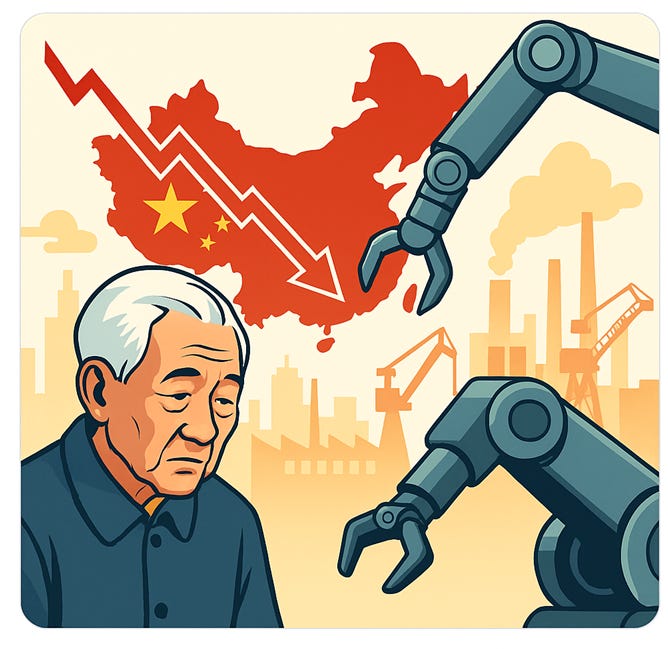
I. The Gravitational Collapse of the Population Pyramid
Since the 1980s, China’s demographic policies have deformed the population structure into a narrowing base and widening top—a pyramid inverted. The one-child policy, enforced from 1979 to 2015, has created a society that will soon consist of more elderly than children (Fang et al., 2020). Improved healthcare and longer life expectancies, while beneficial, have only accelerated the swelling ranks of retirees.
The implications of this aging trend are profound. A diminishing labour force reduces productive capacity, erodes tax revenues, and forces governments to fund social welfare systems with an ever-shrinking contributor base (Čajková & Čajka, 2021). With an increasing dependency ratio, the working generation bears the dual burden of supporting aging parents and raising children, straining familial stability and national productivity. Frailty, a biological syndrome increasingly prevalent with age, adds layers of complexity—demanding more healthcare workers, more facilities, and more funding (Feng et al., 2020).
This isn't merely an economic drag. It is a threat to China’s sociopolitical cohesion. Social unrest, driven by resentment from overworked younger citizens, looms as a potential consequence. The PRC’s policy response, including relaxed birth quotas and subsidised childcare, has failed. As Alpermann and Zhan (2019) observed, families remain reluctant to expand when economic uncertainty looms and educational burdens rise. Thus, the demographic cliff is not a future event—it is an active collapse already underway.
