

I. Opening Gambit – The Death of the Supermarket Fantasy
The supermarket sells a story, not food. Rows of identical vegetables lit under migraine-inducing fluorescents, each with a barcoded smile and the shelf-life of a politician’s promise. They were picked days—sometimes weeks—ago, gassed into a simulation of ripeness, shuttled through a conga line of warehouses and refrigerated trucks so they could arrive at your dinner table embalmed and vaguely edible. This is the vaunted “efficiency” they brag about: the art of keeping dead things looking alive long enough for you to pay for them.
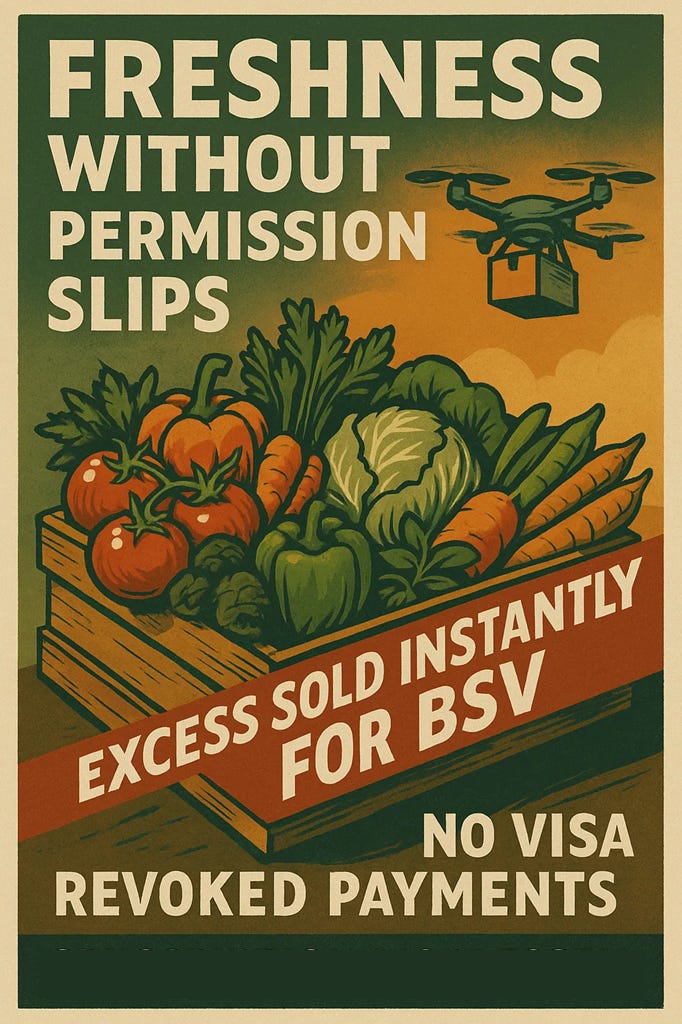
The subscription model is the heresy against this polished rot. Vegetables that have felt the sun in the last twenty-four hours, roots still damp from their own soil, delivered before they’ve had time to forget they were alive. No warehouse purgatory, no cold-chain life support—just a direct line from ground to plate. It’s not nostalgia, and it’s not romanticism. It’s logistics stripped of its absurd theatre, where the distance between farmer and eater is measured in hours, not postcodes.
And here’s the part that really makes the supermarket set squirm: this isn’t just possible—it’s scalable. Rows planned and planted with a calendar’s precision, timed so something is always ready to harvest. Consumers subscribe, their boxes are packed according to the season and their preferences, and there’s no mystery in the process. What they get is what was picked that morning, and they pay instantly—digital cash, settled the moment the crate leaves the farm, with no bank holding it hostage and no plastic card network ready to revoke it on a whim.
In the end, the real efficiency isn’t in keeping a lettuce alive long enough to cross the country. It’s in making sure it never has to.
II. The Subscription as a Contract of Production
The subscription isn’t a friendly handshake—it’s a production contract written in soil. Each member’s payment isn’t for a box of vegetables, it’s for the continuation of a living, breathing cycle that begins with a seed, runs through weeks of tending, and ends in a harvest measured in hours, not shipping miles. The transaction is a promise: you fund the discipline, the row-by-row schedule, the calculated rotation that keeps the ground busy and the yields steady.
For the grower, it means certainty. No gambling on the chaos of wholesale markets or the fickle whims of supermarket buyers. Each subscription locks in income for the season, underwriting the very act of planting. Crops can be planned like military campaigns—variety chosen to match the climate, the soil, and, crucially, the subscribers’ tastes. If someone hates radishes, the rows can flex. If they want more leafy greens in winter, the schedule bends to meet it.
And because it’s all timed, there’s no glut of one week’s excess rotting in a bin while the next week’s box looks apologetic. The output is calibrated—an even flow of food, not the erratic spikes of feast and famine. In this way, the subscription is more than a purchase. It’s an act of commissioning, an investment in continuity, where the grower’s discipline becomes the eater’s guarantee.
III. Why Heritage and Local Varieties Fit the Model
Heritage seeds and local varieties are the natural allies of a subscription system because they refuse to bow to the supermarket’s obsession with visual conformity. In the industrial model, a tomato must be the same size, the same shape, and the same colour—or it is discarded before it even reaches the shelves. In the subscription model, a tomato only has to taste like a tomato. Members trade the false security of uniformity for the reality of flavour, nutrition, and character.
The diversity in heritage planting is more than aesthetic—it's strategic. Dozens of varieties in circulation form a genetic hedge against the unpredictable: late frosts, sudden heat waves, a pest that thrives one season but disappears the next. When one variety falters, another thrives, ensuring the weekly box doesn’t arrive looking like the harvest failed. The quirks of heritage crops—slightly knobbled carrots, tomatoes that run from green to gold—are not defects; they’re proof the plants have been selected to survive and perform here, in this soil, under this sun.
Locally adapted heritage lines are particularly brutal on loss rates. They’ve been honed by decades, sometimes centuries, of survival in the same conditions, which means they yield more consistently without chemical crutches. In a closed-loop subscription, that consistency is everything. Each delivery relies on predictable output. With heritage seeds, the grower doesn’t just plant crops—they plant certainty, resilience, and the promise that no matter the season’s temperament, the box will be full.
IV. Drone Fresh Pick-and-Deliver – The Final Nail in the Old System
Drone integration is the scalpel that carves the last thread of the supermarket’s illusion. When produce leaves the ground, it should be en route to a plate—not taking a diesel-soaked tour of regional depots. In a drone-based system, picking and packing is immediately followed by lift-off. Hours, not days, separate harvest from delivery. The leaf is still taut, the sugars haven’t bled away, and the scent of the soil still clings to the roots.
Road haulage has always been the bottleneck—sluggish schedules, arbitrary delivery windows, and a whole apparatus designed to make produce fit into someone else’s timetable. Drone logistics bypass this entirely. They leap over traffic, sidestep depot handling, and bring food directly from the grower’s hands to the subscriber’s door without lingering in a refrigerated purgatory.
It is also the death knell for the delivery slot farce. Micro-scheduling means dispatch is triggered by harvest completion, not the convenience of a middleman. Your box arrives when it is ready, not when a van’s route happens to pass by. It is a system that works at the speed of ripeness, not the speed of paperwork. The supermarket model can’t compete—not on freshness, not on efficiency, and certainly not on the flavour of something still breathing the air it was grown in.
V. The Machine Logic – Matching Planting Cycles to Delivery Windows
The planting schedule becomes the nervous system of the entire operation, wired directly into the delivery logic. Each bed runs on a three-week pulse: one section germinating, the next pushing into growth, the last ready for harvest. This means the drone doesn’t wait on the crop, and the crop doesn’t wait on the drone—every week there is something to pick, pack, and launch into the air.
Between these cycles lie the long-game players: asparagus crowns, perennial herbs, slow-maturing fruits. They slip between rows like quiet investors, paying out intermittently without disturbing the relentless weekly flow. Their timelines don’t disrupt the rhythm; they enhance it, adding depth to the delivery offerings when they come into season.
Then there are the workhorses—pumpkins, squash, and other vine crops—anchored not only for their eventual bulk yields but for their role as living ploughs. They break up the soil, shade out weeds, and leave behind a crumb structure that makes subsequent plantings faster, cleaner, and more productive. In the machine logic of this system, every plant has two jobs: the crop it delivers, and the way it primes the ground for the one that follows. That’s how the cycle stays unbroken, and why the delivery windows never miss a beat.
VI. Excess as Opportunity, Not Waste
Where the centralised supermarket pipeline drowns in its own glut, this system treats excess as a live asset. There is no backroom full of limp lettuce waiting for a skip; there’s a network ready to redeploy surplus before it even thinks of wilting. Subscribers who want more get first claim—overflow boxes at a reduced cost, a perk for loyalty and a hedge against waste.
Outside that core, nearby buyers receive instant alerts. Payment is frictionless, direct, and irrevocable—token-based transactions settle in seconds, without the bureaucratic purgatory of card processors deciding, days later, whether to claw it back. The moment the “buy” is hit, the deal is done, the drone is loaded, and the produce is airborne.
For the remainder, there’s the second market: pickles, preserves, dehydrated goods. Every excess cucumber is a jar of relish; every flush of tomatoes becomes a bottled sauce with months of shelf life. The point is simple—nothing dies in storage, nothing languishes under flickering supermarket lights. In this model, abundance is not a liability. It is the proof that the system is working so well it occasionally outruns itself—and when it does, it turns the surplus into more revenue instead of more compost.
VII. The Payment Backbone – BSV and Tokens
Money, in this system, doesn’t wait to be told what to do. There are no gatekeepers, no frozen transactions while someone in a tower somewhere decides whether your purchase is righteous enough to clear. The payment infrastructure is BSV: not some speculative fantasy or hot-air placeholder like BTC, but a system designed for actual settlement. Not promise. Not proxy. Finality.
Each subscription is settled the moment it’s made. The token—call it what you will—is not a lottery ticket or a placeholder for some distant redemption. It is the transaction itself. Immutable. Immediate. Final. No reversed charges. No intermediary sneaking a fee when you blink. No standing in line while some fintech platform does a little dance to pretend it’s not a bank. It’s paid. It’s done. The crate is packed. The drone lifts.
This isn’t some NFT trinket economics or trading-card blockchain theatre. The token represents the act of production. It’s a marker that says: this box exists, this row was harvested, this crate is in motion. The grower gets paid in full, not “pending,” not “subject to fraud review,” not “we’ll hold it in escrow for 3–5 business days while our lawyers check your moral purity.” BSV means no delay. No abstraction. Just clearing—real clearing—at scale.
And scale is the point. This isn’t one hippie box of lettuce between friends. This is systematised agriculture, run like a machine. Hundreds, then thousands of subscribers. Rows mapped, harvests scheduled, drones clocking in and out like postal workers. You need a payment layer that doesn’t stutter under load. That doesn’t blow its head off when the transaction count hits double digits per second. BTC chokes. Ethereum melts. BSV stays boring and just works.
So here, money doesn’t ask permission. It doesn’t wear a suit or hold a clipboard. It moves like the crop does: direct, fast, and only once.
VIII. Economics – Stable Income, Minimal Waste
Fixed subscriptions turn a grower’s balance sheet from a slot machine into a timetable. Each member’s weekly allocation is a pre-sold harvest, not a speculative gamble. There is no glut waiting for a discount aisle, no gamble on “what the market will pay this week.” The crop is grown with a name already on it, and that name has already paid.
Drone delivery closes the loop by collapsing the time between harvest and consumption. There’s no cold storage bottleneck, no lorry crawling through traffic while the leaves sweat in plastic bags. Produce leaves the soil in the morning and is in the subscriber’s kitchen before the day’s heat has set in. Spoilage drops to near zero—not because of better refrigeration, but because there’s no need for it.
What little surplus exists never turns into supermarket landfill. It’s either pre-offered to subscribers as overflow at a reduced price, diverted to nearby buyers with instant-pay alerts, or returned to the soil as compost, fuelling the next planting. Waste becomes input, not shame. In a system built this tight, the word “unsold” doesn’t describe a failure—it simply marks the next round of growth.
IX. Composting – Closing the Loop Without the Sermon
Scraps aren’t waste here; they’re deposits back into the bank that feeds the system. Every trimmed leaf, every carrot top, every lettuce core stripped in the packing shed is currency for the soil. It doesn’t vanish into a landfill or stew in a council bin—it cycles back through mechanical composters and thermal windrows, rebuilt into the same ground that produced it.
A mechanical unit—drum or auger-driven—handles the high-turnover material. It shreds, churns, and aerates on a clock, producing usable compost in weeks rather than seasons. For bulkier loads and slower burn, static piles or windrows take the overflow, flipped by loader on schedule. Moisture sensors and temperature probes keep it from either cooking to death or mouldering into anaerobic rot.
The link to production is direct: compost feeds into the soil-conditioning phase of each bed turnover. Vine crops get their kick from the same decomposed stems of last year’s growth. Drone and subscription models don’t just move fresh produce out—they can bring scraps back in. A closed loop where even the leftovers ride home on the system’s spine, stripped of romance, run like a factory, and pointed entirely toward the next harvest.
X. Closing – A System That Produces Without Sympathy
This isn’t a pastoral dream or a weekend diversion. It’s a loop so tight it cuts through mood swings, market “signals,” and the carnival tricks of retail demand. The plan is fixed: land, grower, subscriber, drone, plate. Every element locked to the next, every stage justified by its output. There’s no social-media varnish, no marketing puffery, no endless committee on “consumer engagement.”
It doesn’t matter if the grower feels like planting or if some trend chases kale this week and forgets it next. The soil doesn’t wait for sentiment. The subscribers aren’t betting on supermarket roulette—they’ve already secured their share. Drones don’t idle because a wholesaler is haggling. The harvest moves because it is time, and the plate fills because that was the promise.
It’s production without applause, delivery without drama. Not a lifestyle choice, but a working system—a machine that doesn’t care if anyone calls it beautiful, only that it works exactly as designed.
Epilogue
The ground never really rests. It sulks, maybe. Pretends to be tired. But under the skin, it’s plotting. Seeds go in, the kind that will be here long after the casual onlookers have wandered off to buy bagged salad in a climate-controlled tomb of a shop. You water, you weed, you keep the drip lines humming like lazy snakes in the sun. The work isn’t noble; it’s just work. Noble is a word people use when they’ve never pulled a root out of ground so stubborn it might have been welded there.
Out past the edge of the tunnel, the green doesn’t care about your schedule. The asparagus noses up—slow, smug, the aristocrats of the garden—while the perennials dig in for the long haul between rows. Peppers and vines have already laid claim to their trellis, like drunk regulars who’ve found the good corner of the bar and don’t intend to leave. Pumpkins sprawl across the soil, not politely, but like they own the place—which, in a way, they do, splitting dirt and cracking clods as if the land were theirs to manage.
Next week, there’s more. Of course there’s more. It doesn’t stop. Three weeks’ worth of planting in every section, like a bad habit you’re not quite ready to quit, because the alternative is worse. The cycle turns, and it doesn’t matter if you’re tired, hungover, or sick of the sight of another seed tray. The ground waits for no one. It will feed you or swallow you, depending on whether you keep up your end of the deal.
Beautiful concept. Drones are an invasion; in this case useful in proving efficiency, but a pollution of the skies. Freshness can be invoked and best guaranteed by more buyers than produce, peak ripeness doesn't like to wait.
Check the duplication of paragraphs, eg beginning with 'Between'.
Thought-provoking and action-inducing post.