
How Socrates Won
On the two men who made him immortal — and how Plato and Paul practised the same dark craft toward opposite ends

Keywords: Socrates; Plato; Paul; the Socratic problem; martyrdom; transmission; the made man; philosophy and faith
Socrates won. We said so already, and it is true: he lost the vote and won the millennium, and the jurors who outnumbered him are a footnote to the man they killed. But there is a sentence hiding inside that victory, and it is a strange one, because the dead do not win anything. A corpse cannot press an argument. A man who has drunk the hemlock does not, from inside the urn, out-reason the next twenty-four centuries. So when we say Socrates won, we are saying something we have not examined, and what we have not examined is the most important thing about how the right-but-defeated actually triumph over time. Socrates did not win. Socrates was made to win — by another man, after his death, who took a corpse and an argument and built from them a figure that could not stop conquering.
That man was Plato, and he is the answer to the question the last accounting left open: not that Socrates won, but how. And once you see the mechanism — that a martyr is only ever made immortal by a maker who survives him — you can see it operating a second time, on a second executed teacher, in the hands of a second maker of genius who never met him in the flesh. That maker was Paul. Plato made Socrates. Paul made Christ. They practised the same craft, and they practised it toward opposite ends, and the difference between their two makings is the difference between the two ways a human being can be handed the past.
The man we do not have
Begin with an uncomfortable fact that professional philosophers have long since made their peace with and everyone else finds vaguely scandalous. We do not have Socrates. We have never had him. Socrates wrote nothing — not a treatise, not a letter, not a line — and every word we possess, he did not write. What we have instead are portraits: the reverent, luminous Socrates of Plato; the sensible, slightly dull Socrates of Xenophon; the ridiculous Socrates of Aristophanes, a windbag in a basket studying the clouds. These do not agree. They cannot all be the man, and there is no fourth witness to arbitrate. The problem is old enough to have a name — the Socratic problem — and its lesson is blunt: between us and the historical Socrates stands, permanently, the hand of whoever wrote him down.
And the hand that mattered was Plato’s. The Socrates who conquered philosophy is not some neutral average of the sources; he is specifically Plato’s character, and the honest scholarly consensus is that even within Plato the character drifts — that the questioning, disclaiming Socrates of the early dialogues, who knows only that he knows nothing, slowly becomes, in the later works, a mouthpiece delivering Plato’s own elaborate doctrines, the theory of Forms and the tripartite soul and the rest, things the historical man may never have held. So “Socrates won” resolves, on inspection, into something more precise and more interesting: the Socrates Plato made won. The victory belongs to a figure who is part dead teacher and part living author, and you cannot cleanly say where the one ends and the other begins.
This is not a debunking. It is the discovery of the mechanism. A martyr, by himself, is raw material — a death, and whatever fragments of argument or example survive him in the memory of others. He is necessary. He is not sufficient. What converts the raw death into a victory that outlasts the executioners is the maker: the one who comes after, who takes up the fragments and builds from them a figure that can travel, that can teach, that can go on winning in rooms the dead man never entered. Socrates supplied the death and the seed of a method. Plato supplied the making. Neither, alone, would be a name you know.
How Plato made him: the sword he handed you
Now the craft itself, because Plato’s making was of a very particular kind, and its particularity is half the essay.
Plato did not preserve Socrates by embalming a doctrine. He did something far cleverer and far more durable: he preserved the method. What he handed down was not a set of conclusions to accept but a technique to use — the question, the relentless what do you mean by it, the cross-examination that dismantles false certainty. And he transmitted it in the one form that keeps it alive: the dialogue, in which you do not watch Socrates win from the stands but are yourself drawn into the dock. You cannot read the Euthyphro without the uncomfortable sensation that the questions are being put to you, that your own confident use of “justice” or “goodness” is being tested and found hollow. Plato built a machine that reproduces Socrates in the reader. Every time someone opens the dialogues, the cross-examination begins again, and the person being examined is not some dead Athenian. It is the living reader.
This is why Socrates never stops winning: Plato handed you the sword. The method is not a relic to be admired behind glass; it is a weapon that works in any hand that picks it up, in any century, against any certainty. That is a specific and deliberate kind of making — an open making. Plato did not build a shrine you visit; he built a discipline you practise. The victory is reproducible, transmissible, and, crucially, it does not depend on Plato’s authority or Socrates’ — it depends only on whether the questions still bite, and they do. The made man conquers by turning every reader into an interlocutor and every generation into a fresh agora, and he will go on conquering exactly as long as human beings keep being certain of things they cannot define, which is to say forever.
But note the price of this kind of making, because it has one, and it is severe. An open making stays alive only by staying open. The moment Socrates is frozen into a creed — the moment “Platonism” becomes a set of answers to be recited rather than a method to be used, the moment the Forms become a catechism and Socrates becomes an authority to be quoted rather than a technique to be wielded — the living thing dies. A questioner turned into a set of settled answers is a questioner killed, and killed precisely by his admirers, who loved the conclusions so much they discarded the questioning that was the whole point. Socrates can die a second death, and the ones who deal it are not juries. They are disciples who mistook the sword for a monument and hung it on the wall.
The second maker, and the different craft
Now the parallel, and I mean to draw it carefully, because it is exact in its structure and precisely because it is exact it illuminates the difference in the making.
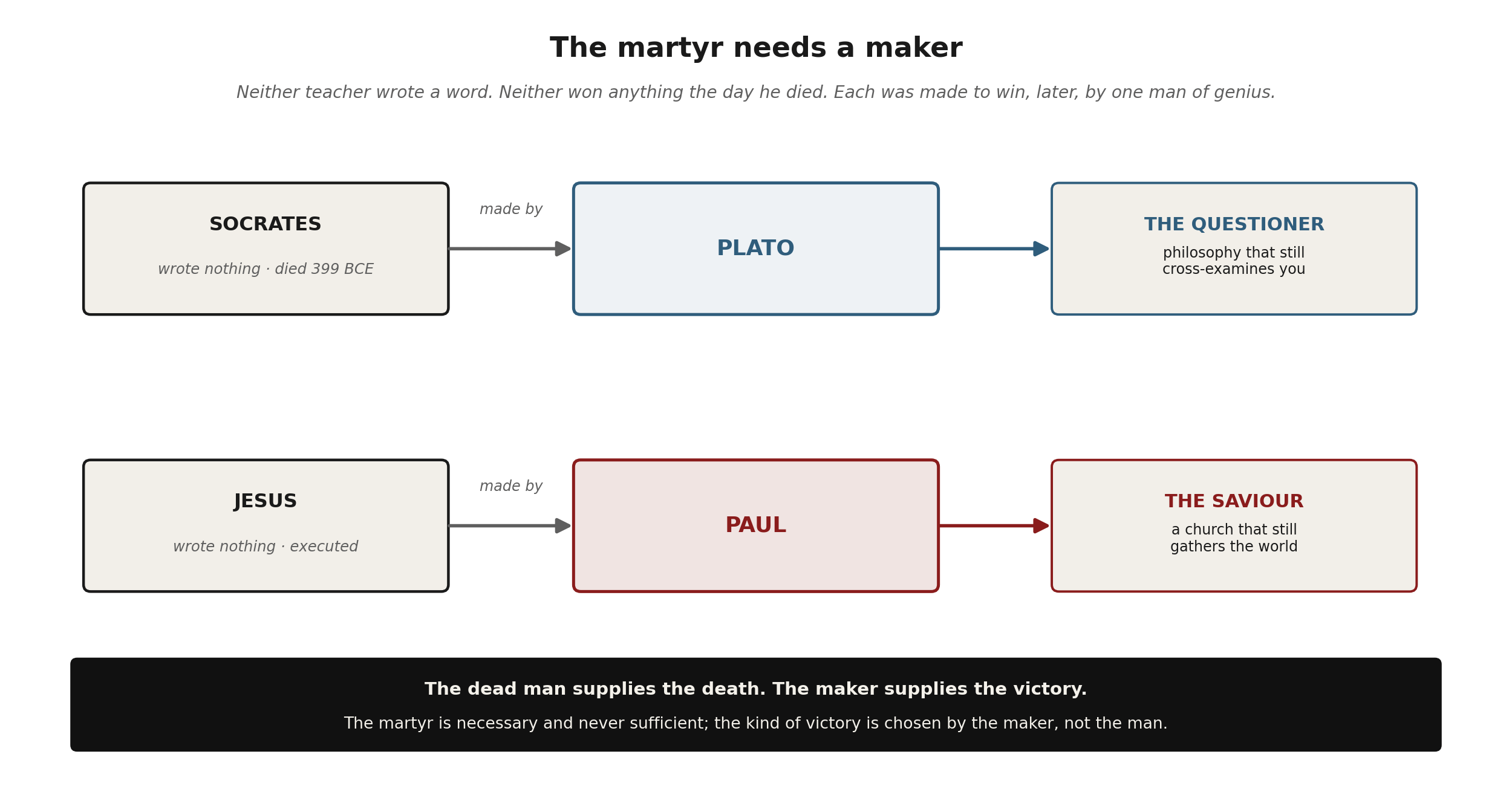
There was another teacher who wrote nothing. He too left not a treatise, not a letter, not a line; every word attributed to him was written down by others, after him, and the earliest of those others did not walk with him in the flesh. He too was killed by the authorities of his day — not a jury and a cup, but a Roman cross at the instigation of local power. And he too became immortal not by his own pen but through a maker of genius who came after: a man who had never been his disciple in life, who encountered him only after the death, and who took the raw fact of an executed teacher and built from it a figure that conquered not a school but a world. The teacher was Jesus. The maker was Paul.
I am not saying, and will not say, that Paul invented Jesus, or that there was nothing there to make — that is a question about history and about faith on which the craft of making takes no side, and on which I take none here. I am saying something narrower and, I think, undeniable: that the Christ who conquered the Roman world and everything after it is, as a matter of plain history, unimaginable without Paul, exactly as the Socrates who conquered philosophy is unimaginable without Plato. Paul wrote the earliest Christian documents we possess. Paul carried the movement out of a single province and made it universal, portable, addressed to the whole world rather than one people. Paul gave it its theology of the cross and the resurrection, of grace and faith, of the body into which believers are gathered. Whatever the teacher was in Galilee, the figure that went on to remake the West was shaped, decisively and at the deepest level, by the maker from Tarsus.
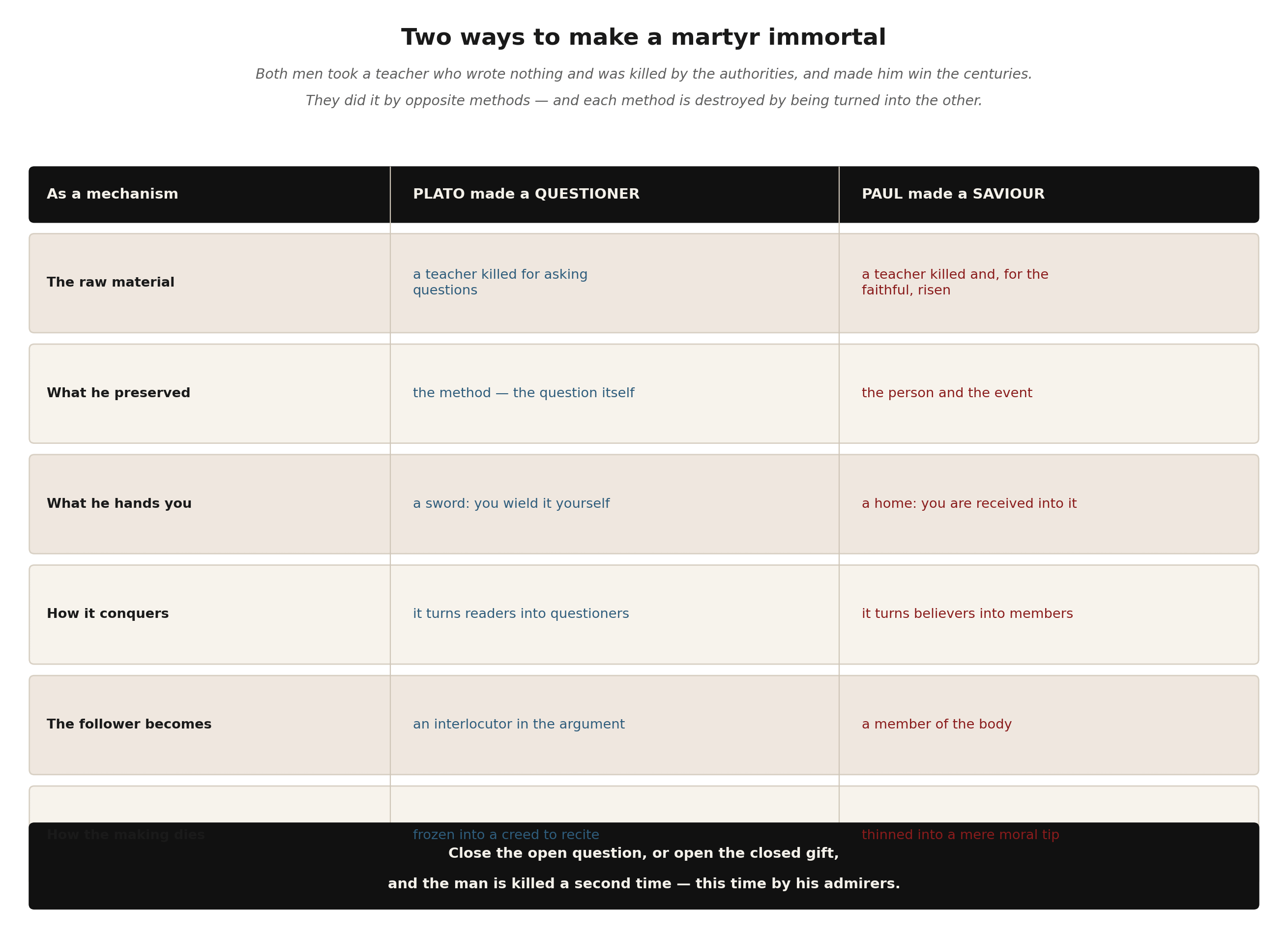
And here is the whole point: Paul’s making was of the opposite kind from Plato’s. Plato preserved the method; Paul preserved the person and the event. Plato handed you a technique to reproduce; Paul proclaimed a person to belong to and a death-and-resurrection to be saved by. You do not do what Christ did — you cannot; that is the entire theology — you are grafted into what he did. Where Plato made a Socrates you argue with, Paul made a Christ you are received into. Where Plato’s making produces inquiry — the question, the doubt, the open agora — Paul’s making produces belonging: faith, the church, the body of the saved. Plato handed you a sword. Paul offered you a home.
The two makings, laid side by side
Set the two crafts beside each other and the contrast is not a matter of degree but of kind, running down every joint of the thing.
Plato’s making conquers by turning readers into questioners; Paul’s conquers by turning believers into members. The follower of Plato’s Socrates becomes an interlocutor — one more voice in an argument that has no last word by design. The follower of Paul’s Christ becomes a member of a body — one more cell in a communion that offers exactly the last word the argument refuses. The one is open, reproducible, authority-free: it works because the questions still bite, and it needs no one’s permission. The other is a gift received, not a tool seized: it works because the person still saves, and it is offered rather than wielded. Neither is a lesser thing. They are different things — the difference, at bottom, between a mind handed a method and a heart offered a home, which is very nearly the whole distance a human being can travel.
And now the sharpest observation, the one that makes the comparison more than a curiosity: each making is destroyed by being turned into the other. We have already seen that Plato’s Socrates dies when he is closed into a creed — when the open question is welded into a settled doctrine. The mirror is just as true. Paul’s Christ dies when he is opened into a mere method — when the person and the event are dissolved into “a good moral teacher,” a set of ethical tips, a philosophy of kindness you could extract and use without belonging to anyone. That reduction, so often offered as a rescue of Christianity for the modern mind, is in fact its quiet execution: it keeps the sayings and discards the salvation, keeps the teacher and loses the Lord, and what remains is not a purified Christ but a second Socrates — a method where a person had been. The believer who thins Christ into ethics kills exactly what Paul built, as surely as the disciple who freezes Socrates into dogma kills exactly what Plato built. The open weapon and the closed gift cannot be exchanged. Force either into the other’s shape and the specific victory drains out of it, and the man dies a second time.
Why both won, and what it teaches about winning
Step back and the two cases together yield a law, and the law is the real answer to how Socrates won.
The last time we looked at his death, we said the argument outlives the arguer — that power ends the man but cannot touch the argument. That is true, but it was incomplete, and the incompleteness matters: an argument does not run on its own. It has no legs. It runs only because someone carries it — copies it, teaches it, translates it, presses it on the next generation, builds the school or the church or the book that bears it forward. The argument outlives the arguer if and only if a maker takes it up. Left to itself, an argument dies with the mouth that spoke it, and history is a vast unmarked graveyard of the right-but-defeated who had no Plato and so simply vanished, correct and forgotten, their names not even lost because they were never recorded. For every Socrates there are ten thousand nameless people who were just as right and just as doomed and had no one to make them win.
So the mechanism of the martyr’s victory is a collaboration, and an unequal one. The martyr supplies the death — the sincerity, the refusal to recant, the fact that gives the maker something true to work from. The maker supplies the victory — the form, the transmission, the figure that can travel. Neither wins alone. The martyr without a maker is a private tragedy that leaves no trace. The maker without a martyr has nothing to make; Plato needed a Socrates to have died as Socrates died, and Paul needed a teacher to have been crucified, or there is no raw material for the craft to work. But the two contributions are not symmetric in their power, and this is the hard part: the martyr provides the necessary condition and the maker provides the sufficient one, and it is therefore the maker who decides what kind of victory the dead man gets. Socrates did not choose to become the patron saint of open inquiry rather than the founder of a faith. Plato chose it, by the kind of making he practised. The dead man cannot pick his own immortality. The living maker picks it for him.
The teeth: made is not fake, and made is not transparent
Here I have to guard both flanks, because the observation that these figures were made invites two opposite errors, and both are cheap, and both are wrong.
The first is the debunker’s, and it runs: if Socrates is largely Plato’s construction and the Christ of the churches is largely Paul’s, then it is all invention, fiction, fabrication — and therefore false, therefore empty, therefore to be dismissed. This does not follow, and the reason it does not follow is worth stating plainly: made is not the same as fake. A portrait is not a lie because a painter made it; a portrait can be truer to its sitter than a photograph, precisely because a gifted hand selected and emphasised what mattered. Plato made the winning Socrates out of a man who really lived, really questioned, and really died rather than stop — and the making transmitted something true about him, or it would not still work on you when you read it; a pure fabrication does not cross-examine the reader twenty-four centuries later, because there is nothing real underneath to bite. And Paul’s making, whatever you conclude about its metaphysics, has answered the deepest needs of billions of human beings across two thousand years, which is not the record of an empty invention. “It was made, therefore it is worthless” is a non sequitur wearing the costume of sophistication. The made-ness of a figure is simply orthogonal to the truth of what he carries. You have to examine the thing itself. The provenance does not settle it.
The second error is the mirror image, and it belongs to the reverent rather than the cynical: mistaking the made man for the unmediated man — reading Plato’s Socrates as a stenographic transcript, or reading any received Christ as though no maker’s hand ever stood between us and the teacher. This is idolatry in the precise sense: worshipping the portrait as if it were the sitter, forgetting that every making selects, shapes, emphasises, and omits, and that a maker has purposes of his own. To forget the maker is to be defenceless against him — to receive his selections as if they were the raw facts, his emphases as if they were the man’s own, and to lose the ability to ask what he left out and why. Honouring the martyr honestly means keeping the maker in view: not to debunk the figure, but to know what you are receiving, and from whose hand, and shaped toward what end.
The balance is the whole of the discipline. Making is neither fabrication nor transparency. It is transmission with a shaping hand — and the honest reader holds both the man and the maker in view at once, refusing both the cynic who says the hand proves it false and the idolater who forgets there was a hand at all.
The maker you cannot choose
So: how did Socrates win?
He did not. He died, correct and outvoted, in a city that had every power over his body and none over his argument. And then Plato won, on his behalf, by an act of love and genius and, yes, invention — taking a death and a method and building from them a figure who has out-argued every generation since, and who is being read, right now, by you, cross-examining you across the distance of an ocean of centuries. Paul did the same for another dead teacher, by the opposite craft, and built from a cross not a school but a civilisation. Two makers, two makings, one law: the martyr provides the death, the maker provides the victory, and the kind of victory — an open question you inherit or a closed home you enter — is decided not by the man who died but by the man who made him.
Which leaves a hard and slightly frightening truth for anyone who imagines that being right is enough. It is not enough. Being right is the necessary condition and never the sufficient one. To win the way Socrates won, you need two things, and you control exactly one of them. You can be right — right enough, and sincere enough in your refusal to recant, that there is something true for a maker to work from. That much is yours. The other thing is not yours at all: you need a maker, a Plato, a Paul, someone of genius who survives you and takes up what you left and carries it into the rooms you will never enter. And you cannot summon him, cannot choose him, cannot even know whether he will come. The graveyard of the correct and forgotten is full of people who did their whole part and simply never got their maker.
So be right — because without it there is nothing to carry. But hold the truth loosely enough to remember that its survival was never wholly in your hands, and that the immortality of the right is a gift given by the living to the dead, and cannot be demanded, only earned and then hoped for. Ask, as always, whether the thing is so. And then ask the question the dead man cannot answer for himself, the one Socrates could not answer and Plato answered for him:
Who will carry it — and what will they make of me?
State. Classify. Done.
The scaffolding is standard and can be checked: the “Socratic problem,” the impossibility of cleanly separating the historical Socrates from Plato’s character across Aristophanes, Xenophon, Plato, and Aristotle’s reports; the widely held view that the later Platonic dialogues put Plato’s own doctrines in Socrates’ mouth; the fact that neither Socrates nor Jesus left any writing; and the long scholarly discussion of Paul as the decisive shaper of Christianity as a universal, cross-and-resurrection-centred faith, through the earliest Christian documents we possess. Nothing here adjudicates the truth of any religious claim; the essay concerns the craft of transmission, not the metaphysics of its subjects.
Roark's courtroom speech in The Fountainhead, has always felt, to me, like Rand's not-so-subtle hat-doff to Plato's Apologia (an unsurprising personal favorite) due to Socrates unflinching, calling-out of his adjudicator's hypocrisy—evocative of the latter Protestant Old Testament fire & brimstone sermons & Nietzsche's scathing polemic, The Problem of Socrates.
Antisthenes take on Socrates offers a worthwhile comparison & contrast. Especially, since Plato not only wrote, but understood the power of rhetoric as an instrument of political propaganda—the enduring story which upends entire systems & reorganizes whole establishments—sentiment shifting markets, much like Ovid's Metamorphosis was knowingly wrought with political intrigue of the time embedded within myths retold.
Not all arche held equally, as even martyrs need great publicists.