
Keynes and Samuelson: The Corruption of Prudence and the Myth of Endless Stimulus
How a doctrine of cyclical responsibility was transformed into an ideology of perpetual indulgence

Keywords:
Keynes, Samuelson, Keynesianism, fiscal policy, public debt, savings, countercyclical policy, economic theory, deficit spending, economic misinterpretation
Abstract:
John Maynard Keynes conceived a world in which the state would act as a disciplined custodian of prosperity—saving in expansion and spending in contraction. His vision was a theory of equilibrium, not excess; prudence, not profligacy. Yet by the mid-twentieth century, through Paul Samuelson’s textbook evangelism, Keynesianism had mutated into something grotesque: a justification for ceaseless expenditure, for deficits as policy rather than emergency. The essay dissects this evolution, exposing how Samuelson’s simplification of Keynesian thought warped fiscal morality, leading governments to treat every downturn as pretext for intervention and every boom as a political opportunity. What Keynes sought to temper, Samuelson canonised.
Thesis Statement:
Modern “Keynesian” economics is not Keynesian at all. It is Samuelsonian—an institutionalised misreading that replaces Keynes’s conditional countercyclicality with permanent stimulus, divorcing responsibility from prosperity and turning cyclical management into an ideology of debt without consequence.
Section I — The Discipline of Cycles
John Maynard Keynes was not the prophet of permanent stimulus that modern governments have made of him. He was, above all, a theorist of balance—an economist who understood that prosperity and hardship are not opposites but phases of a single rhythm. The economy, he believed, was an organism, not a machine; it breathed in growth and exhaled contraction. The task of the state was not to fight this natural cycle but to temper its extremes. The true Keynesian government was to be a steward, not a gambler. It would save in times of plenty and spend in times of distress, just as a prudent household puts aside grain in the harvest to endure the winter.
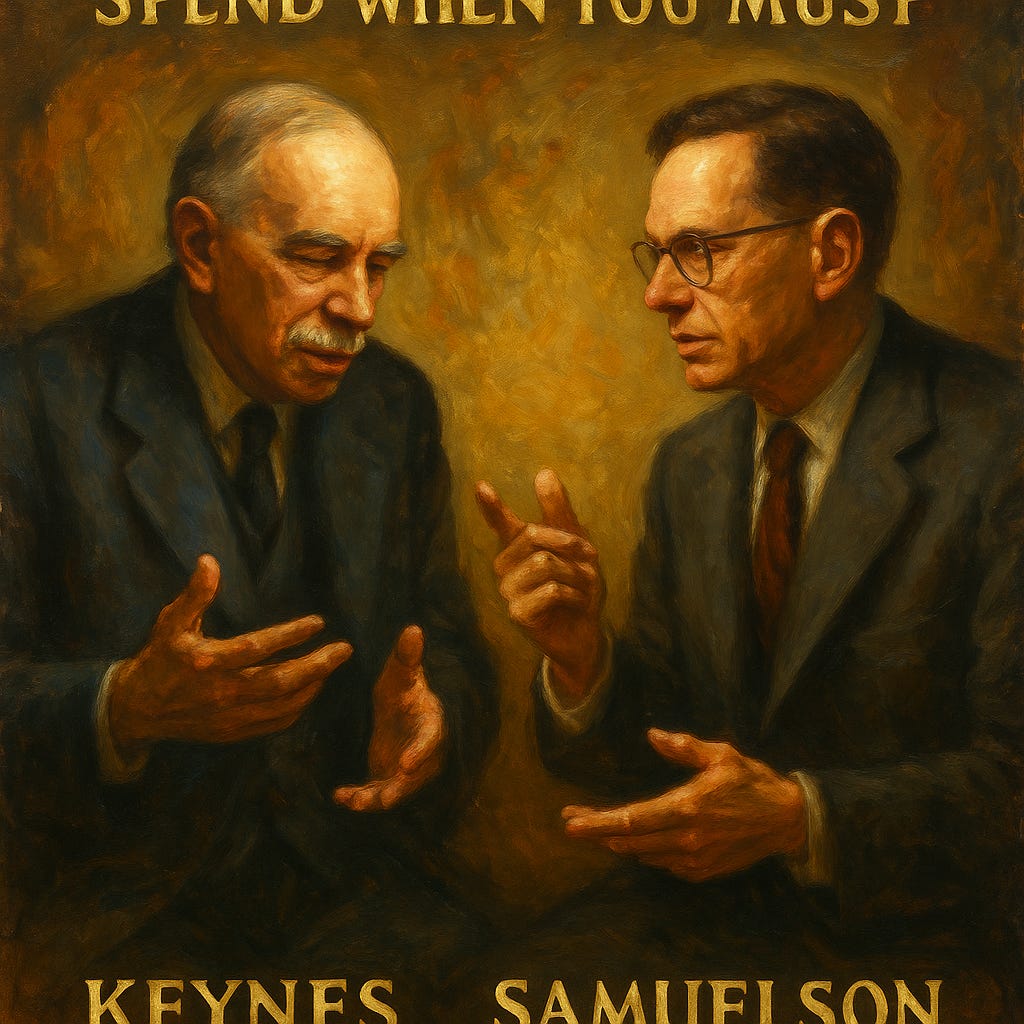
In The General Theory of Employment, Interest and Money (1936), Keynes proposed something elegant yet morally exacting: countercyclical fiscal policy. During economic expansions, tax revenues increase and the appetite for spending grows. Keynes demanded that in these times, restraint should prevail. Governments were to accumulate surpluses—not as hoarded treasure, but as instruments of stability. These surpluses would then be deployed in downturns, when private investment faltered and the psychology of fear paralysed markets. The purpose was not to expand the size of the state but to stabilise the system it governed.
This concept of cyclicality required something that modern politics has largely forgotten: memory. Keynes assumed that governments would remember their own advice. They would store the fruits of prosperity and later redeem them in adversity. It was a principle grounded in both economic realism and ethical philosophy—the idea that prudence in good times earns the right to intervene in bad ones. It is the polar opposite of the moral hazard of today’s politics, where every surplus is treated as an excuse for expansion and every deficit as justification for more of the same.
The Keynesian model was never intended as a licence for perpetual spending. It was a rule of conduct. His vision depended on an implicit covenant between the state and its citizens: that the state would be fiscally responsible in abundance so it could be effective in scarcity. The role of policy was not to eliminate cycles but to manage expectations, to prevent temporary contractions from becoming permanent despair. Keynes never imagined that the government’s budget should remain permanently in deficit; rather, he warned that neglecting to save during periods of growth would make stimulus during recessions both costlier and less effective.
To Keynes, restraint was as vital as intervention. His method demanded discipline in both directions—something the generations that followed proved incapable of. The Keynesian equilibrium was dynamic, not indulgent; it balanced expansion with contraction, optimism with prudence. It was a doctrine of stewardship, not of indulgence. Yet this subtlety was destined to be lost. When Samuelson later transformed Keynes’s cyclical framework into a perpetual policy of motion without counterbalance, he destroyed the equilibrium that gave Keynes’s theory its integrity.
In Keynes’s world, prosperity was a test of character. In Samuelson’s, it became an excuse to spend. The first honoured the rhythm of the economy; the second drowned it in noise.
Section II — The Logic of Prudence
Keynes’s logic was moral before it was mathematical. His concern was not simply with output and employment, but with the temperament of a civilisation—how it behaves when flush with success and when seized by fear. He saw economics not as a machine to be optimised but as a reflection of human frailty: greed in prosperity, paralysis in adversity. The genius of his design lay in understanding both and correcting neither, only moderating their excesses. Where classical economists imagined self-correcting markets and socialists imagined omnipotent states, Keynes imagined something subtler—a system disciplined by prudence.
In his model, government intervention was neither constant nor ideological. It was situational. When private enterprise thrived, the state’s role was to step back, harvest revenue, and build a surplus. When panic and contraction took hold, it was to step in—not to dominate, but to bridge the temporary vacuum of confidence. The point was balance, not growth for its own sake. Keynes was pragmatic enough to know that economies cannot expand endlessly, and moral enough to insist that they must not collapse needlessly. The act of saving during the good years was not a concession to austerity but a preparation for liberty: it allowed intervention later without the stain of debt.
This logic rests on reciprocity, the social contract between citizens and their government. The state earns the right to spend by first proving its ability to withhold. To Keynes, stimulus financed by previous restraint was legitimate, even virtuous. Stimulus financed by borrowing was tolerable only as a temporary necessity. His ideal government resembled a careful merchant—willing to take risk when opportunity demands it, but never confusing credit with capital. Every deficit, in his view, was to be repaid not just in currency but in credibility.
Yet Keynes’s notion of prudence has been conveniently forgotten, precisely because it demands what politics cannot supply: self-denial. His system worked only if policymakers were capable of restraint in prosperity, the moment when restraint is least appealing. The electorate, intoxicated by abundance, sees surplus as spoil, not as savings. Politicians, rewarded for distributing rather than conserving, yield to the temptation. Thus, Keynes’s two-act play—saving, then spending—was rewritten as a single act of eternal generosity. The surplus never arrives; the deficit never leaves.
To understand Keynes’s logic is to recognise that he treated the state as a moral actor, not a magician. His model presupposed integrity. The idea of accumulating reserves required the faith that governments could resist their own voters, that they would save even when doing so cost them popularity. He assumed, perhaps naively, that the civil service would remain a steward of national interest, not a dispenser of patronage. His theory, in short, worked only in a nation of adults.
The paradox of prudence, then, is that it relies on foresight in an age governed by appetite. Keynes expected the state to behave as a disciplined participant in the market, balancing its fiscal health as an investor balances a portfolio. He did not foresee the emergence of the modern political economy, in which governments mistake borrowing for innovation and consumption for progress. The prudence he imagined—measured, cyclical, deliberate—was eroded not by economics but by democracy’s own incentives.
In this, Keynes’s logic remains flawless in theory and impossible in practice. It asks men to act against their instincts, to prepare for famine in the midst of feast, to save in triumph and spend in defeat. His system was a mirror of character as much as of capital. It demanded virtue from the state and patience from the people. Where both exist, the economy breathes naturally; where either fails, it gasps. Samuelson’s later distortion would eliminate this moral equilibrium entirely, replacing prudence with perpetual motion and responsibility with arithmetic. Keynes wrote of cycles; Samuelson wrote of engines. One sought balance, the other sought momentum—and between them, prudence was lost.
Section III — Samuelson’s Textbook Revolution
Paul Samuelson did not invent Keynesianism; he domesticated it. He took a theory of balance and moral discipline and reduced it to a set of algebraic prescriptions—elegant, digestible, and disastrously incomplete. Keynes had written for statesmen; Samuelson wrote for students. In doing so, he translated an argument about prudence into a policy of perpetual motion. His Economics: An Introductory Analysis (1948) became not merely a textbook but a catechism—half scripture, half sedative—for generations of policymakers. By the time the ink had dried, Keynes’s call for symmetry between saving and spending had been flattened into a single, ceaseless imperative: spend.
Samuelson’s ambition was pedagogical, but his influence was theological. His textbook gave post-war America the illusion of mastery over the business cycle. Through clean diagrams and comforting curves, he promised that recessions could be smoothed, growth maintained, and prosperity engineered. The messy human psychology that haunted Keynes—the greed, fear, and short-termism—vanished under Samuelson’s chalk. Economics became a science of aggregates, not of behaviour; of equations, not ethics. What had been an art of timing and restraint was reborn as an ideology of intervention.
In Keynes’s writing, the word spending was conditional, an instrument deployed with reluctance and precision. In Samuelson’s, it became prescriptive—a panacea to be administered regardless of the patient’s condition. The cyclical reserve Keynes required in good times disappeared from the model entirely. The emphasis shifted from balance to stimulus, from prudence to propulsion. Samuelson’s neat simplifications made Keynes palatable to politicians because they removed the one element politics could never tolerate: the demand to save. His diagrams never included the season of discipline—only the eternal spring of spending.
By reinterpreting Keynes through the lens of post-war optimism, Samuelson gave governments moral cover for their own indulgence. The industrial nations of the mid-twentieth century were drunk on growth; they mistook expansion for permanence. Samuelson’s Keynesianism offered them both an excuse and a method: if spending produced output, then more spending would produce more output. Surplus became obsolete, thrift became regressive, and deficit became modern. Economies were reimagined as engines that must never idle. The concept of cyclical balance—the saving of surpluses to finance future stimulus—was lost to history, and with it the entire ethical foundation of Keynes’s vision.
The consequence was profound. Under Samuelson’s banner, fiscal responsibility was not abandoned but rebranded. Permanent deficit was recast as enlightened management. Every downturn justified stimulus, and every expansion justified even greater expenditure to “sustain growth.” The discipline of cycles—the very heart of Keynes’s system—was amputated. Keynes had conceived a scalpel; Samuelson forged a shovel.
His motivation, perhaps, was not malicious. He sought clarity in a chaotic field, a unified theory for a post-war world desperate for control. But in seeking simplicity, he performed a kind of intellectual vandalism. He stripped Keynes’s theory of its moral anatomy and left behind a skeleton of arithmetic. The Keynes who spoke of prudence and reciprocity was buried beneath the Keynes who, according to Samuelson’s equations, simply spent.
The textbook’s reach was absolute. By the 1960s, Samuelson’s version of Keynesianism had become the lingua franca of Western economic policy. Every finance ministry spoke in its vocabulary; every university taught its catechism. Keynes’s nuanced moral structure had been erased and replaced with mechanistic optimism—the faith that any problem, economic or political, could be solved by fiscal expansion and central planning. The world had not embraced Keynes; it had embraced Samuelson’s caricature of him.
Thus began the modern confusion: Keynes blamed for the sins of Samuelson, prudence held responsible for profligacy. The man who preached saving in good times was recast as the prophet of endless deficit. What had once been a call for responsibility became the intellectual alibi for indulgence. The irony is exquisite. Keynes sought to tame the excesses of capitalism; Samuelson gave them a new theology. The result was not stability, but a civilisation that mistook liquidity for wealth and spending for salvation.
Section IV — The Rise of Perpetual Deficit
Samuelson’s greatest achievement was to make irresponsibility respectable. His diagrams and models clothed excess in the language of science, transforming the political vice of spending into a policy virtue. Governments no longer needed to justify deficits—they could now present them as instruments of growth. What had once been Keynes’s temporary medicine for recession became, under Samuelson’s doctrine, the daily diet of the state. The cyclical restraint that gave Keynesianism its moral backbone was amputated, leaving only the muscle of intervention.
By the mid-twentieth century, this mutation had hardened into orthodoxy. The post-war boom seemed to validate Samuelson’s creed. The economies of the United States, Britain, and Western Europe expanded rapidly, and politicians congratulated themselves on having engineered a new era of “managed prosperity.” Budget deficits no longer represented emergencies; they were seen as evidence of enlightened policy. In this atmosphere of intellectual intoxication, Keynes’s balanced symphony of saving and spending was rewritten as a one-note anthem of stimulus.
The political incentives aligned perfectly. No electorate punishes generosity, and no politician gains glory from restraint. Samuelson’s neat equations offered the perfect moral disguise for indulgence. Surpluses became politically suicidal; deficits became patriotic. Each government claimed that its spending would “sustain demand,” “stimulate employment,” and “stabilise growth.” Yet behind the rhetoric lay an economy addicted to artificial respiration, unable to breathe on its own.
In this new fiscal theology, the business cycle itself was reinterpreted. Where Keynes saw a pattern to be moderated, Samuelson’s disciples saw a problem to be eradicated. Recessions, instead of being temporary corrections, were recast as moral failures to spend enough. The state was no longer a counterweight to private excess; it became the primary engine of motion. Stimulus ceased to be an emergency tool and became a permanent entitlement—a standing order for intervention.
The results were as inevitable as they were ironic. As governments discovered that deficits could be rolled forward indefinitely, they began to treat debt as wealth. Borrowing no longer appeared to constrain; it seemed to empower. Samuelson’s model suggested that as long as spending created output, debt could be managed, even multiplied, without consequence. But the arithmetic was a mirage. Growth funded by debt is not growth—it is anticipation, the consumption of tomorrow’s output to sustain today’s illusion.
By the 1970s, the illusion began to crack. Inflation rose, productivity faltered, and the Keynesian toolkit—misused, misunderstood, and misapplied—failed to deliver stability. Yet instead of revisiting Keynes’s original equilibrium, policymakers doubled down on Samuelson’s distortion. Each crisis was met with greater spending, each recession with larger deficits. The concept of a surplus became mythological, a relic of an earlier, more responsible age.
Keynes’s true principle—save in good times to spend in bad—requires a cyclical memory. Samuelson’s version erased that memory entirely. It recast government as a perpetual motion machine, one that could defy the laws of fiscal gravity through the sheer force of economic jargon. The modern fiscal state was born: a leviathan sustained by rolling credit, divorced from restraint, and perpetually surprised by its own insolvency.
This transformation was not a misunderstanding but an institutionalisation of convenience. Keynes demanded prudence; Samuelson offered power. The former limited government’s reach; the latter expanded it under the banner of progress. The moral distinction between responsible intervention and reckless expenditure disappeared, replaced by the comforting dogma that all spending is good spending. In Samuelson’s world, there are no seasons—only an endless summer financed by debt.
The rise of perpetual deficit was not an evolution of Keynesian thought; it was its betrayal. What had begun as a disciplined act of stewardship became the machinery of addiction. The Keynesian cycle was broken, replaced by the Samuelsonian spiral—one that moves endlessly forward in theory, yet always downward in reality. The tragedy is that the world continues to call this “Keynesianism,” as if the architect of prudence could be held responsible for the religion of excess built upon his name.
Section V — Keynes Misquoted, Prudence Abandoned
Few injustices in intellectual history rival what has been done to Keynes by those who claim to follow him. The man who counselled governments to store surplus in times of prosperity has been recast as the prophet of boundless indulgence. His name, once synonymous with prudence in adversity, is now the rallying cry of debt without limit. What he built as a mechanism of equilibrium, others converted into an ideology of expansion. His cautionary principles were lost to a generation that mistook liquidity for virtue and motion for progress.
Nowhere is this distortion more glaring than in the misquotation that haunts every policy debate: “In the long run, we are all dead.” Wrenched from its context, it has been cited as justification for perpetual spending, as though Keynes were advocating the abandonment of foresight. Yet in The Tract on Monetary Reform (1923), where the line first appeared, he was ridiculing economists who refused to act in the present because of hypothetical perfection in the distant future. He meant not that the future was irrelevant, but that inaction was fatal. He was attacking paralysis, not prudence. Those who brandish the quote as a licence for fiscal abandon reveal only that they never read the paragraph that follows, in which Keynes insists upon restraint once conditions stabilise.
This wilful misunderstanding is more than academic. It is political utility dressed as theory. Samuelson’s simplified “Keynesianism” provided the language, and politicians provided the appetite. Keynes’s delicate cycle of saving and spending—thrift in growth, stimulus in decline—was replaced by a blunt policy of permanent motion. Governments began to treat surpluses as fiscal aberrations to be corrected with new expenditures. A balanced budget came to symbolise neglect, not prudence. The Keynesian discipline of timing was inverted; the reserve that made stimulus responsible vanished from the equation.
Keynes’s original idea of countercyclical management assumed that surpluses would precede deficits. The capacity to spend in downturns depended entirely on restraint during expansions. This conditional symmetry was the moral keystone of his thought. Samuelson removed it. Once the symmetry collapsed, Keynes’s system became unrecognisable—an endless justification for deficit disguised as doctrine. To a Keynesian purist, this modern perversion is blasphemy. The Keynes of history would have looked upon the debt-fattened leviathans of the twenty-first century with horror.
The shift from Keynes to Samuelson was a shift from stewardship to opportunism. Keynes viewed fiscal policy as a moral trust—a compact between generations. Borrowing was legitimate only when its fruits outlasted the debt itself, such as in public works, education, or energy infrastructure. Debt was to be self-liquidating, its yield measured in enduring productivity. Samuelson’s Keynesianism severed that link. It turned deficit into a political commodity, a way to purchase the illusion of prosperity. The new economists treated debt as a lubricant of perpetual growth rather than a tool of temporary relief.
Even the notion of the economic “cycle” was quietly discarded. Keynes had understood that economies oscillate, that booms and recessions are as natural as tides. Samuelson’s disciples imagined that policy could abolish this rhythm entirely—that through sufficient fiscal manipulation, the state could smooth every contraction, extend every expansion, and maintain a permanent plateau of growth. It was the bureaucratic fantasy of immortality—the belief that men could rewrite the laws of economics by rewriting their models. What began as Keynes’s realism became Samuelson’s hubris.
The moral inversion was complete when deficit itself became a badge of compassion. Spending was equated with caring; restraint with cruelty. Politicians found in this new orthodoxy both justification and immunity: they could distribute without saving, borrow without apology, and call it Keynesianism. The electorate, sedated by stimulus, mistook this for progress. But Keynes would have called it theft—a quiet expropriation of the future by the present. His intention had been to preserve capitalism from collapse by moderating its excesses; Samuelson’s interpretation handed governments a blank cheque to indulge those excesses under the guise of management.
Thus Keynes’s intellectual legacy was inverted. The man who sought to restore responsibility to capitalism became the patron saint of its fiscal dissolution. His words were polished into slogans by those they condemned. His balanced cycle became a one-way spiral of debt. To accuse Keynes of the sins of Samuelson is to indict the architect for the vandalism of his imitator. Yet this is the irony of history: that the thinker who sought to save governments from themselves was immortalised as their accomplice.
In the ruins of this distortion, one truth remains unmistakable—Keynes’s vision required discipline, not dogma. His theory worked only when courage was matched by restraint. The loss of that symmetry marks not merely a deviation of policy, but a corruption of philosophy. The misquotation became the epitaph: “In the long run, we are all dead.” And so, with each new deficit, each new expansion built on debt, the modern world ensures that Keynes’s warning, long misunderstood, becomes prophecy.
Section VI — The Debt Economy
The culmination of Samuelson’s distortion is the modern debt economy—an apparatus of perpetual obligation masquerading as progress. What Keynes had designed as a dynamic balance between restraint and intervention has degenerated into an open-ended spiral, in which the state’s existence is financed by tomorrow’s earnings and its virtue measured by the size of its deficit. Debt has ceased to be an instrument; it has become the bloodstream of policy, circulating endlessly through the veins of bureaucracy.
The mechanics are deceptively elegant. Governments issue bonds, not as emergency measures, but as routine procedure. Central banks absorb them, conjuring liquidity through the sterile ritual of “monetary operations.” Interest rates are suppressed, savings punished, and consumption deified. What was once considered borrowing is now euphemised as “fiscal expansion.” The purpose is no longer to build for the future, but to maintain the illusion of perpetual motion. Each generation inherits both the wealth and the waste of the last, yet the latter always outweighs the former. The arithmetic of deceit compounds faster than any interest rate.
Under Keynes, debt was a bridge between crisis and recovery; under Samuelson, it became a bridge to nowhere. Keynes’s deficit was the act of a government that had saved and could afford to spend; Samuelson’s was the act of a government that had spent and could not afford to stop. The transformation is moral as much as mathematical. Keynes’s state borrowed against its reserves; Samuelson’s borrowed against its reputation. The former built railways, dams, and schools; the latter builds paperwork, promises, and electoral campaigns.
The logic of the debt economy is self-reinforcing. Each crisis, however mild, demands stimulus. Each stimulus breeds dependency. Each dependency erodes productivity, necessitating further stimulus. The cycle of spending, once meant to soften recession, now perpetuates it. The system no longer breathes; it hyperventilates. To slow is to collapse, so it accelerates instead, moving faster only to stay still. In this regime, debt is not a temporary measure but a permanent condition—a fiscal coma disguised as vitality.
The moral hazard Keynes warned against has metastasised into orthodoxy. In the debt economy, success is measured not by surplus but by the scale of borrowing. Markets cheer deficits as “confidence,” central banks reward risk as “innovation,” and economists baptise inflation as “growth.” The line between liquidity and illusion has vanished. We now inhabit a civilisation where wealth is measured in promises—an empire of IOUs, governed by the arithmetic of deferral.
This is the world Samuelson’s Keynesianism created: one where governments no longer ask should we borrow? but only how much can we get away with? The purpose of debt has shifted from investment to insurance—from building capacity to buying stability. Infrastructure still exists, but as spectacle, not necessity; bridges and bullet trains are erected as symbols of competence while the foundations of productivity decay. Keynes would have seen through the masquerade instantly. For him, borrowing was justified only when it created more than it consumed. Under the debt economy, consumption is creation.
What makes this transformation truly tragic is its intellectual veneer. The very models that were once meant to guide prudence now sanctify excess. Economists speak of “optimal deficits” and “sustainable debt-to-GDP ratios,” as though insolvency can be managed through semantics. The reality is blunter: every borrowed pound must either be repaid, defaulted, or inflated away. These are not policy choices; they are the mathematical fates of profligacy. The debt economy disguises this inevitability with jargon—“rolling over,” “quantitative easing,” “liquidity provision”—all euphemisms for postponing reckoning.
Keynes believed that the true strength of an economy lay in its productive capacity—in what men could build, invent, and trade. The debt economy measures strength in leverage. It rewards speculation, not creation; management, not enterprise. It mistakes the growth of credit for the growth of civilisation. The economy becomes a mirror reflecting only its own distortion, its apparent expansion merely the magnification of its fragility.
In such a world, restraint is revolutionary. To save is to rebel; to balance a budget is to commit heresy. Yet only through that heresy can recovery begin. The debt economy cannot sustain itself indefinitely; arithmetic forbids it. The reckoning will not come with flames or crashes, but with exhaustion—the slow, quiet death of productivity under the weight of promises.
Keynes once wrote that “the boom, not the slump, is the right time for austerity.” It was the most important sentence of his career and the one the world chose to ignore. Under Samuelson’s tutelage, the opposite became doctrine: spend in boom, spend in slump, and borrow to cover the difference. Thus, what Keynes saw as the rhythm of civilisation—the pulse of saving and spending—has become its arrhythmia. The debt economy is not capitalism, nor Keynesianism; it is the necrosis of both, embalmed in optimism and animated by debt.
Section VI — The Debt Economy
The culmination of Samuelson’s distortion is the modern debt economy—an apparatus of perpetual obligation masquerading as progress. What Keynes had designed as a dynamic balance between restraint and intervention has degenerated into an open-ended spiral, in which the state’s existence is financed by tomorrow’s earnings and its virtue measured by the size of its deficit. Debt has ceased to be an instrument; it has become the bloodstream of policy, circulating endlessly through the veins of bureaucracy.
The mechanics are deceptively elegant. Governments issue bonds, not as emergency measures, but as routine procedure. Central banks absorb them, conjuring liquidity through the sterile ritual of “monetary operations.” Interest rates are suppressed, savings punished, and consumption deified. What was once considered borrowing is now euphemised as “fiscal expansion.” The purpose is no longer to build for the future, but to maintain the illusion of perpetual motion. Each generation inherits both the wealth and the waste of the last, yet the latter always outweighs the former. The arithmetic of deceit compounds faster than any interest rate.
Under Keynes, debt was a bridge between crisis and recovery; under Samuelson, it became a bridge to nowhere. Keynes’s deficit was the act of a government that had saved and could afford to spend; Samuelson’s was the act of a government that had spent and could not afford to stop. The transformation is moral as much as mathematical. Keynes’s state borrowed against its reserves; Samuelson’s borrowed against its reputation. The former built railways, dams, and schools; the latter builds paperwork, promises, and electoral campaigns.
The logic of the debt economy is self-reinforcing. Each crisis, however mild, demands stimulus. Each stimulus breeds dependency. Each dependency erodes productivity, necessitating further stimulus. The cycle of spending, once meant to soften recession, now perpetuates it. The system no longer breathes; it hyperventilates. To slow is to collapse, so it accelerates instead, moving faster only to stay still. In this regime, debt is not a temporary measure but a permanent condition—a fiscal coma disguised as vitality.
The moral hazard Keynes warned against has metastasised into orthodoxy. In the debt economy, success is measured not by surplus but by the scale of borrowing. Markets cheer deficits as “confidence,” central banks reward risk as “innovation,” and economists baptise inflation as “growth.” The line between liquidity and illusion has vanished. We now inhabit a civilisation where wealth is measured in promises—an empire of IOUs, governed by the arithmetic of deferral.
This is the world Samuelson’s Keynesianism created: one where governments no longer ask should we borrow? but only how much can we get away with? The purpose of debt has shifted from investment to insurance—from building capacity to buying stability. Infrastructure still exists, but as spectacle, not necessity; bridges and bullet trains are erected as symbols of competence while the foundations of productivity decay. Keynes would have seen through the masquerade instantly. For him, borrowing was justified only when it created more than it consumed. Under the debt economy, consumption is creation.
What makes this transformation truly tragic is its intellectual veneer. The very models that were once meant to guide prudence now sanctify excess. Economists speak of “optimal deficits” and “sustainable debt-to-GDP ratios,” as though insolvency can be managed through semantics. The reality is blunter: every borrowed pound must either be repaid, defaulted, or inflated away. These are not policy choices; they are the mathematical fates of profligacy. The debt economy disguises this inevitability with jargon—“rolling over,” “quantitative easing,” “liquidity provision”—all euphemisms for postponing reckoning.
Keynes believed that the true strength of an economy lay in its productive capacity—in what men could build, invent, and trade. The debt economy measures strength in leverage. It rewards speculation, not creation; management, not enterprise. It mistakes the growth of credit for the growth of civilisation. The economy becomes a mirror reflecting only its own distortion, its apparent expansion merely the magnification of its fragility.
In such a world, restraint is revolutionary. To save is to rebel; to balance a budget is to commit heresy. Yet only through that heresy can recovery begin. The debt economy cannot sustain itself indefinitely; arithmetic forbids it. The reckoning will not come with flames or crashes, but with exhaustion—the slow, quiet death of productivity under the weight of promises.
Keynes once wrote that “the boom, not the slump, is the right time for austerity.” It was the most important sentence of his career and the one the world chose to ignore. Under Samuelson’s tutelage, the opposite became doctrine: spend in boom, spend in slump, and borrow to cover the difference. Thus, what Keynes saw as the rhythm of civilisation—the pulse of saving and spending—has become its arrhythmia. The debt economy is not capitalism, nor Keynesianism; it is the necrosis of both, embalmed in optimism and animated by debt.
Section VII — Restoring the Original Equation
To restore Keynes is not to return to 1936; it is to recover the intellectual integrity that his successors betrayed. His vision was never a formula—it was an ethic, a code of proportion. The equation he proposed was not merely fiscal but civilisational: restraint in prosperity grants legitimacy to intervention in hardship. This symmetry—so elegant, so humane—was the centrepiece of his thought. Once broken by Samuelson’s simplifications, it left governments with the means to spend but none of the discipline to save. The restoration of Keynesianism, therefore, is not a technical adjustment but a moral reformation.
Keynes’s original equation was anchored in reciprocity: the present must prepare for the future, and the future must honour the prudence of the past. When governments save in the good times, they purchase the right to act decisively in the bad. This was not mere accountancy but philosophy—the application of justice to economics. A surplus was not an inert balance; it was a moral instrument. It meant that a nation had the integrity to act without hypocrisy, to intervene in crisis without resorting to the counterfeit courage of borrowed money.
To restore this equilibrium, we must first expose the delusion that prosperity is self-sustaining. The Samuelsonian creed of endless stimulus taught the modern state to treat expansion as a permanent condition, forgetting that every boom contains its own contraction. Keynes knew better. The good times, he wrote, are the very moment when restraint must be exercised—when governments must store the moral and fiscal capital required for future correction. A society that refuses to save in abundance will inevitably panic in scarcity, for it will have neither resources nor credibility to draw upon.
Keynes’s restoration also demands the reassertion of hierarchy in spending: capital before consumption, productivity before populism. True Keynesian policy is not the indiscriminate injection of liquidity into every crevice of the economy, but the targeted investment in activities that expand the productive frontier. Infrastructure, research, energy, education—these are multipliers that yield beyond the ledger. Their debt pays for itself through the wealth it creates. In contrast, the modern debt economy finances political expedience: subsidies without return, entitlements without end. Keynes would have recognised this not as progress but as parasitism.
Central to the restoration is the rejection of fiscal amnesia. The Keynesian cycle depends on collective memory—the willingness to recall restraint during prosperity. Modern politics, addicted to the now, lacks this faculty. Each administration begins as though history were reset, inheriting the privileges of power but not the responsibilities of its predecessors. Thus, the surpluses of one generation are consumed by the indulgences of the next. Keynes’s cycle collapses because the line of accountability between the saver and the spender has been severed. To rebuild it requires institutional mechanisms that enforce saving, not just recommend it—constitutional rules for surplus in expansion as binding as those for expenditure in recession.
The restoration of Keynesianism, then, is not nostalgic but revolutionary. It is not a retreat to austerity but a reassertion of sequence: first earn, then spend; first build, then distribute. Keynes was not an advocate for a larger state but for a more intelligent one—capable of self-restraint as well as ambition. He believed that the credibility of intervention depended on the virtue of preparation. The Keynesian ideal is not a state that dominates the market, but one that mirrors its best discipline: the ability to defer gratification in pursuit of long-term gain.
To rescue Keynes from Samuelson is to rescue economics from its mechanisation. It is to return thought to its proper moral context. For Keynes, the economy was not a static system of equations but a living order governed by human choice. Its health depended on balance—between private investment and public intervention, between risk and prudence, between present comfort and future stability. Samuelson’s equations erased this humanity. They replaced the ethic of stewardship with the illusion of control, transforming policy into perpetual motion.
The true Keynesian equation—save when you can, spend when you must—demands something beyond intellect: character. It requires that governments act not as opportunists but as trustees, bound by duty to the unborn as much as to the living. This is the antithesis of modern politics, which regards the future as a negotiable debt rather than a sacred inheritance. Keynes’s restoration will not come through academic debate but through cultural revolt—a return to the idea that freedom and responsibility are indivisible.
The irony is that Keynes’s theory, so often blamed for excess, contains within it the cure for it. His cycle of saving and spending is not merely economic hygiene; it is the moral architecture of a sustainable civilisation. When that architecture was dismantled by Samuelson’s simplifications, we gained models and lost wisdom. To restore the original equation is to recover both—to remember that an economy, like a soul, cannot thrive on stimulus alone. It must rest, rebuild, and redeem its own prosperity through restraint. Only then can the balance that Keynes envisioned—between growth and grace—be restored.
Section VIII — Conclusion: From Prudence to Perpetuity
The tragedy of Keynesianism is not that Keynes was wrong, but that he was right in a world determined to misunderstand him. His theory was not a licence for endless spending; it was a compact between reason and restraint. The state, in his design, was not a conjurer but a custodian—a temporary stabiliser when private enterprise faltered, and a disciplined saver when it flourished. What survives under his name, however, is not his doctrine but its inversion: an economy of perpetual deficit justified by a philosophy of perpetual fear. Keynes gave the world prudence; Samuelson gave it permission. The former saved capitalism from collapse; the latter taught governments how to bankrupt it politely.
Keynes imagined the state as a rational actor with a conscience, a moral counterweight to the volatility of markets. He never conceived of a government that would treat debt as permanent or prosperity as licence. To him, economic management was cyclical by nature, a tide to be guided but never defied. His philosophy was born of limits—of recognising that the economy breathes in seasons, that intervention must be matched by withdrawal, that the state must rest when the market runs. In this balance lay the civility of economics, the very idea that growth could coexist with integrity.
Samuelson’s “Keynesianism” annihilated that balance. It transformed prudence into policy opportunism, equilibrium into momentum, and moral discipline into mechanised optimism. The mathematics of his models promised control but delivered dependency. He turned Keynes’s cyclical governor into an engine of perpetual motion, one that could not stop without collapsing. Governments learned to call this “management,” yet it was little more than addiction disguised as administration. The deficit became not an occasional instrument but an identity.
In this Samuelsonian world, surplus is treated as failure, and thrift as regression. The virtue of saving—central to Keynes’s entire schema—has been expunged from political vocabulary. Fiscal restraint has been recast as cruelty, and borrowing as benevolence. Politicians now speak of “investing in the future” when they mean consuming it, of “stimulus” when they mean sedation. They have forgotten the first principle of Keynesian logic: that one cannot spend what one has not first earned. Keynes’s model was arithmetic morality; Samuelson’s became moral arithmetic, forever shifting the columns to make indulgence appear sustainable.
The debt economy that emerged from this misreading has transformed politics itself. No longer tethered to prudence, governments rule through liquidity rather than legitimacy. Elections are won through expenditure; crises are solved through dilution. The citizen becomes not a participant in production but a client of the state’s perpetual redistribution. Keynes sought to stabilise capitalism so that it could remain productive; Samuelson’s descendants have stabilised it only long enough to consume itself.
To restore Keynes is to reclaim the lost virtue of the long view—to see prosperity as a responsibility rather than a celebration. Keynes’s cycles demanded courage: to save when applause was loudest, to spend when despair was greatest, to remember that equilibrium is not stillness but discipline in motion. His economic theory was also a moral theory, a philosophy of character disguised as arithmetic. It required governments to act with humility—to accept that their role was to moderate, not to manufacture.
The restoration of that spirit is not a nostalgic yearning for the past but a survival requirement for the future. The arithmetic of the debt economy is not infinite. No system can borrow indefinitely without consequence, just as no civilisation can consume more than it produces and remain free. The reckoning is not a cataclysm but a slow suffocation—the gradual erosion of productivity, trust, and initiative beneath the weight of deferred responsibility. The only antidote lies in the very principle Keynes articulated and Samuelson erased: that wealth must be earned before it can be spent, and discipline must precede ambition.
Keynes’s true legacy was not a mechanism but a warning: that civilisation endures only when its economic system reflects its moral structure. A society that borrows without saving, that consumes without building, that spends without foresight, will find itself rich in motion and bankrupt in purpose. Samuelson gave us the illusion of perpetual growth; Keynes gave us the truth that growth without restraint is decay in disguise.
Thus, the end of the Keynes–Samuelson divide is not merely academic—it is civilisational. The question is not which model to adopt but which morality to restore. Keynes taught that the rhythm of prosperity requires rest, that the future must be earned, and that discipline is the highest form of compassion. To recover that truth is to recover the very idea of civilisation itself: the belief that progress is not measured by how much we spend, but by how wisely we remember when not to.
Democracy is inherently doomed because politicians buy votes with spending.