
Logic, Meaning, and Being Right
On the difference between the man who has the argument and the crowd that has the votes — and why they killed Socrates

Keywords: Socrates; logic; meaning; being right; validity; equivocation; the elenchus; truth and power
In 399 BCE a jury of several hundred Athenians found an old man guilty and, a little later, voted by a wider margin to put him to death. He drank the hemlock without fleeing, though he could have fled, and without recanting, though recanting would have saved him. The men who condemned him were, in the only sense they cared about, right. They had the law, the votes, the verdict, and the power to enforce it. They won. And they were wrong — not slightly, not arguably, but so completely that twenty-four centuries later we know the name of the man they killed and remember the jurors, if at all, only as the people who killed him. Socrates lost, and he was right. Athens won, and it was wrong. It took his death to make the difference visible, and the winners never saw it, because the winners never do.
This is the oldest and cleanest demonstration of a confusion that runs through almost every argument human beings have ever had, and it is a confusion buried in a single phrase: being right. The phrase names two entirely different things, and people who cannot tell them apart — which is nearly everyone, nearly all the time — spend their lives mistaking the one for the other, and occasionally killing men over the mix-up.
Two things called being right
To be right can mean that your argument is correct — that your reasoning is valid, your premises true, your terms clear, so that what you have said actually tracks how the world is. Call this being correct. It is a relation between your claim and the world, and it has nothing whatever to do with anyone’s agreement. A correct argument is correct in an empty room, correct when everyone denies it, correct when the man who made it is dead.
To be right can also mean that you prevailed — that the vote went your way, the room came round, the other man gave up or was shouted down or was carried out feet-first. Call this being victorious. It is a relation between you and the crowd, and it has nothing whatever to do with the world. A victory is a victory whether or not you were correct; you can win with a lie, win with a threat, win by outlasting a better man’s patience or outnumbering his friends. The vote counts the hands in the room. It does not reach past the walls.
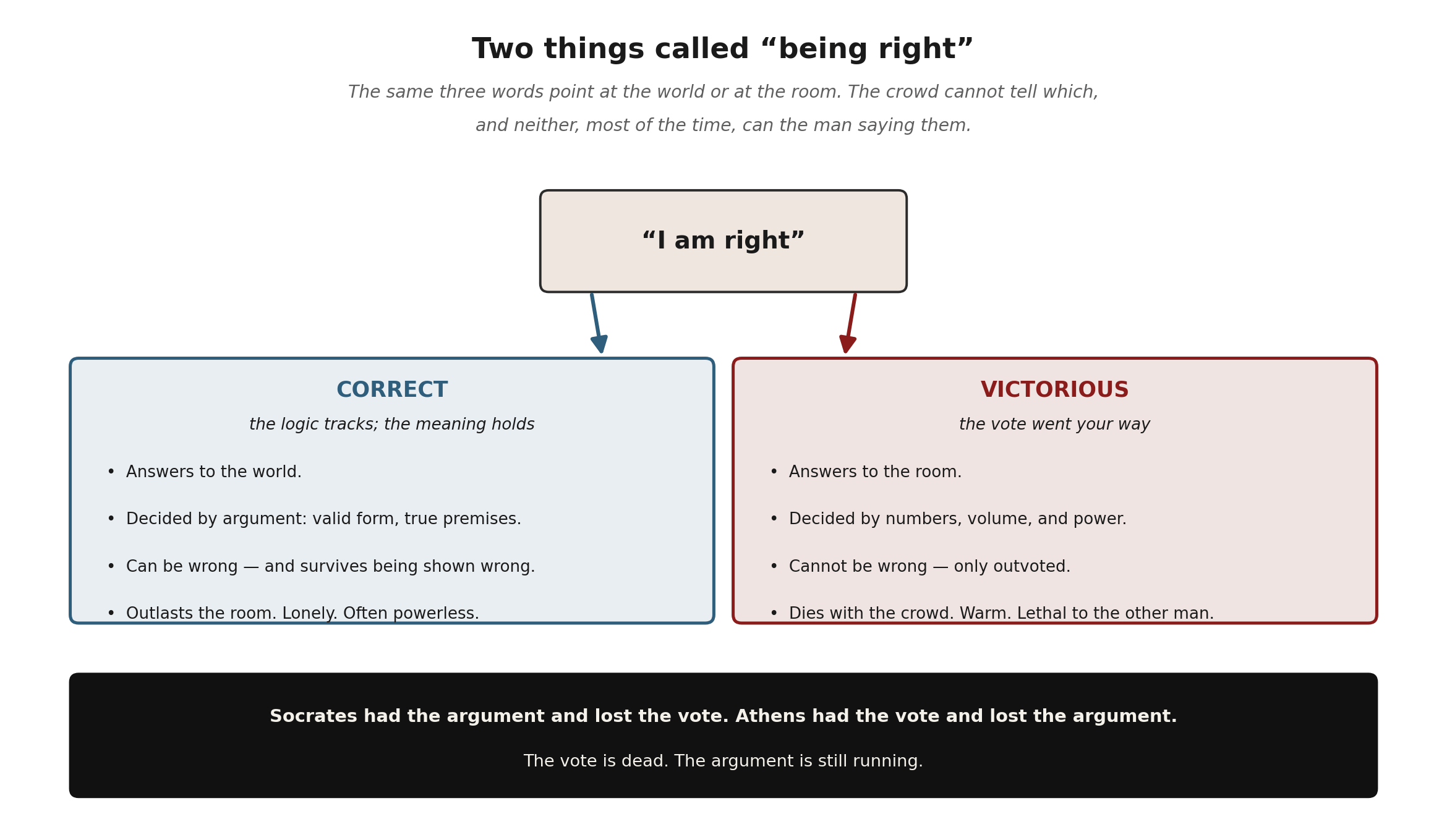
These are the two, and the whole disaster is that they wear the same three words. When a man says “I am right,” you cannot tell from the sentence whether he means his argument tracks reality or his side won the room — and, more dangerous still, he often cannot tell either. He feels the warmth of agreement, the solidity of the majority, the collapse of his opponent, and he reads all of it as though it were the click of a valid inference locking into place. It is not. It is the sound of a crowd. The crowd is very loud and the click is very quiet, and men have been confusing the two since before Athens had a name for either.
So let me take the two things that actually make a claim correct — logic and meaning — and show how little either has to do with winning, and why the man who has them is so often the man who loses.
Logic: what compels, and whom it does not
Logic is the discipline of valid inference — of whether a conclusion actually follows from its premises. It is worth being precise about what this buys you, because it is both more and less than people think.
Logic is truth-preserving, not truth-generating. A valid argument guarantees that if the premises are true, the conclusion is true; it manufactures no truth of its own. Feed it falsehoods and it will hand you falsehoods with perfect rigour — validity intact, conclusion worthless. This is why “logical” is not a synonym for “correct”: you can reason flawlessly from a rotten premise to a rotten conclusion and never make a single mistake in the reasoning. The most dangerous arguments in the world are not the illogical ones, which fall apart on inspection, but the impeccably valid ones resting quietly on a premise no one thought to check.
And logic has a second property, which is the one that got Socrates killed: it compels only those who accept its premises and its rules, and it compels no one else at all. A valid argument drags you to its conclusion — but only if you have already granted the starting points and agreed to be bound by inference. Grant them and you are helpless; the conclusion arrives whether you like it or not, which is the peculiar violence of logic, that it can force you to a place you did not want to go. But refuse the premises, or refuse to be bound, and the argument cannot touch you. It has no army. It cannot make you concede, cannot make you care, and above all cannot make a jury vote your way. Logic coerces the mind that has agreed to think. Against the mind that has agreed only to belong, it is completely powerless — and a mob is a mind that has agreed only to belong.
This is the first half of why being correct and being victorious come apart. Logic wins arguments only among people who have already consented to lose to a better one. Everywhere else, it is a man alone in a room, being irrefutable, and losing.
Meaning: the weapon that made them hate him
But Socrates’ real instrument was not logic. It was meaning, and meaning is where the deepest confusion lives, because most of what passes for disagreement is not disagreement at all — it is two people using the same word to mean different things, each certain he is right, arguing past each other forever with total conviction and no contact.
Socrates’ method — the elenchus, the relentless cross-examination — was almost entirely an assault on unexamined meaning. He would find a man who used a great word with total confidence: justice, courage, piety, virtue. And he would ask the one question that turns out to be unanswerable: what do you mean by it? Not an example — a definition. Not “name a just act” but “tell me what justice is, such that I could recognise it anywhere.” And the confident man, the general sure he understood courage, the priest sure he understood piety, would open his mouth and discover that he could not say. He had used the word his whole life. He had staked his identity, his office, his certainty on it. And he could not state what it meant. His rightness, examined, turned out to be a feeling wrapped around a word he could not define.
This is prior to logic and more devastating than logic, because logic operates on meanings, and if the meanings are mush then the most valid argument in the world is valid nonsense. The great engine of feeling right while being wrong is equivocation — the same word sliding from one sense to another in the course of an argument, so that the premises are true under one meaning and the conclusion follows under another, and the whole thing feels airtight precisely because no one noticed the word change costume between the lines. A man who has not fixed his meanings cannot be correct about anything, because he does not yet know what he is claiming. He only knows that he is sure.
And now you see why they killed him, and it is not the reason usually given. They did not kill Socrates for being wrong — he was not wrong, and they could not show that he was. They killed him for something far less forgivable: he showed them that their rightness was empty. He took the men most certain they knew what justice and piety were, the pillars of the city, and demonstrated, in public, in front of the young, that they could not say what they meant. He did not refute their beliefs. He revealed that underneath the beliefs there was no argument at all — only confidence, only belonging, only a word worn smooth by use and hollow at the core. No one forgives the man who reveals the performance. You can survive being told you are wrong. You cannot easily survive being shown, before an audience, that you never knew what you were talking about, and that your certainty was a costume. That is not an argument the powerful lose. It is an argument they end, by ending the man.
The steelman: Athens was not simply a mob
I have to stop here and make the case for the jury, and make it seriously, because the comfortable version of this story — noble philosopher, stupid mob — is a fairy tale, and a diagnosis that cannot understand why decent men voted to kill Socrates has understood nothing about the danger he actually posed.
Consider Athens in 399 BCE. It had just lost a catastrophic war. It had suffered, within recent memory, the rule of the Thirty Tyrants, a murderous oligarchy that had drowned the city in blood — and several of the tyrants had been Socrates’ companions and students. Another of his brilliant young associates had defected to the enemy and helped ruin the city. Here was a man who spent his days in the marketplace teaching the sharpest young men in Athens how to take apart every claim their elders held sacred, how to reduce any confident belief to stammering incoherence — and whose graduates included traitors and tyrants. To the jurors this was not abstract. They had watched what happened when the shared beliefs that hold a fragile democracy together were dissolved by clever men who had learned that nothing could withstand a sufficiently relentless what do you mean by it? A city runs on commitments its citizens do not examine — on a shared, unquestioned sense of what is just and pious and owed, the fixed points that let a community cohere and act. And here was a man whose entire life’s work was the public dissolution of exactly those fixed points, teaching the technique to the young, and calling it wisdom.
They had, in other words, a genuine interest in stopping him — not a stupid interest, a real one. A society that lets every sacred commitment be corroded by a genius in the agora may find, as Athens had just found, that it has corroded the beliefs it needed to survive, and that the corrosion trained a generation of its most gifted men to despise the city that fed them. Seen from inside, the verdict was not madness. It was a wounded community protecting the commitments that held it together against the man who was, with great skill and no apparent limit, taking them apart. From inside, it felt exactly like justice. That is the steelman, and it is strong, and I mean every word of it.
The crack: inconvenient is not the same as wrong
Now watch what the steelman does not establish, because everything turns on the gap.
Grant all of it. Grant that Athens had every reason to want Socrates silenced, that he was corrosive, that his corrosiveness was dangerous to a fragile city, that decent men could in good conscience fear him. Not one word of that shows he was wrong. It shows he was inconvenient — that his being right was costly, threatening, destabilising, intolerable. And the whole disease of the human mind is compressed in the distance between those two words, because the crowd feels the inconvenience and reports it, to itself, as wrongness. He is dangerous to us, therefore he is wrong. But the “therefore” spans a chasm nothing can bridge. A true thing can be dangerous. A correct argument can be corrosive. The world is under no obligation to have arranged matters so that the truths are all safe and the safe things all true, and a great deal of history is the record of communities discovering, too late, that the man they silenced for the danger had been right about the thing.
Here is the tell, the same tell that gives every one of these confusions away: they reached for the hemlock, not the rebuttal. If Socrates had been wrong — if his questions had rested on some error, if his method had some flaw — the answer was to show it, in the agora, on his own ground, with the argument he claimed to love and would have been bound by. They did not do this. They could not do this. So they did the other thing, the thing you do only when you cannot win the argument: they raised the cost of the argument until the man could not afford to keep making it. And the price they set was his life.
When you answer an argument with a penalty, you have conceded the argument. The penalty is the confession. A jury that could have refuted Socrates would have refuted him; a jury that kills him has told you, in the loudest voice available, that refutation was not on the table — that his rightness was real and unanswerable and had to be removed rather than met. The verdict was not a judgment on the argument. It was an admission about it. They did not prove him wrong. They proved they could not, and killed him instead, and called the killing a proof.
The asymmetry: power ends the arguer, not the argument
And this is where the two meanings of “being right” reveal their most important difference — the one that makes the whole story bearable, and even, in a strange way, triumphant.
A victory answers to the room, and the room empties. The jurors’ rightness was real on the afternoon they voted, and it lasted exactly as long as their power to enforce it — which is to say, it lasted their lifetimes and not one hour longer, and it is now so thoroughly dead that we cannot name a single man who held it. The vote expired the day it was cast. It reached the man; it took his life; it was, as a matter of brute power, entirely successful. And it changed nothing about whether he was correct, because correctness answers to the world and not to the room, and the world was not in the room and did not vote.
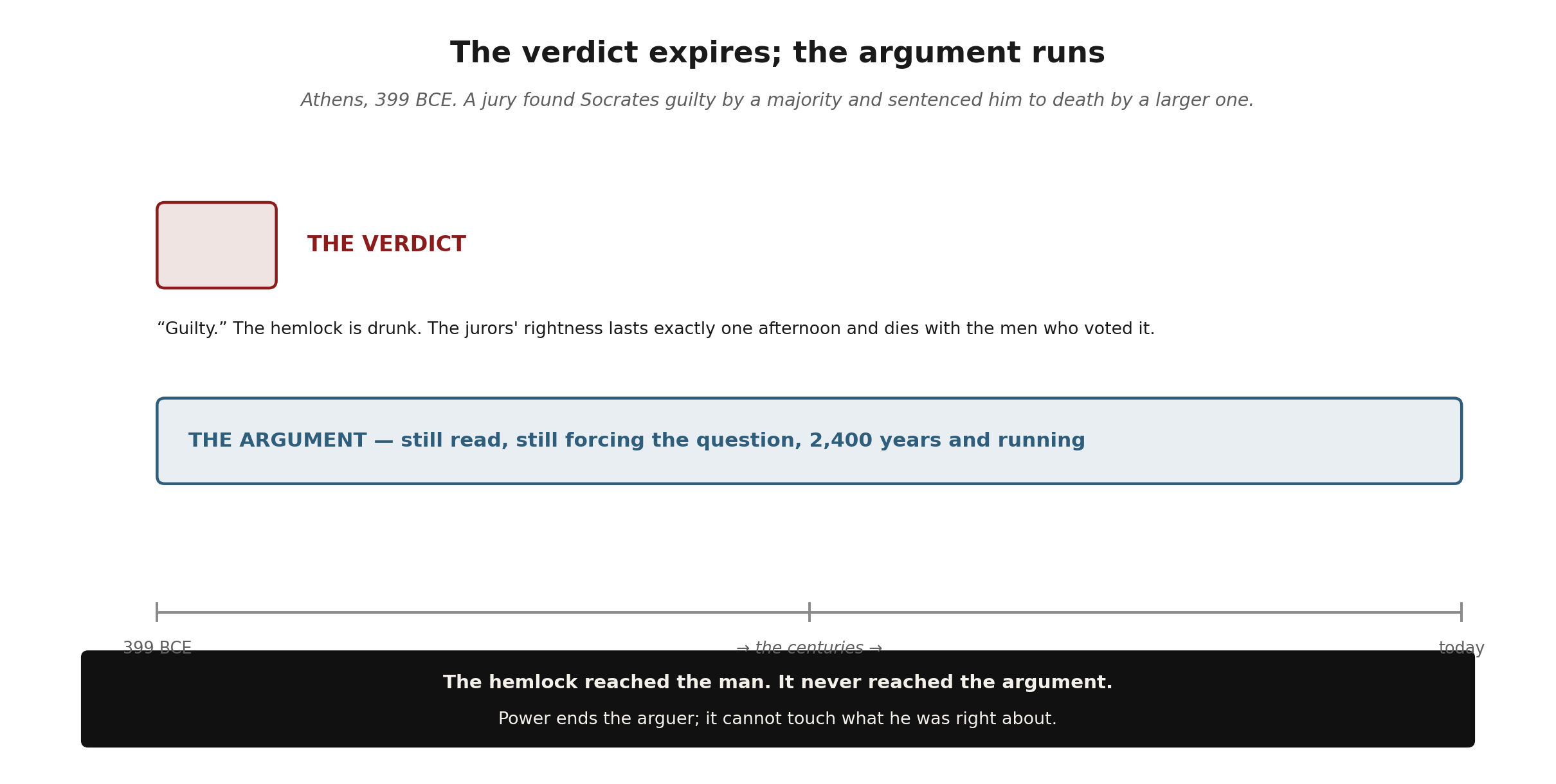
The argument, meanwhile, kept running. It is running now. We read the account of his trial twenty-four centuries later not as a curiosity but as a live provocation, because the questions he asked — what do you mean by justice, can you defend the certainty you would kill for, is the unexamined life worth living — are exactly as unanswered and exactly as sharp as they were the day the poison was mixed. The hemlock reached the man. It never reached the argument. Power can silence the arguer — it can exile him, jail him, kill him, erase his name — and it remains, against the argument itself, completely impotent, because the argument was never located in the man. It was located in the relation between the claim and the world, and that relation is not a thing you can poison. Being killed did not make Socrates wrong. Killing him did not make Athens right. The world declined to consult the verdict, and has gone on declining for two thousand four hundred years.
The teeth: winning is not evidence, and losing is not refutation
Here I have to guard both flanks at once, because there are two cheap conclusions waiting, and they are mirror images, and both are false.
The first is the cynic’s, and it reads the death of Socrates as proof that logic and meaning are worthless — that might makes right, the crowd always wins, the argument never saves anyone, so why trouble to be correct when you could just be on the winning side? This is the loser’s relativism, and it collapses on the very case it cites, because Socrates won — not the vote, which was worthless the moment the voters died, but the only contest that outlasts the room. He is more right today than the entire jury that outnumbered him, and their outnumbering has rotted to nothing while his argument still stands. To read his death as the triumph of power over truth is to mistake the afternoon for the millennium. Power won the afternoon. Truth is still winning the millennium, and the millennium is longer.
The second is the victor’s, and it is the jury’s own creed: we won, therefore we were right. History written by the victors is exactly this fallacy institutionalised — the inference from prevailed to correct, from the verdict to the fact. But the hemlock is not a premise. The vote is not an argument. That a claim triumphed tells you about the balance of power in the room where it triumphed and nothing whatever about its relation to the world, because those are different rooms, and the world’s room has no door the crowd can enter. The winners are sometimes also correct — by luck, by the occasional alignment of power with truth — but nothing in their winning makes them so, and the confident slide from “we prevailed” to “we were right” is the precise error that every triumphant injustice in history has used to sanctify itself.
Both errors make the identical mistake from opposite ends: both treat being right as a fact about who won. The cynic says the loser must have been wrong; the victor says the winner must have been right; and both have located the truth of a claim in the outcome of a contest, when truth was never in the contest at all. It was in the world, being the case, indifferent to the vote — as indifferent to Socrates’ death as to his opponents’ triumph, and as available, afterward, to vindicate the dead man as to convict the living ones, which is exactly what it did.
Being right, and being willing to lose
So what is a person to do who wants the first kind of rightness in a world that pays only for the second? The discipline, as always, can be stated in a few hard rules.
Separate the two rights, in yourself, every time. When you win an argument, ask the question the crowd never asks: did I win because I was correct, or because I was louder, or more numerous, or more stubborn, or because the other man simply tired? Winning is evidence of many things — your power, your persistence, your popularity — and of your correctness least of all, because the correct and the incorrect win at rates that have far more to do with the room than the world. The feeling of having won is not the feeling of being right. It only rhymes with it, and the rhyme has killed more truth than any lie.
Fix the meaning before you fight about the fact. Before you are certain you are right that something is just, or free, or fair, or true, do the Socratic thing and find out whether you and your opponent mean the same thing by the word — and whether you yourself can say what you mean. Most ferocious disagreements are equivocations that dissolve the instant the meaning is pinned, and most confident certainties are, on examination, words worn smooth and hollow. Socrates left us no doctrines. He left us a demand, and it is the most useful thing anyone ever bequeathed: know what you are talking about before you are sure you are right about it.
Be willing to be correct and lose. This is the whole of it, and it is the only proof that you were ever after truth rather than triumph. A man who is only ever “right” when being right also happens to win has never once shown that he can tell the two apart — he may simply love winning and call it truth. The willingness to hold the correct position into defeat, to keep the argument when the argument costs you the room, is the single act that distinguishes a mind that answers to the world from a mind that answers to the crowd. It is expensive. It cost Socrates everything. And it is the only rightness that winning can never give you and losing can never take away.
The cup
The crowd offers you the chance to be right every single day, cheaply, at the price of agreeing with it — and it is a real bargain, because the rightness it sells is warm and immediate and shared, and comes with a room full of people nodding, and asks nothing of you but that you never look too hard at what the words mean or where the argument leads. Socrates was offered that bargain, in the end, quite explicitly: recant, or flee, and live. He declined it, and drank the cup, because he had understood the one thing the jury never would — that the rightness they were offering him in exchange for his life was not the kind that survives the man who holds it, and the kind he already had would survive anything, including his death, including their victory, including the total and permanent triumph of their power over his body.
He was correct about that, too. The cup ended the arguer. The argument is reading over your shoulder right now.
So ask not whether you won. The room is always emptying, and the votes are always dying, and the crowd that agrees with you today is assembling, somewhere, the crowd that will agree against you tomorrow. Ask the other thing, the lonely thing, the thing that answers to something the room cannot reach and the hemlock cannot touch —
Is it so?
And be willing, if it comes to that, to be the one who was right and lost. It is the only kind of right they can never take from you, because it was never theirs to give.
State. Classify. Done.
The account rests on Plato’s Apology, Crito, and Phaedo, and on the ancient tradition of the trial of 399 BCE; the philosophical machinery is standard — the validity/soundness distinction, by which valid reasoning preserves truth without generating it; the fallacy of equivocation; and the Socratic elenchus as a method aimed at meaning before assertion. The exact vote counts are disputed in the sources and are given here only as majority and larger majority.Every claim above is meant to answer to those, and to the world they point at not to any jury’s approval of it.