
Maximum Pressure, Maximum Blowback
How Trump’s Iran policy strengthened Tehran, weakened the United States in European eyes, and exposed NATO’s political fragility

Keywords: Iran; Trump; JCPOA; maximum pressure; NATO; Europe; China; Strait of Hormuz; Kharg Island; sanctions; deterrence; alliance credibility
Thesis
Trump’s Iran policy did not break the Islamic Republic. It hardened Iran’s strategic credibility, deepened its dependence on China, widened the breach between Washington and Europe, and made American power look erratic rather than commanding, thereby weakening the United States while strengthening Iran’s relative position (Consilium, 2018, 2019; EEAS, 2019; U.S. Department of State, 2018).
Maximum Pressure, Maximum Blowback
How Trump’s Iran policy strengthened Tehran, weakened the United States in European eyes, and exposed NATO’s political fragility
Keywords: Iran; Trump; JCPOA; maximum pressure; NATO; Europe; China; Strait of Hormuz; Kharg Island; sanctions; deterrence; alliance credibility
Thesis
Trump’s Iran policy did not break the Islamic Republic. It hardened Iran’s strategic credibility, deepened its dependence on China, widened the breach between Washington and Europe, and made American power look erratic rather than commanding, thereby weakening the United States while strengthening Iran’s relative position (Consilium, 2018, 2019; EEAS, 2019; U.S. Department of State, 2018).
Introduction
Great powers do not always damage themselves through military defeat. Often they do it by misreading the meaning of force. They assume that punishment equals leverage, that disruption equals control, and that theatrical displays of power are a substitute for strategic coherence. Donald Trump’s Iran policy belongs to that category. It was sold as realism. It was, in practice, a case study in strategic self-harm.
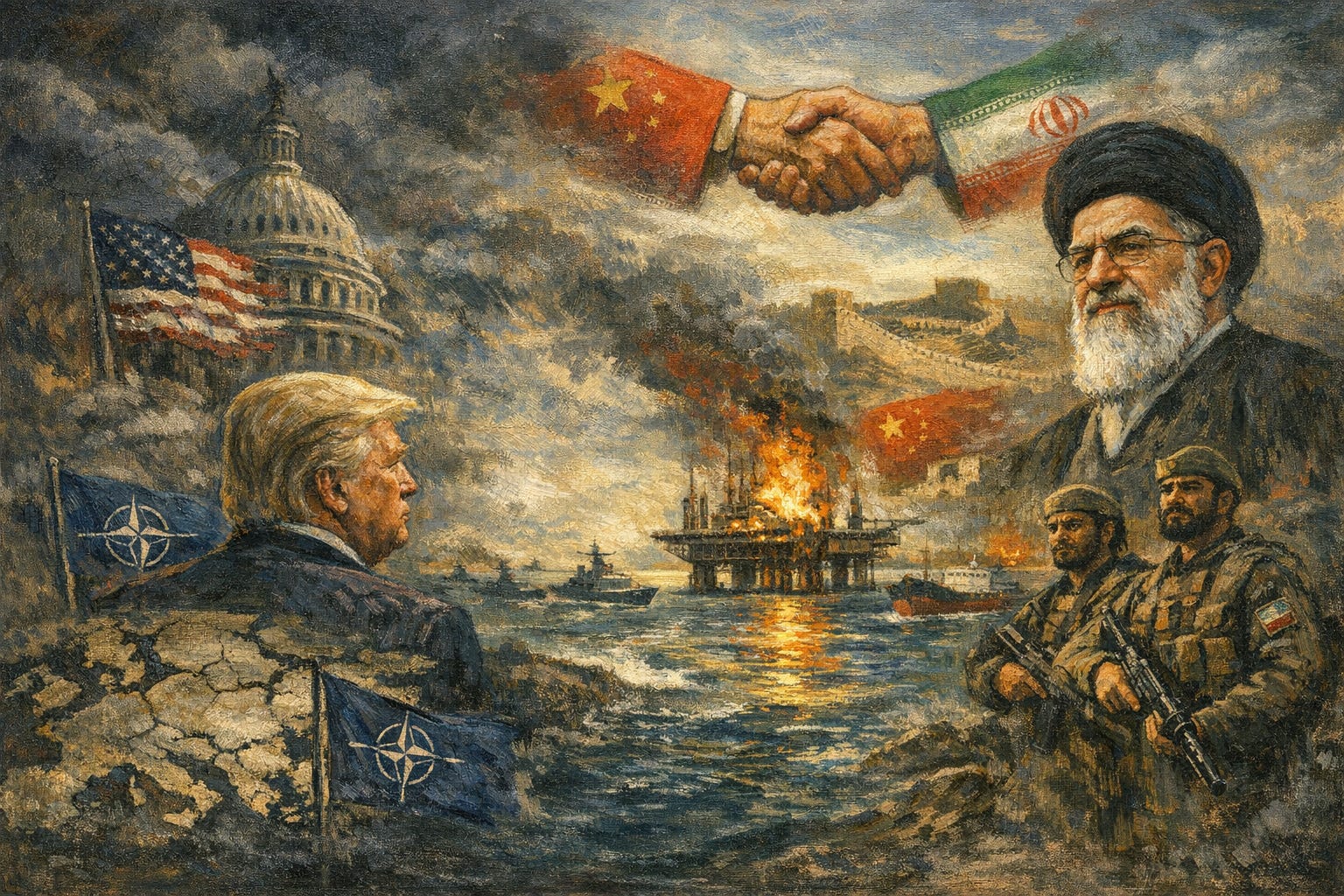
The central claim of this essay is simple. Trump made Iran stronger in relative strategic terms. He did not make it richer. He did not make it internally stable. He did not solve its structural weaknesses. What he did was give Iran something a pressured state values immensely: a reputation for survival, retaliation, and endurance. At the same time, he damaged U.S. credibility with Europe, deepened transatlantic distrust, encouraged Iran’s pivot toward China, and exposed NATO as a less coherent political-military community than Washington had long pretended. The result was not the restoration of American primacy. It was the demonstration that the United States could impose pain without producing obedience and escalate without constructing a durable political outcome (Consilium, 2018, 2019; Kirschenbaum, 2018).
This matters because coercion is not judged by how much suffering it causes. It is judged by whether it compels. A sanctions regime that impoverishes but does not break, a strike that kills but does not settle, and an alliance policy that alienates allies while failing to isolate the target are not signs of disciplined power. They are signs of strategic failure.
Trump’s Iran policy had five major effects. First, by abandoning the JCPOA, it handed Iran the political argument that Washington, not Tehran, had wrecked a functioning diplomatic arrangement. Second, the “maximum pressure” campaign hurt Iran economically but accelerated its adaptation, especially through covert oil flows and deeper Chinese ties. Third, Iran’s survival under punishment increased its deterrent credibility in the eyes of other states. Fourth, Europe’s public divergence from Washington weakened U.S. authority across the Atlantic. Fifth, NATO’s response to Iran-related escalation revealed that the alliance was far less politically unified than official rhetoric implied. These effects did not occur in isolation. Together, they made Iran look harder, the United States look less reliable, and the West look less coherent.
The First Strategic Error: Destroying a Working Diplomatic Framework
Trump’s withdrawal from the JCPOA in May 2018 was the original act of self-sabotage. The problem was not merely that he left a deal. The problem was that he left one that America’s principal European allies still regarded as functioning and worth preserving. The European Union stated immediately after the U.S. withdrawal that it “deeply regrets” the decision and reaffirmed its commitment to the agreement so long as Iran continued implementing its nuclear commitments, noting that the IAEA had repeatedly verified Iranian compliance (Consilium, 2018). A year later, the Council of the European Union again underscored its “resolute commitment” to the JCPOA and referred to thirteen consecutive IAEA confirmations of Iran’s implementation of its nuclear-related commitments (Consilium, 2019).
That is the critical point. Trump did not smash a dead agreement. He smashed a live one. He did not expose Iranian bad faith. He exposed American volatility. Once Washington abandoned an arrangement that Europe still defended and that inspectors still monitored, Iran gained the argument of diplomatic asymmetry. Tehran could now present itself as the party that had accepted inspections and limitations only to be punished regardless. In coercive diplomacy, that shift matters enormously. Legitimacy is not sentimental decoration. It is political capital. The side seen as violating a functioning arrangement is the side more likely to lose allied discipline and diplomatic credibility. That is exactly what happened.
The U.S. State Department insisted that withdrawal was necessary because the JCPOA had failed to address Iran’s ballistic missiles, regional activities, and long-term nuclear potential (U.S. Department of State, 2018). That argument was politically useful but strategically thin. No agreement solves every problem. The question is whether a working constraint regime is more valuable than an unconstrained confrontation. Europe answered yes. Trump answered no. Iran watched Washington answer no and correctly inferred that it now possessed an opportunity: to let the United States carry the blame for destroying the center.
That move had effects far beyond Iran. Once the United States showed that a major multilateral agreement could be discarded despite continuing allied support and ongoing verification, every future American guarantee became less stable. States do not judge credibility by slogans. They judge it by whether commitments survive domestic political turnover. Trump made it harder for allies and adversaries alike to believe that Washington’s word would endure beyond a single administration.
Maximum Pressure Produced Adaptation, Not Submission
The second major error lay in the theory of sanctions. Trump’s “maximum pressure” campaign assumed that overwhelming economic pain would produce either capitulation or internal fracture. It did not. It produced adaptation.
It is perfectly true that sanctions inflicted severe economic damage. Iranian oil revenue fell sharply after the U.S. withdrawal from the JCPOA. Inflation worsened. Budgetary pressures intensified. But pain is not the same thing as strategic defeat. A state does not lose simply because its economy deteriorates. It loses when pain becomes unmanageable and politically disintegrative. Iran did not reach that point. Instead, the regime adjusted, rerouted, concealed, discounted, and endured.
The strongest evidence of adaptation is Iran’s oil relationship with China. The U.S. Energy Information Administration’s 2025 analysis of Iran’s petroleum and other liquids exports shows estimated exports to China rising from 311 thousand barrels per day in 2020 to 706 thousand in 2021, 834 thousand in 2022, 1.189 million in 2023, and 1.444 million in 2024 (U.S. Energy Information Administration, 2025). Those numbers are not trivial leakage. They are proof that the sanctions regime did not eliminate Iran’s energy relevance. It redirected it into a more opaque and China-dependent channel.
That is the irony at the heart of maximum pressure. It was supposed to isolate Iran. It helped integrate Iran more deeply into a sanctions-resistant Chinese orbit. Reporting on the March 2021 China-Iran cooperation agreement emphasized a long-term framework linking Chinese investment and infrastructure interests with discounted Iranian oil supplies (Axios, 2021). Whatever the practical limits of that arrangement, the strategic direction is unmistakable. American pressure reduced Iran’s dependence on Europe and incentivized a tighter turn toward Beijing.
That was not a side effect. It was a structural consequence. The more Washington weaponized access to the global financial system without maintaining allied unanimity, the more incentive Iran had to build alternative circuits of survival. It is one thing to punish an enemy. It is another to punish it into the arms of your largest systemic rival. Trump managed the latter.
Sanctions also strengthened coercive adaptation inside Iran. The state and its affiliated networks gained greater experience in sanctions evasion, shipping concealment, financial workarounds, and oil rebranding practices. In other words, U.S. pressure became a training mechanism. It taught Iran how to survive outside formal compliance channels. Once a regime learns that lesson at scale, future sanctions lose marginal effectiveness.
Iran’s Credibility Increased Because It Survived
The third effect of Trump’s policy was reputational. Iran’s strength after 2018 did not come from prosperity. It came from demonstrated endurance. That distinction matters.
A state gains strategic credibility when it proves that it can absorb punishment without collapsing and still retain the capacity to impose costs. Iran did exactly that. Under severe sanctions, intense diplomatic pressure, cyber pressure, covert confrontation, and direct U.S. military action, the regime remained intact. It did not concede on core sovereignty questions. It continued projecting influence regionally. It sustained energy exports through modified channels. And, perhaps most importantly, it preserved a credible ability to threaten wider disruption in the Gulf.
That last point is vital. Iran’s position near the Strait of Hormuz remains one of its greatest assets. The Strait is one of the world’s central energy chokepoints. Iran’s coastal geography, missile forces, naval assets, island positions, and asymmetric capabilities ensure that no confrontation with Tehran can be treated as local in consequence. If Iran is threatened severely enough, it retains the ability to disrupt shipping, threaten energy flows, and raise global costs.
Kharg Island illustrates the point in the export dimension. The EIA’s 2025 report identifies Kharg Island as a key Iranian crude oil export terminal in the Persian Gulf, describing it as a vital node in Iran’s export infrastructure (U.S. Energy Information Administration, 2025). A state that can continue exporting through key terminals while also retaining the latent capacity to threaten the surrounding maritime system is not strategically neutralized. It is dangerous in exactly the way sanctions were meant to eliminate.
Trump unintentionally enhanced this perception. By hitting Iran hard and failing to settle it, he made the regime look durable. In world politics, durability under pressure can become its own kind of legitimacy. Not moral legitimacy in a liberal sense. Strategic legitimacy. Credibility. If the United States tears up a deal, imposes sweeping sanctions, conducts major strikes, and still fails to produce submission, observers draw conclusions. They conclude that Iran cannot easily be broken. They conclude that the United States is willing to escalate but unable to convert escalation into closure. That combination strengthens the weaker power’s reputation.
The Soleimani Strike Did Not Restore Deterrence
The killing of Qasem Soleimani in January 2020 was intended to reassert deterrence. It did something more ambiguous and, in strategic terms, more damaging.
Tactically, the strike demonstrated reach. Politically, it risked restoring cohesion to a regime that had been under internal pressure. A foreign power killing a senior Iranian military figure on Iraqi soil allowed Tehran to frame itself as a state under direct assault by an external enemy. Even for Iranians critical of the regime, that widened the emotional and political space for nationalist reaction. Washington was no longer merely sanctioning the government. It was visibly waging personal state violence against one of its most prominent commanders.
The immediate result was not Iranian collapse. It was crisis expansion. It pushed the region closer to war, generated fear in Europe, and reinforced a broader point: the United States could destroy individual targets, but it still could not define the political aftermath. That is not trivial. Deterrence is not just the capacity to kill. It is the capacity to shape future behavior predictably. In this case, the United States demonstrated lethality but not control.
For Tehran, the lesson was grim but useful. It learned that Washington might act dramatically, but also that Washington remained reluctant to move from episodic violence to full-scale war. That widened the space for calibrated Iranian risk-taking. A regime that believes the stronger adversary will punish but stop short of comprehensive confrontation becomes more confident in operating beneath that threshold. Trump’s policy therefore increased uncertainty but did not increase American command. In strategic terms, that is a bad trade.
Europe Saw Recklessness, Not Leadership
Europe’s reaction is one of the clearest indicators that Trump weakened the United States in global eyes. The divergence was not subtle. It was official, repeated, and institutional.
After the U.S. withdrawal from the JCPOA, the EU did not follow Washington. It tried to preserve the agreement. The creation of INSTEX in January 2019 was politically significant even if commercially limited. Federica Mogherini said it would support legitimate trade between Europe and Iran and reiterated the EU’s commitment to continued implementation of the JCPOA by all sides (EEAS, 2019). Europe was not merely grumbling. It was building a mechanism, however modest, designed to resist the practical reach of U.S. secondary sanctions.
That is extraordinary. Allies do not create sanctions-buffer structures against each other unless trust has materially eroded. INSTEX’s limited effectiveness does not change its meaning. Its meaning was political: Europe no longer accepted the assumption that American strategic judgment on Iran was authoritative.
Kirschenbaum’s 2018 analysis for the German Marshall Fund captured the danger early. He argued that unilateral U.S. withdrawal from the JCPOA risked ceding political ground to Iran, alienating Europe, and reducing the credibility of American coercive diplomacy (Kirschenbaum, 2018). That judgment proved sound. Europe came to see Washington less as the custodian of order and more as a generator of preventable instability.
This perception mattered because Europe’s view of American reliability affects far more than Iran. It affects the broader question of whether U.S. leadership remains disciplined, predictable, and strategically serious. Trump’s behavior suggested the opposite. He treated agreements as disposable, allies as followers, and crises as personal theater. That weakened American authority because allied confidence is part of U.S. power. A state that can no longer elicit automatic strategic confidence from Europe is weaker even if its military budget remains colossal.
NATO Looked Brittle, Not Unified
The fifth effect of Trump’s Iran posture was to expose NATO’s political fragility. NATO did not rupture over Iran. But it did reveal, in plain view, the difference between formal alliance and genuine strategic unity.
The issue is not whether Article 5 would apply to some hypothetical Iranian attack on a NATO member. The issue is whether European allies viewed a U.S.-Iran confrontation generated by Washington as their war. Increasingly, they did not. Reporting from 2026 captured that divergence clearly. Finland’s president stated that the war in Iran was “not a NATO matter” because NATO is a defensive alliance. Norway’s position was even sharper: “not our war,” and initiated without consultation (The Guardian, 2026). Those remarks were tied to a later crisis context, but they reflect a deeper reality that Trump helped create: Europeans had become far less willing to treat U.S.-driven escalation in the Middle East as automatically legitimate or collective.
That is what fragility looks like in modern alliance politics. Not treaty abrogation. Not open defection. Fragility is when states begin distinguishing between threats they recognize as genuinely collective and crises they regard as self-authored liabilities of the leading power. Once that distinction becomes normal, cohesion weakens. The alliance may still stand, but it becomes more conditional, more politically narrow, and less strategically elastic.
Trump’s Iran policy accelerated that outcome. He did not just fail to isolate Tehran. He made it easier for European governments to distance themselves from Washington on matters of war and peace. That weakens the United States because American hegemony has always depended on more than force. It has depended on organizational authority, allied trust, and the ability to define common strategic priorities. On Iran, Trump damaged all three.
China Was the Quiet Strategic Winner
The state that benefited most quietly from Trump’s Iran policy, after Iran itself, was China. Beijing did not need to rescue Tehran militarily. It only needed to become the principal large-scale economic outlet through which Iran could continue selling oil and sustaining parts of its external position.
That role increased China’s leverage in the Gulf and gave it access to discounted energy under sanctions conditions. More importantly, it illustrated a broader strategic point: when the United States uses sanctions and coercion without preserving allied consensus, it often incentivizes the growth of alternative economic circuits rather than the submission of the target state.
Iran’s turn toward China was therefore not a minor bilateral adjustment. It was evidence of a larger shift in the structure of global power. U.S. pressure helped demonstrate that states under American punishment would increasingly look to Chinese demand, Chinese finance, and Chinese political cover. That development weakens Washington twice. It preserves the target’s endurance and strengthens Beijing’s geopolitical role at the same time.
Europe, in turn, was left in a worse position. It did not want Iran unconstrained, but neither did it want China becoming more central to Iran’s external survival. Yet once Washington destroyed the diplomatic center and replaced it with unilateral coercion, those were precisely the outcomes it made more likely. Trump did not reduce strategic complexity. He redistributed it in ways hostile to American interests.
The Counterargument and Why It Fails
The obvious counterargument is that Trump weakened Iran economically and showed that Washington would use force. There is truth in both claims. Neither amounts to strategic success.
Economic pain is not equivalent to political compellence. Iran became poorer, but it did not become compliant. Nor did it lose the ability to threaten regional order, preserve its governing structure, or maintain crucial external ties. A strategy that impoverishes without settling is punitive, not effective.
Likewise, a show of force is not automatically deterrence. Deterrence is measured by whether the adversary alters behavior in the desired direction under fear of future cost. The Soleimani strike demonstrated lethality. It did not produce a broader settlement, a new agreement, or clear long-term submission. Instead, it intensified crisis dynamics and helped reaffirm Iran’s image as a state willing to endure.
Another counterargument is that Europe remained inside NATO, so alliance fragility is overstated. That objection misses the point. Fragility is not identical with rupture. An alliance becomes fragile when confidence narrows, when consultation weakens, and when members begin explicitly distancing themselves from the strategic choices of the leading power. That occurred. Trump’s Iran policy did not destroy NATO. It made visible how limited NATO’s political unity becomes when Washington acts without discipline.
Finally, one might argue that Iran’s internal weaknesses remained severe and therefore strength is overstated. That is true only if strength is defined crudely. The claim here is not that Iran became a flourishing power. It is that, relative to the aims of U.S. policy, Iran emerged more credible, more hardened, and more capable of claiming endurance than before. On that narrower and more serious measure, it gained.
Conclusion
Trump’s Iran policy is best understood as a strategic reversal disguised as toughness. He withdrew from a working diplomatic framework, lost the support of Europe, increased Iran’s justification for resistance, strengthened the China-Iran connection, and exposed the limits of NATO’s political cohesion. The regime in Tehran did not need to win outright. It only needed to survive, adapt, and remain dangerous. It did all three.
That is why the policy weakened the United States in global eyes. Europe watched Washington destroy a functioning agreement and then demand obedience. China watched American pressure create a sanctioned client more dependent on Chinese demand. Iran watched the strongest power in the world inflict pain without generating closure. The lesson all three could draw was the same: the United States remained violent, but it was no longer reliably strategic.
There is a broader historical pattern here. Powers in decline do not necessarily lose the capacity to hit. They lose the capacity to persuade, coordinate, and convert force into stable outcomes. Trump’s Iran policy revealed exactly that weakness. It made Iran look more resilient, Europe more skeptical, China more relevant, and NATO more conditional. That is not a record of restored primacy. It is a record of blowback.
References
Axios. (2021, March 27). China and Iran sign 25-year cooperation agreement. https://www.axios.com/2021/03/27/iran-china-25-year-cooperation-agreement
Consilium. (2018, May 9). Declaration by the High Representative on behalf of the EU following U.S. President Trump’s announcement on the Iran nuclear deal (JCPOA). https://www.consilium.europa.eu/en/press/press-releases/2018/05/09/declaration-by-the-high-representative-on-behalf-of-the-eu-following-us-president-trump-s-announcement-on-the-iran-nuclear-deal-jcpoa/
Consilium. (2019, June 17). Council conclusions on Iran. https://www.consilium.europa.eu/en/press/press-releases/2019/06/17/council-conclusions-on-iran/
European External Action Service. (2019, January 31). Joint statement on the creation of INSTEX, the special purpose vehicle aimed at facilitating legitimate trade with Iran. https://www.eeas.europa.eu/node/57475_en
International Atomic Energy Agency. (2018, May 24). Verification and monitoring in the Islamic Republic of Iran in light of United Nations Security Council Resolution 2231 (2015). https://www.iaea.org/sites/default/files/18/05/gov2018-24.pdf
Kirschenbaum, J. (2018, May 9). Trump’s decision on Iran could isolate America, not Tehran. The German Marshall Fund of the United States. https://www.gmfus.org/news/trumps-decision-iran-could-isolate-america-not-tehran
The Guardian. (2026, March 28). Finland and Norway distance themselves from U.S.-Iran war plans. https://www.theguardian.com/world/2026/mar/28/finland-norway-distance-themselves-us-iran-war-plans
U.S. Department of State. (2018, May 8). Remarks by President Trump on the Joint Comprehensive Plan of Action. https://2017-2021.state.gov/remarks-by-president-trump-on-the-joint-comprehensive-plan-of-action/
U.S. Energy Information Administration. (2025, June 26). Iran petroleum and other liquids exports. https://www.eia.gov/international/analysis/country/IRN
Trump declares victory 16 times but then says they better open the straight or else
It’s a massive scam