
Pipe Dreams
Laying Lines, Losing Time, and Learning That Water Never Listens

I. The Tunnel Breathes
It begins in the polytarp tunnel, where heat collects like a debt unpaid. Plastic stretched over frame, diffusing sunlight into something sterile and bright, a perfect mimic of care. Inside, rows of greens too fragile for the outside: rocket, coriander, a few tomatoes attempting bravery. They do not yet wilt, but their thirst is growing bolder by the day.
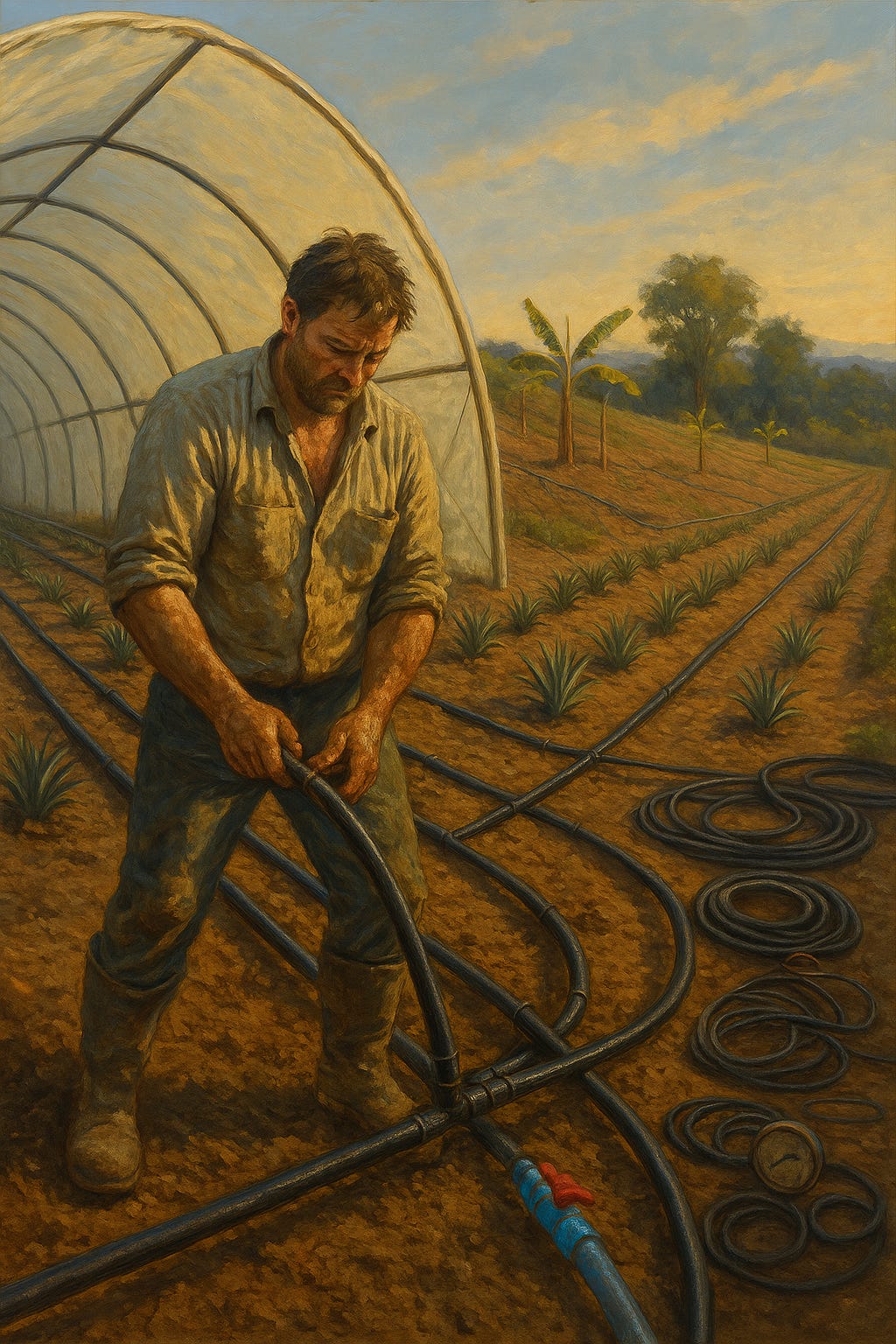
I stood over the first riser at dawn, the dew still hanging from the tape like a premonition. The mist line was sealed the night before. A gamble on solvent, pressure, gravity, and faith. You know quickly whether it worked. You open the main and listen. A low hum. Then a twitch. Then life. Water surged through the blue PVC like blood through unclogged veins. Pressure balanced. Risers held.
And then the whisper began—a thin line of mist arching from each emitter, catching the slant of morning sun like spider silk. Not a leak. Not a flood. Controlled exhalation. The tunnel breathed. For the first time since I carved this trench, this structure began to feed itself. No buckets. No hoses dragged like intestines across tilled earth. Just pipe and timing.
The rocket held its leaves higher by noon.
II. The Fence and the Fruit
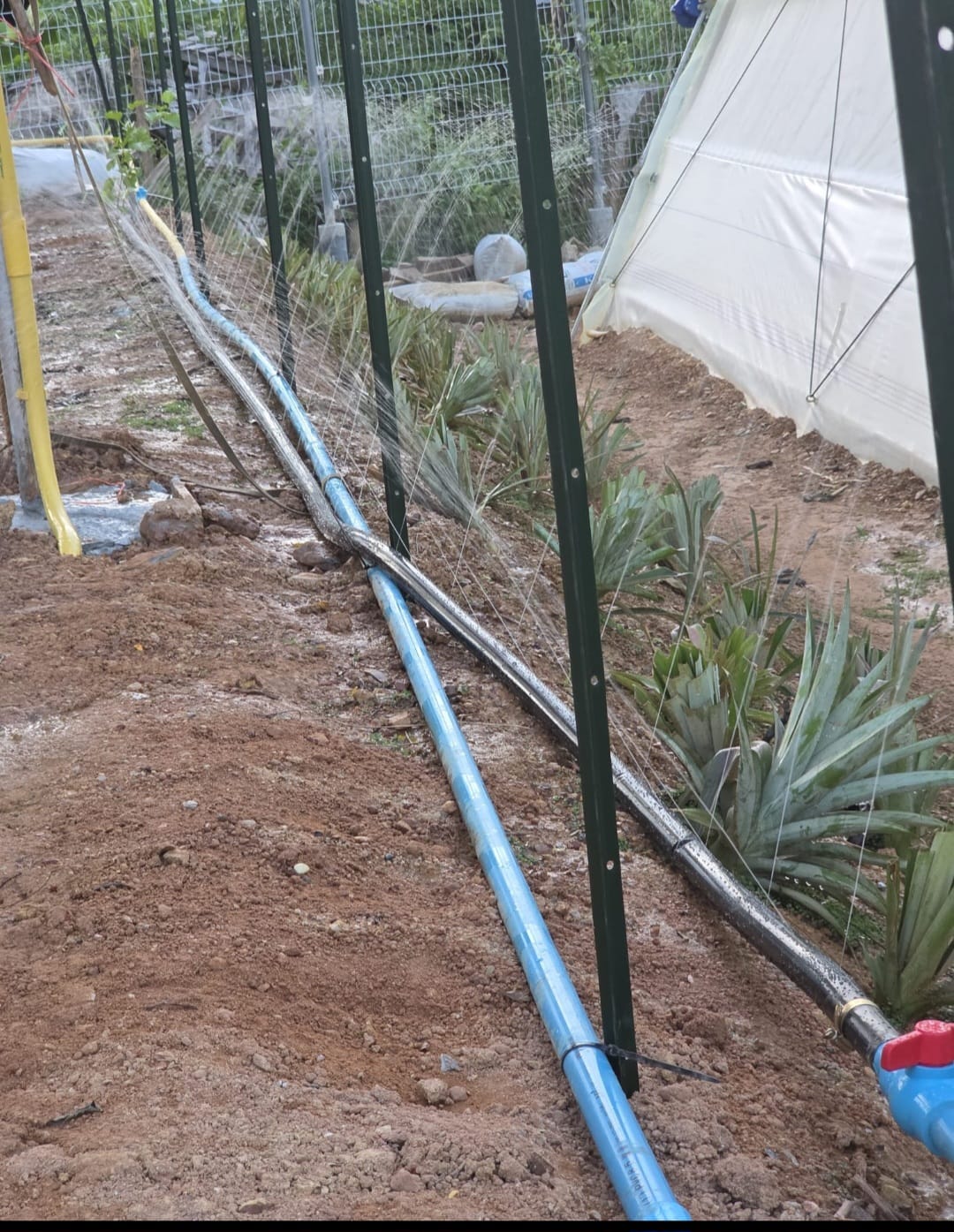
Beyond the tunnel, the pineapples sit in serried ranks. Little crowns of stubborn geometry. They don’t ask for much. Just consistency. Water near the base, not on the leaves. No drama, no flood. Their roots are shallow, like suspicion. Give too much, and they rot. Too little, and they sulk for months.
I laid the mist line parallel to the steel fence. Blue PVC as carrier, black polytube as delivery. A coupling every metre, precisely punched, barbed and sealed. Each emitter a weak pulse of deliberate care. You learn to measure irrigation not by volume, but by silence. If it screams, it’s broken. If it sings, you’ve gone too far. You want a hush. A near-nothing. And that’s what I got.
But getting it wasn’t quiet. The trench was shallow and dry, clay thick with memory. Every inch fought back. The sun, already unforgiving by 8 a.m., had no sympathy for plans. The PVC bent reluctantly, and the mist line coiled like it had opinions. I cursed. I bled. I kept going. Because systems matter. Because a bucket is a confession. Because real irrigation is a promise you don’t break.
By the time the line was pressurised, the pineapple leaves were humming. The sound isn’t audible, but you feel it in the skin: the gratitude of things finally being fed.
You don’t do this work for applause. You do it so that you can look at a root system and know it will go deeper tomorrow. That’s irrigation. Not just the movement of water, but the movement of time. A way of saying: you matter next week.
III. And Still the Trees Wait
They line the top ridge like witnesses. Mangoes, durians, tamarinds—the old guard. Each sapling spaced in its grid, but nothing yet uniform, nothing yet fed. Their leaves are still dry, curling faintly in protest. And it’s not ignorance—they know. Trees always know. They’ve watched the pipes inch closer for days. They’ve seen the trench lines snake along the fence. They’ve heard the cut of PVC, the low hiss of glued joints pressed and sealed. And still, they wait.
The pipes stop short of them for now, like a promise half-spoken.
This section of the farm isn’t silent. It’s loaded. Charged with the anticipation of flow. There’s no visible water yet, but beneath the surface, the lines are coiled, primed. The taps are shut. The pressure isn’t. When you walk past, you feel it. Like standing beside a closed dam. All potential. No release. You know what it will take to finish it. More pipe. More valves. More time bent double with your back in the dirt and your brain counting bar and litres per second like some priest of thermoplastic liturgy. It’s coming, but not today.
Today was enough. The tunnel runs. The pineapples along the fence drink mist from their own private kingdom now. And you could stop here—many would. They’d post a filtered photo, they’d write a caption, and they’d call it a win. But farming is not a PR strategy. It is not a show of milestones. It is the constant deferral of comfort. It is tomorrow’s job, always, because today was just triage.
You don’t just irrigate plants. You irrigate time. You create systems that your future self can live inside, or resent. Every connector you skimp on is a blister next month. Every line you bury shallow to save effort will burst in the dry season. And every inch you overextend without accounting for flow loss will haunt your yield like a ghost. That’s what they don’t tell you in books. The system never forgets. It just waits for the moment of maximum inconvenience.
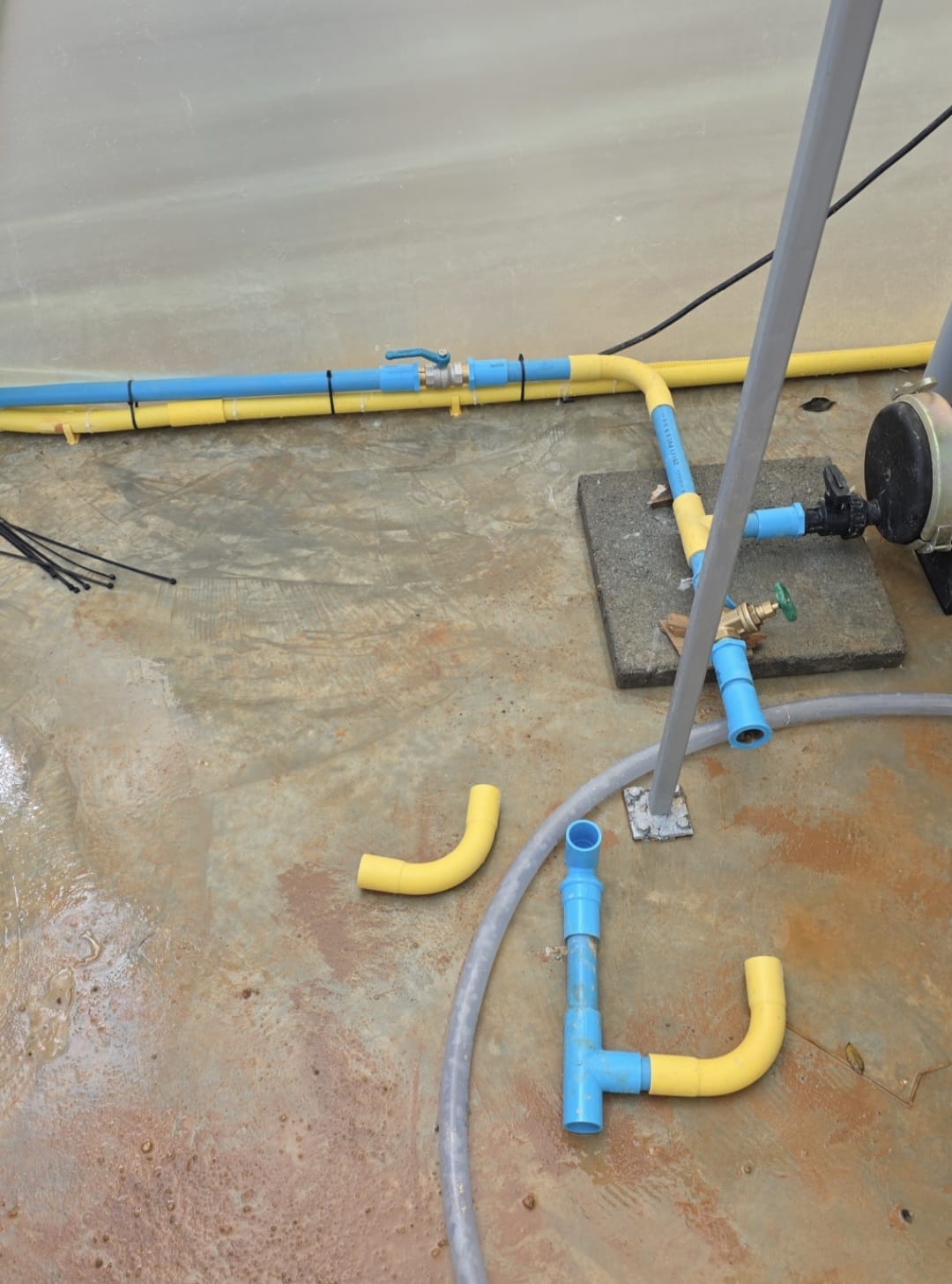
And so you sit on the concrete slab beside the pump—the heart of it all. It’s loud, slightly off-rhythm, like a jazz drummer who drinks too much. But it works. It throws pressure up the hill and into the tunnel. It lifts, it pushes, it hums. You look at the T-junctions beside it: yellow, blue, absurd in colour, childish even—but this is no toy. This is a nervous system. Miss one valve here, and the whole thing backs up, floods, bleeds out in chaos. You know. You've done it.
There’s always one joint you forget to reinforce. One clamp you tighten too late. You know because you walk the line again and again, after dark sometimes, with a torch, catching the sheen of a micro-leak at the base of a riser. You catch it early, or you catch it too late. That’s irrigation. It teaches you the cost of attention. Or the cost of its absence.
And yet. And yet, despite it all, the thing works. The system breathes. Water moves. Roots drink. The soil, stubborn and dusty this morning, now smells alive—rich, fungal, filled with unseen things crawling into motion. And you helped make that happen. Not with faith. With pipe. With pressure ratings. With solvent and skill. You didn’t pray for rain. You built the storm.
So tomorrow, the trees. Tomorrow, the trenching moves forward. The mangoes get their lines. The durians—stubborn bastards that they are—will finally drink. And slowly, line by line, tap by tap, the system grows. Not as a monument. Not as an achievement. As a discipline.
This is how you build a future: not with dreams, but with pipe. With sweat. With system. With the quiet obedience of pressure doing its job. And when it all flows, and the trees stop waiting—then maybe you breathe. But not before.
Not yet.
(The fun comes when I add the sensors and IoT devices to control these).