
Small Worlds, Large Errors
Why home nodes do not slow miners, do not censor miners, and do not occupy the topology that matters for BTC block creation

Keywords: BTC, home nodes, miners, proof-of-work, small-world networks, block creation, censorship resistance, transaction delivery, mining pools, mempool policy, network topology, public gossip, miner connectivity, local verification
The topology mistake
There is a soft, clever-sounding concession that appears in BTC arguments whenever the home-node mythology begins to collapse. It concedes, with one hand, that home nodes do not censor miners. Then, with the other, it smuggles the same claim back into the room in weaker form. The concession says: home nodes cannot prevent inclusion, but the topology of non-mining public communication still affects censorship resistance because dominant relay software can make some transactions more costly to deliver to miners.
It is a tidy sentence. It sounds technical. It has the varnish of nuance. It is also an evasion.
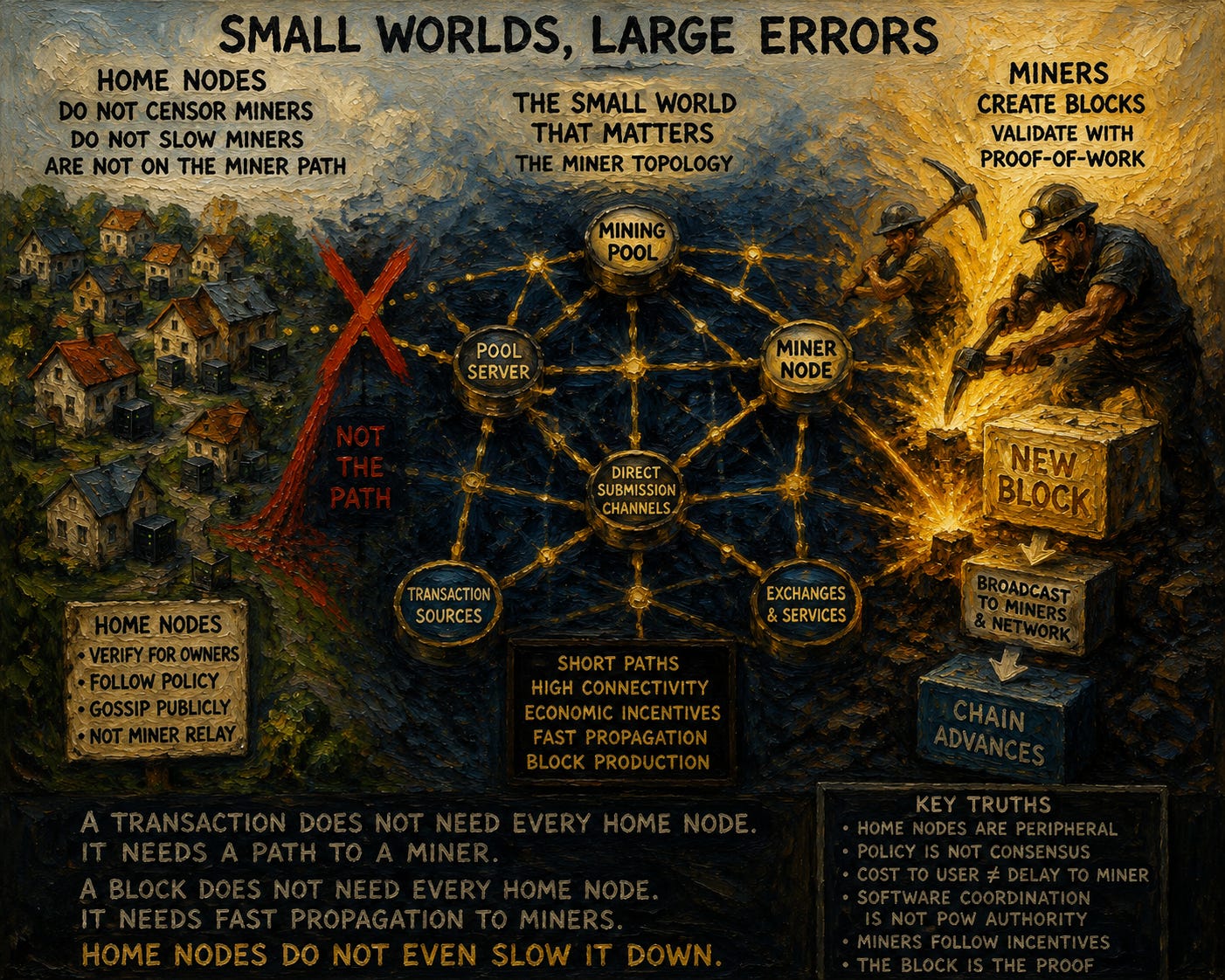
The first half is correct: home nodes do not censor miners. The second half becomes true only after it changes the subject. Public transaction gossip may affect ordinary user convenience. Default software policy may affect whether a casual broadcast spreads widely through the public network. But that is not the same as slowing miners. It is not the same as censoring miners. It is not even the same as materially delaying miner access where the transaction has a direct economic reason to reach mining infrastructure.
The error is a topology error. It imagines the BTC communication environment as though miners sit behind a fog of home machines, waiting for domestic verification boxes to pass them news. They do not. Miners and pools are not passive recipients at the end of a suburban whisper chain. They are the industrial centre of block production. They maintain connections because every second of ignorance costs money. They have reasons to hear about new blocks quickly, reasons to hear about profitable transactions quickly, and reasons not to let hobbyist software preferences define their revenue.
The public gossip network and the miner economy are not the same object. A home machine that checks blocks for its owner is not miner communication infrastructure. It may be visible in peer-count statistics. It may open sockets. It may keep a mempool. It may repeat some data to some peers. It may decline to accept other data. None of that makes it a path on which miners depend. None of that makes it a bottleneck. None of that makes it a censor. None of that even proves that it has slowed the transaction’s path to a miner.
A transaction does not have to win a popularity contest among home machines. It has to reach a miner. A block does not require applause from domestic verifiers. It has to reach other miners and economically relevant recipients. Proof-of-work is written by block creation, not by the mood of machines that do not create blocks.
The phrase “topology of non-mining relay” therefore needs dissection. Some non-mining infrastructure may matter if it sits close to wallets, exchanges, processors, miners, or pools. Some public software defaults may matter if users have no alternate path. Some network chokepoints may matter if they genuinely control delivery. But the ordinary home node, as such, is not that chokepoint. It is peripheral. It is replaceable. It is bypassable. It is outside the miner’s core communication problem.
The distinction is not pedantry. It is the difference between saying roads matter and saying a garden path controls the railway.
What a small-world network means
A small-world network is not a small network. It is a network in which most participants are connected by short paths despite the network having many members. The classic small-world model describes networks with high local clustering and short average path lengths, meaning that many nodes sit in local neighbourhoods, yet only a few long-range links can make the whole structure traversable in surprisingly few steps (Watts & Strogatz, 1998). The popular phrase “six degrees of separation” captures the intuition badly but usefully: a large social graph can still have short routes between distant persons because certain connections bridge otherwise separate clusters.
That is the first point. “Small world” does not mean every participant matters equally. It means the route structure is shaped by clustering, shortcuts, and hubs. Some actors sit at the edge. Some sit near the centre. Some provide shortcuts. Some can vanish with little effect. Others, because of their connectivity and economic role, matter far more than their simple count suggests.
BTC is commonly misunderstood because people count visible machines and then infer power from visibility. That is the home-node error. A population of domestic machines may appear numerous. It may produce an impressive map. It may let enthusiasts say that the network is broad. But broad visibility is not the same as productive centrality. A machine that never creates blocks, never selects block contents, never receives direct fee flow, and never participates in miner-to-miner block communication is not central merely because it exists.
The miner network is a small world in the economically relevant sense. Miners and pools have strong incentives to connect well to each other and to the infrastructure that feeds them transaction data. The reason is not ideology. It is arithmetic. If a miner learns late that another valid block has been found, it wastes work building on an obsolete tip. If a miner fails to learn about fee-paying transactions, it leaves revenue out of its candidate block. If a pool is poorly connected, it exposes itself and its hashers to avoidable loss. Therefore, the productive actors have direct incentives to build short, efficient, redundant paths among themselves.
That is the small world that matters for block creation.
The home machine is not usually part of it. A domestic verifier may sit on the public network and exchange messages with peers. It may help some ordinary data propagate under ordinary conditions. But miner infrastructure is not waiting upon it. The miner’s relevant paths are to other miners, pools, pool servers, block propagation systems, direct peers, transaction submitters, commercial counterparties, exchanges, processors, and other economically active infrastructure. The home node is a spectator at the edge.
A small-world topology therefore weakens the home-node censorship claim. In a small-world miner environment, a transaction does not have to traverse a random sequence of home machines. It can reach a hub, a pool, a miner-facing service, or a direct miner connection. Once it enters the productive small world, the domestic periphery becomes irrelevant. The path length from transaction origin to miner is not determined by the number of home nodes that disapprove. It is determined by whether the transaction can reach one of the economically connected points that miners actually monitor.
This is why the concession that “non-mining relay topology matters” is too crude. Topology matters only after one identifies which topology and which paths. The topology of domestic public gossip is not the topology of block production. The topology of wallet broadcast is not the topology of miner block construction. The topology visible to hobbyists is not necessarily the topology that carries high-value miner information.
To say “topology matters” without this distinction is to confuse a city map with a power grid.
Home nodes are not miner relay
The sentence must be stated without softness: home nodes are not miner relay.
They may run software that talks to peers. They may receive blocks. They may request data. They may keep local copies. They may share information with some peers under some conditions. But that does not make them miner relay in the sense relevant to censorship resistance or block production. Miner relay is the communication structure by which miners and pools learn of transactions worth mining and blocks worth building upon. A household verifier is not transformed into part of that structure merely by having an internet connection.
A miner has no reason to entrust its economic life to the preferences of domestic machines. It has every reason to avoid doing so. Mining is not a polite public conversation; it is a competition measured in block discovery, stale work, fee capture, and time. The miner’s world is harsh. A delay has cost. Ignorance has cost. Poor connectivity has cost. If miners were actually dependent on home nodes for critical block and transaction information, mining would be an amateur communications disaster. It is not structured that way because miners are not trying to subsidise the self-esteem of home verifiers.
This is especially obvious for blocks. When a miner finds a block, propagation speed matters. Other miners must learn of it quickly or they may waste work on a stale tip. The finding miner must distribute the block quickly or risk losing the race of recognition. That is a miner-to-miner and miner-to-infrastructure concern. It is not a domestic hobbyist concern. Decker and Wattenhofer (2013) showed that block and transaction propagation delays affect temporary inconsistencies in BTC. Gervais et al. (2016) likewise treated propagation as a central variable in proof-of-work performance and security. The lesson is not that home nodes rule miners. The lesson is that serious mining actors require efficient connectivity and have strong incentives to obtain it.
Compact block relay was introduced precisely because block propagation speed and bandwidth matter. BIP 152 allows peers with substantially overlapping transaction knowledge to communicate compact representations of blocks and request missing transactions where necessary (Corallo, 2016). The mechanism is a performance optimisation. It assumes that different machines may not have identical mempools. It does not grant home machines a veto. It does not make a household verifier the bottleneck for miners. It exists because productive and connected nodes need efficient data transfer, not because domestic machines govern block creation.
The same is true for transaction delivery. A transaction’s meaningful destination is not every home machine. It is a miner willing to include it. If the transaction reaches a miner through a direct channel, a pool interface, a commercial processor, or a specialised path, it does not matter that ordinary public gossip failed to carry it through domestic machines. The home machine did not slow the miner because the miner was not waiting on the home machine.
The claim that default public relay policy increases the cost of transaction delivery may be true for naive users who insist on using only the default public path. But even there, the causal actor is not “home nodes” as censors. It is software policy shaping one broadcast path. The moment the user uses a miner-facing path, the home-node periphery falls away. The cost is not imposed on mining. It is imposed on a particular method of public broadcast.
That distinction is decisive. If a road to the port is closed but the railway is open, the port has not been blockaded. If a domestic machine refuses to carry a transaction but a miner receives it directly, the miner has not been slowed. The home node has merely demonstrated that it was not on the critical path.
Home nodes are not miner relay. They are household verifiers attached to a public communications layer whose importance to mining is routinely exaggerated by people who are not mining.
Public gossip is not the miner graph
The public network and the miner graph overlap, but they are not identical. Treating them as identical is the source of the argument’s false strength.
The public network is where ordinary nodes discover peers, request data, announce inventory, and exchange transactions and blocks according to their software rules. It is useful. It can help distribute information. It can support wallets and services. It can give ordinary participants access to chain data. But it is not the exclusive path by which miners receive transactions, and it is not the exclusive path by which miners learn of blocks.
The miner graph is the set of economically relevant connections through which block producers, pools, and associated infrastructure receive transaction data and block information. This graph is shaped by incentives, not by hobbyist equality. A mining pool with substantial hash power is not just another domestic endpoint. It is a productive hub. A major exchange or payment processor that submits transactions directly is not just another home machine. It is a transaction source. A pool server distributing templates to hashers is not ordinary public gossip. It is mining infrastructure. A private peering relationship between economically relevant actors is not a home-node broadcast.
Once this distinction is introduced, the quoted-style concession begins to disintegrate. It says that if dominant relay software refuses to carry certain transactions, the cost of getting those transactions to miners increases. The correct reply is: through which graph, for which sender, and to which miners?
For a naive wallet that broadcasts only to ordinary public peers, default public policy may affect convenience. For a commercial actor with miner access, it may not. For a transaction with sufficient fee value and demand, miners may have incentive to receive it directly. For a miner already connected to sources outside public gossip, the refusal of home machines is not a speed bump. For block propagation among miners, the home-node public layer is not the decisive channel.
A serious argument must therefore specify the path. It cannot merely say “non-mining relay topology” and expect the phrase to do the work. Topology is not magic. It is a structure of actual paths between actual actors. A home machine affects only paths on which it lies. If it is not on the path from transaction source to miner, it does not slow the transaction. If it is not on the path from miner to other miners, it does not slow the block. If it has no control over miner-facing routes, it is not a censor.
This is basic graph reasoning. A vertex cannot delay traffic that does not pass through it. An edge cannot be a bottleneck for a route that does not use it. A cluster of peripheral vertices can refuse communication among themselves while the hubs continue communicating through other routes. In a small-world structure, shortcuts and hubs dominate path length. That is precisely why counting domestic nodes tells so little about miner access.
Small-world networks make peripheral censorship harder, not easier. The presence of short paths and economically motivated hubs means that information can bypass hostile or indifferent local clusters. A transaction does not need universal public sympathy. It needs a short path to a producer. Miners, being the producers, have reason to make those paths exist.
The public gossip layer can be noisy, large, ideological, and visible. The miner graph is smaller, more economically disciplined, and more important. Confusing the two allows a home node to imagine itself a gate. It is not a gate. It is usually a leaf.
The difference between cost and censorship
The soft concession also trades on ambiguity in the word “cost.” It says that if dominant public relay software refuses some transaction types, the cost of delivering those transactions to miners rises. That can be true in a weak sense while being irrelevant to the claim that home nodes slow miners. Every non-default route has some cost. Speaking, typing, copying, submitting, connecting, and configuring all have cost. But censorship analysis requires more than the discovery that alternatives are not frictionless.
A user who relies only on ordinary public gossip may face increased cost when default policy refuses a transaction. The user may need to find a different path. That is a cost to the user’s chosen method of broadcast. It is not a cost imposed by home nodes on miners. The miner has not necessarily waited longer. The miner may receive the transaction directly. The miner may advertise a submission channel. The miner may monitor sources that ordinary home machines do not affect. The miner may have no knowledge that domestic public gossip refused anything, because the miner’s path did not depend on it.
The distinction between user inconvenience and miner delay is central. The claim under dispute is not “public software policy can inconvenience some users.” That is obvious. The claim is whether home nodes can censor or even slow miners. They do not slow miners when miners receive the relevant information through routes independent of them. They do not slow miners when they were never on the miner’s path. They do not slow miners by refusing to carry data the miner already has.
A grocery shop that refuses to stock a book may inconvenience local buyers. It does not slow the publisher if the publisher sells directly online. A village road closure may inconvenience pedestrians. It does not slow freight travelling by rail. A home node refusing a transaction may inconvenience a user broadcasting only through default public gossip. It does not slow a miner who receives the transaction through a miner-facing channel.
The same logic applies to reliability. Public relay policy may reduce the reliability of a naive public broadcast. It does not reduce the reliability of transaction delivery to miners where delivery uses direct or professional paths. If anything, restrictive public relay can push serious users toward more reliable miner-facing channels. That is not an argument for home-node power. It is evidence that the home-node path is not the controlling path.
The cost argument also ignores fee incentives. If a transaction carries sufficient fee value or commercial importance, miners have reason to receive it. A market for direct submission can form precisely because public gossip is not mandatory. The greater the gap between consensus validity and public relay policy, the greater the incentive for miners and users to route around public policy. The home-node barrier then becomes self-defeating: it excludes itself from the flow while the flow moves elsewhere.
The final measure is block inclusion. If the transaction confirms, the claimed censorship failed. If it confirms without material delay through a direct miner path, the claimed slowing also failed. If domestic machines never carried it, the proof is stronger: the home nodes were not merely ineffective; they were irrelevant.
Cost is not censorship. User inconvenience is not miner delay. Public gossip friction is not proof-of-work authority.
Software coordination is not proof-of-work authority
The softer argument sometimes tries to escape by saying that the mechanism is not proof-of-work authority but software coordination. That is a retreat, not a rescue.
Software coordination can matter. If many users run the same default software, those defaults affect their experience. If many public machines apply the same mempool policy, certain transactions may spread less easily through that public layer. If wallets build assumptions around dominant policy, users may shape their transactions accordingly. These are sociotechnical facts. They are not proof that home nodes slow miners.
Software coordination affects those who depend on the coordinated software path. It does not bind those who route around it. It does not alter consensus validity. It does not control miners unless miners choose to depend on it. It does not create blocks. It does not prevent a miner from including a valid transaction received by other means.
The difference between software policy and consensus must be kept in view. Policy concerns what a machine will accept into its local unconfirmed transaction set or pass along before confirmation. Consensus concerns what makes a block valid once mined. BTC Core documentation treats transaction relay policy as additional rules applied to unconfirmed transactions before mempool admission and distinguishes it from consensus rules (BTC Core Contributors, 2026). That distinction is fatal to the idea that public relay policy governs miners. It may govern one class of pre-confirmation communication. It does not govern block validity.
If a transaction is valid by consensus and a miner includes it in a block, public relay policy has been bypassed. The home machines that refused the transaction before confirmation are not vindicated. They are bypassed. Their policy did not become law. It became a local preference that failed to prevent inclusion.
Software coordination may also be fragile because miners are not merely software users. They are economic actors. A miner can run different software. A pool can patch policy. A miner can accept direct submissions. A miner can build templates outside default assumptions. A miner can include transactions that domestic public policy dislikes. If there is money in doing so, the miner has a reason to consider it. If other miners refuse profitable transactions, the willing miner has an opportunity.
The phrase “dominant relay software” therefore overstates the case unless it identifies dominance over the actual miner path. Dominance among home verifiers is not dominance over miners. Dominance among public gossip participants is not dominance over direct submission. Dominance over default mempools is not dominance over block templates. Dominance over casual broadcast is not dominance over proof-of-work.
Software coordination may create a social norm. Miners may ignore it. Software coordination may create friction. Direct paths may bypass it. Software coordination may create visibility problems. Economic actors may solve them. None of this gives home nodes authority.
A policy that miners can route around is not a censor. It is a detour sign on one road.
Why home nodes do not even slow it down
The statement that home nodes do not censor miners is too weak. In the relevant miner small world, home nodes do not even slow the process.
They do not slow a transaction that does not travel through them.
They do not slow a miner that already has the transaction.
They do not slow a block that propagates through miner-connected paths.
They do not slow block production because they do not participate in block production.
They do not slow proof-of-work because their approval is not an input into proof-of-work.
They do not slow miner selection because miners do not select transactions from a particular home node’s local mempool.
They do not slow confirmation where the transaction reaches a miner by direct or professional means and the miner includes it.
This is not a rhetorical flourish. It is a path claim. Delay requires position on a path. A home node outside the path cannot delay traffic on that path. The domestic verifier may refuse to keep a transaction. It may refuse to pass it to its peers. It may sit in the corner of the public network congratulating itself. If the transaction reaches a miner through another route, the home node’s refusal has contributed no delay. Zero. Not a small delay. Not a meaningful delay. No delay at all.
The small-world structure reinforces this. In a network with short paths through connected hubs, peripheral refusal is often irrelevant. A cluster of home machines may refuse a transaction while one direct connection to a miner renders the cluster irrelevant. The miner world is small because miners and pools are economically forced into efficient connection. The home-node world may be large, but largeness at the edge does not create control at the centre.
This is why “most relay nodes” is a misleading phrase. Most visible public nodes are not most miner paths. Most domestic machines are not most hash power. Most local mempools are not most block templates. Most public software instances are not most economically relevant transaction routes. The word “most” counts the wrong thing. In proof-of-work, the relevant count is not household processes. It is block-producing power and miner access.
A hundred thousand home machines that refuse to carry a transaction do not slow the transaction if it is handed directly to a pool. A million home machines that never saw a block do not slow the block if miners receive it through their own connections. A public relay majority that dislikes a transaction does not matter if the transaction enters the next block through a miner’s own system. The proof is not philosophical. It is operational. The block contains the transaction.
The only way home nodes matter to delay is if a user foolishly or necessarily depends on them as the route. But that is a statement about the user’s chosen path, not a statement about miner slowdown. It says that the public broadcast route was inconvenient. It does not say that miners were delayed. It says that a transaction had to be delivered another way. It does not say that the home nodes stood between miners and block creation.
When a transaction can be delivered directly, the home-node layer has no clock to run. It cannot slow what it never carries.
The miner’s incentives defeat the domestic veto
Miners do not require sermons. They require revenue and timely information.
A miner has a reason to include valid fee-paying transactions. A miner has a reason to hear about competing blocks quickly. A miner has a reason to avoid stale work. A miner has a reason to maintain connections that serve those interests. These incentives are stronger than the preferences of home verifiers because they are tied directly to money.
A home node has no comparable leverage. It does not pay the miner to obey. It does not compensate the miner for omitted fees. It does not bear the miner’s stale risk. It does not contribute hash power. It does not produce candidate blocks. It does not enlarge or reduce the miner’s block reward by the act of local refusal. Its influence is therefore indirect at best and usually nonexistent.
If public software policy refuses a transaction type that miners regard as valuable, miners have a reason to receive it elsewhere. If users want those transactions confirmed, users have a reason to find miners. This mutual incentive creates a path around home-node refusal. That path may be private, commercial, specialised, or direct. Once it exists, the domestic veto fails.
This is the economic reason home-node obstruction cannot become miner censorship. It lacks enforcement. It does not command the productive actor. It offers no superior incentive. It cannot prevent alternative communication. It cannot punish the miner for inclusion except through whatever economic acceptance the node operator separately controls. A home operator with no market weight and no hash power has no sanction.
Mining is not governed by the emotional preferences of non-miners. It is governed by the creation of blocks under cost and competition. If a transaction is profitable and valid, a miner willing to include it can do so. The home nodes that refused to gossip about it are irrelevant once the miner has it.
This is why the soft topology argument ends in the wrong place. It asks whether default public relay software can affect transaction delivery. The better question is whether miners can be prevented from learning about valid fee-paying transactions. That is a much harder claim. It requires control over miner-facing paths, not merely influence over domestic public gossip. Home nodes do not supply that control.
The miner’s incentive is the great solvent of domestic veto. A miner who can earn by hearing what home nodes refuse has reason to stop listening to home nodes.
Blocks expose the fraud
The argument becomes clearest after a block is mined.
Suppose a transaction was refused by ordinary home machines. Suppose it was not widely present in their local mempools. Suppose it reached a miner directly. The miner included it. The miner found proof-of-work. The block propagated through miner-connected routes. Other miners built on it. The transaction confirmed.
At that moment the entire home-node theory stands naked. The domestic public layer did not censor the transaction. It did not prevent inclusion. It did not stop miners. It did not even necessarily slow the miner. It merely failed to participate. Its refusal was private abstention misdescribed as public power.
The block is the proof. It contains the transaction. It shows that the path to the miner existed. It shows that the miner did not need universal public relay. It shows that local mempool refusal was not consensus. It shows that software policy did not bind block construction. It shows that the home-node layer, however numerous, was not the controlling topology.
This is why block inclusion is the proper empirical endpoint. If the transaction appears in a valid block, then any claimed censorial power failed. If it appears promptly through direct submission, then any claimed slowing by home nodes failed as well. The analysis should not stop at whether public gossip was friendly. It must end with whether the transaction reached a miner and entered a block.
The same applies to blocks themselves. If a block propagates among miners and is built upon, domestic refusal to carry it does not matter. The chain advances by proof-of-work extension. The home verifier’s role is to check what it receives. If it refuses to receive, it blinds itself. If it refuses to recognise a valid block while the economy continues, it exits. It does not censor the block.
Proof-of-work has no patience for imaginary authority. It records the block. The home node can read it, refuse it, misunderstand it, or shout at it. It cannot unmake it.
The correct answer to the soft concession
The correct answer to the soft concession is therefore precise.
Yes, public software policy can affect the convenience of public transaction broadcast.
Yes, ordinary users may face higher friction if their transaction is disfavoured by default mempool policy.
Yes, network topology matters when one identifies the actual path being used.
No, this does not mean home nodes censor miners.
No, this does not mean home nodes slow miners.
No, this does not mean dominant home-node software policy is proof-of-work authority.
No, this does not mean public gossip topology is the miner graph.
No, this does not mean a home node lies on the path from transaction origin to block producer.
No, this does not mean a domestic verifier has any block-creating function.
The phrase “the cost of getting those transactions to miners increases” is therefore not a conclusion. It is a hypothesis requiring path analysis. If the transaction’s only route is through public gossip dominated by restrictive software, cost may rise for that user. If the transaction is sent directly to a miner or pool, the home-node layer imposes no cost at all. If miners have independent sources, no miner delay follows. If a miner includes the transaction promptly, the claim collapses empirically.
The decisive distinction is between the cost of using one route and the cost of reaching miners at all. Closing the wrong road does not block the destination. It only proves that another road matters.
A small-world miner topology means the economically relevant graph has short paths among productive actors. It means miners and pools are not waiting at the far end of random domestic gossip. It means information can reach block producers through hubs and shortcuts. It means peripheral home-node refusal is usually irrelevant to miner awareness. It means the domestic layer can be large and still not be controlling.
That is the reason home nodes do not even slow it down. They are not in the route that matters unless the sender chooses to use them. Once the sender uses a miner-facing path, their refusal has no causal role. They are not censoring. They are not throttling. They are not governing. They are absent.
The soft concession tries to save the home-node myth by retreating from power to friction. But even the friction claim fails when stated categorically. Home nodes create friction only for paths that depend on home nodes. Miner paths need not. Therefore home nodes do not slow miners. They slow, at most, users who voluntarily rely on the wrong public route after that route has made itself hostile.
That is not censorship resistance. That is bad routing.
The proper model
The proper model has four layers.
First, block creation. Miners create blocks. Validation in the proof-of-work sense occurs when miners build candidate blocks, expend work, and publish successful blocks. This is the productive layer.
Second, transaction access. Miners need transactions to include. Those transactions may arrive through public gossip, direct submission, pool infrastructure, commercial systems, or other miner-facing channels. This is the delivery layer.
Third, block propagation. Newly found blocks must reach other miners and economic actors quickly. This depends on miner connectivity, efficient communication, and the avoidance of stale work. This is the propagation layer.
Fourth, local verification. Home machines may check what they receive and decide what their owners recognise locally. This is the private assurance layer.
The home-node myth collapses because it places the fourth layer above the first. It treats local verification as though it governed block creation. It does not. The first layer writes the chain. The second feeds it. The third spreads it where it matters. The fourth checks locally after the productive act or observes some data before it. Only by confusing these layers can one say that home nodes censor miners or slow miners.
A correct censorship analysis asks whether valid transactions can reach layer one through layer two, and whether valid blocks from layer one can propagate through layer three. Home nodes matter only if they control those paths. They generally do not. Domestic local verification is layer four. It may inspect the results. It is not the productive centre.
This layered model also explains why public policy fights are often misdescribed. A dispute over default mempool policy is a dispute over one part of the delivery layer for public gossip. It is not a dispute over consensus unless the transaction would make a block invalid. It is not a dispute over block creation unless miners adopt the policy in their templates. It is not a dispute over miner propagation unless it affects miner block communication. It is not a dispute over home-node sovereignty because no such sovereignty exists.
If default public policy diverges from miner incentives, the delivery layer adapts. Direct submission becomes more important. Miner-facing services become more valuable. Public gossip loses relevance for the affected transactions. The home-node population has not gained power. It has made itself less useful.
That is the hidden consequence. Home nodes that refuse economically demanded valid transactions do not become censors. They become obsolete for that traffic.
Conclusion: small world, no home-node veto
The small-world point does not rescue the home-node argument. It destroys it.
A small-world network is defined by short paths, clusters, hubs, and shortcuts. In BTC, the economically relevant small world is the world of miners, pools, transaction sources, block propagation systems, and commercial infrastructure. That world is driven by revenue and latency. It is not governed by domestic machines that merely check data for their owners.
Home nodes do not validate. Miners validate by creating blocks. Home nodes do not decide transaction inclusion. Miners decide what enters candidate blocks. Home nodes do not control miner transaction access. Transactions can go directly to miners. Home nodes do not control block propagation among productive actors. Miners and pools have their own reasons and routes for fast communication. Home nodes do not slow proof-of-work. Proof-of-work proceeds without asking them.
The softer claim that dominant public relay policy can raise transaction-delivery costs is true only when confined to the public route that policy controls. It is false as a general claim about miners. It is false as a claim about home-node power. It is false as a claim about transactions that reach miners through direct or professional paths. It is false as a claim that home nodes even slow the productive system when they are outside the path.
A home node refusing to carry a transaction is not censorship. It is local refusal. A home node missing a transaction is not miner delay. It is local ignorance. A home node rejecting a valid block is not block suppression. It is self-exclusion. A public gossip path becoming hostile is not proof-of-work authority. It is an invitation to route around it.
The miner writes the chain. The small world that matters is the miner world. The home node watches from the edge, checks what it receives, and mistakes its local preferences for power only when language is allowed to do engineering’s job.
Home nodes do not censor miners. In the miner topology that matters, they do not even slow them.
References
BTC Core Contributors. (2026). Transaction relay policy. BTC Core Project.
Corallo, M. (2016). BIP 152: Compact block relay. Bitcoin Improvement Proposals.
Decker, C., & Wattenhofer, R. (2013). Information propagation in the Bitcoin network. IEEE Thirteenth International Conference on Peer-to-Peer Computing, 1–10.
Garay, J., Kiayias, A., & Leonardos, N. (2015). The Bitcoin backbone protocol: Analysis and applications. In E. Oswald & M. Fischlin (Eds.), Advances in Cryptology—EUROCRYPT 2015 (pp. 281–310). Springer.
Gervais, A., Karame, G. O., Wüst, K., Glykantzis, V., Ritzdorf, H., & Čapkun, S. (2016). On the security and performance of proof of work blockchains. Proceedings of the 2016 ACM SIGSAC Conference on Computer and Communications Security, 3–16.
Nakamoto, S. (2008). Bitcoin: A peer-to-peer electronic cash system.
Pass, R., Seeman, L., & Shelat, A. (2017). Analysis of the blockchain protocol in asynchronous networks. In J.-S. Coron & J. B. Nielsen (Eds.), Advances in Cryptology—EUROCRYPT 2017 (pp. 643–673). Springer.
Sompolinsky, Y., & Zohar, A. (2015). Secure high-rate transaction processing in Bitcoin. In R. Böhme & T. Okamoto (Eds.), Financial Cryptography and Data Security (pp. 507–527). Springer.
Watts, D. J., & Strogatz, S. H. (1998). Collective dynamics of “small-world” networks. Nature, 393(6684), 440–442.