
The Coconut Problem
On Ageing, Archery, and the Quiet Indignity of Trees That Refuse to Cooperate

Keywords:
coconuts, ageing, physical decline, archery, problem solving, rural life, humour, self-reliance, ingenuity, failure, persistence, tropical farming, manual labour, adaptation, absurdity
There comes a moment in every man’s life—assuming he lives long enough to cultivate both a garden and a sense of irony—when he finds himself standing beneath a tree, looking upward, and realising that nature has conspired against him in the most personal way imaginable.
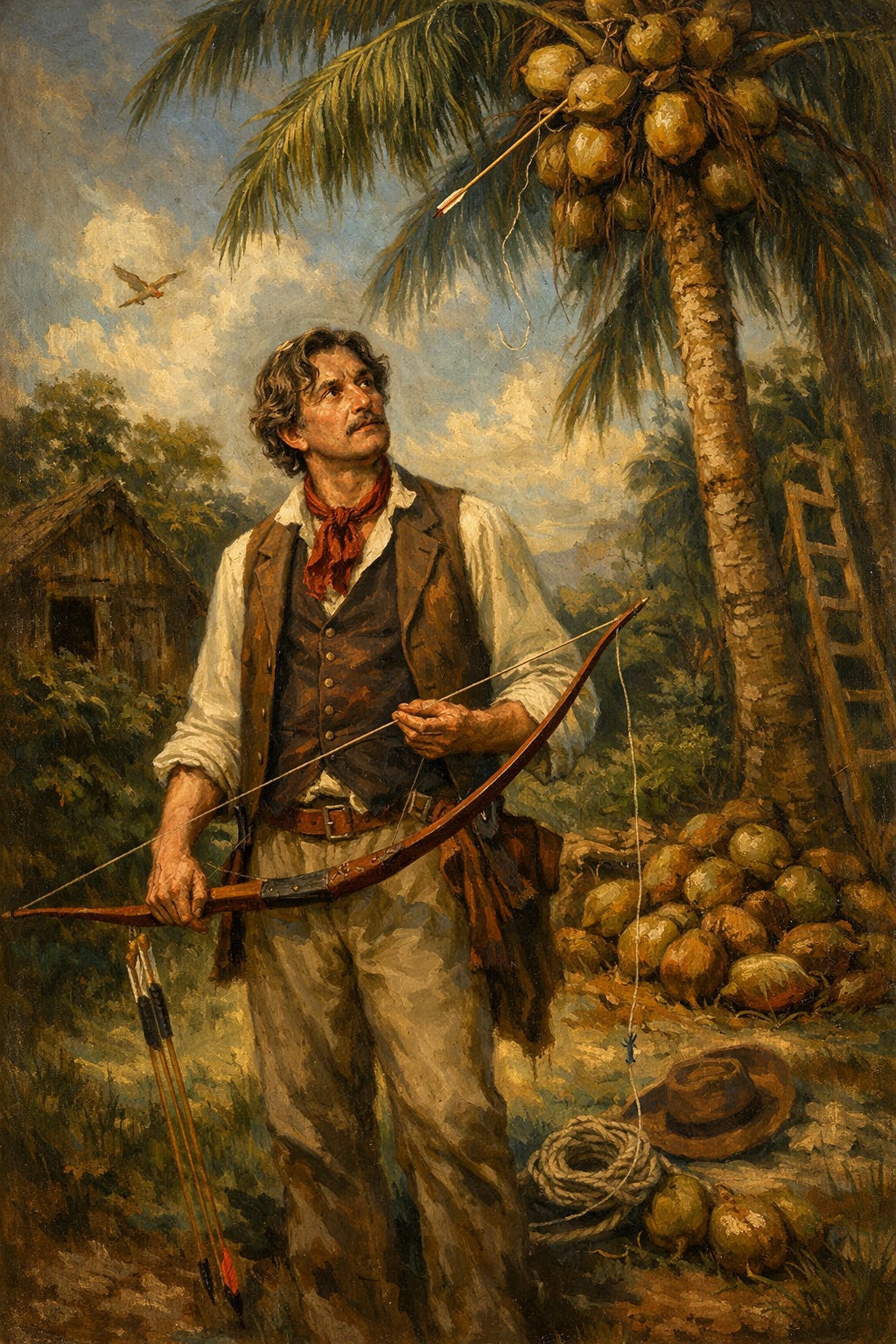
Mine arrived beneath a coconut tree.
It is not, I think, an unreasonable ambition to wish to provide one’s wife with coconuts. Indeed, it is a noble, almost pastoral aspiration. There is something ancient and reassuring in the idea: a man, his land, and the quiet duty of gathering fruit for the household. One imagines it with a certain rustic dignity, as though one were participating in a tradition stretching back to myth, or at the very least, to a time before joints began to creak in protest.
The reality, however, is less Homeric and more absurd.
My wife, whose tastes are impeccable and therefore entirely inconvenient, has developed a fondness—no, a devotion—to coconuts. Not a passing interest, not a casual indulgence, but a sustained and unwavering enthusiasm. She likes them fresh, she likes them plentiful, and she likes them, most inconveniently of all, from the trees that grow on our land.
Now, the trees themselves are magnificent. Tall, elegant, and entirely indifferent to human frailty, they rise upward with a confidence I can no longer claim as my own. They are laden with coconuts—piles of them, really—clustered high above, as though they were curated specifically to taunt me. It is an arrangement that feels less like agriculture and more like satire.
And so, inevitably, I climb.
Not as I once might have, in the careless manner of youth, when the body obeyed without question and gravity was little more than a suggestion. No—those days belong to the myth of the self, to that curious fiction in which one imagines oneself perpetually capable. I am no longer a twenty-something-year-old bounding up trees with reckless enthusiasm and no consideration for consequence. I am, instead, a man who understands precisely what consequence entails.
Each ascent is now a negotiation.
The hands grip, the feet search for purchase, and somewhere in the background there is a quiet, persistent awareness that this is an activity with a non-zero chance of catastrophe. One does not think of falling in youth; one merely assumes one will not. Age, however, introduces a certain statistical awareness into even the simplest acts. Climbing a tree ceases to be an expression of vitality and becomes, instead, a calculated risk.
And yet—how deliciously perverse—I can still do it.
No ladder, no assistance, no mechanical contrivance. Just the stubborn insistence that I remain, in some essential way, capable. I climb, I reach, I harvest, and I descend with what I generously describe as dignity. It is, I suspect, a dignity visible only to myself.
There is, I admit, a certain pleasure in this defiance. To stand at the top, coconuts in hand, looking down upon the world, is to experience a fleeting illusion of mastery. One feels, if only for a moment, that time has been outwitted, that decline has been postponed, that the inevitable can be negotiated with charm and determination.
But illusions, like coconuts, are often positioned just beyond comfortable reach.
For even as I climb, I can see the end approaching. Not dramatically, not with any tragic flourish, but with the quiet certainty of a conclusion already written. There will come a day when I stand beneath these trees, look upward, and decide—quite rationally—that the cost exceeds the benefit. That coconuts, however beloved, are no longer worth the climb.
And that, more than the physical limitation, is the true indignity: not that one cannot climb, but that one chooses not to.
Naturally, being a man of both intellect and questionable ingenuity, I sought alternatives.
Climbing, after all, is merely one solution to the problem of vertical acquisition. Surely, I reasoned, there must exist a more elegant method. Something less dependent on ligament integrity and more reliant on civilisation. After all, we have progressed beyond the brute necessity of physical exertion. We have invented machines, tools, and entire disciplines dedicated to avoiding precisely this sort of inconvenience.
And so I turned to archery.
There is something deeply appealing about solving practical problems with aesthetic means. Archery carries with it a certain refinement, a suggestion of culture. One does not merely throw objects or shake trees; one employs skill, precision, and a hint of theatricality. It is, in its way, a gentleman’s solution to an agricultural dilemma.
My archery, I am pleased to report, remains quite good.
The body may protest when climbing, but the eye and hand retain their quiet conspiracy. I can still draw, aim, and release with a competence that borders on elegance. There is a satisfaction in it, a reminder that not all faculties decline in unison. Some remain sharp, even as others begin their slow retreat.
The plan, therefore, was simple.
Attach a fishing line to the arrow, shoot the coconut, and use the line to pull it down. It was, in theory, a perfect marriage of precision and practicality. The arrow would do the difficult work of reaching the target, and the line would transform that success into tangible possession.
In theory.
Reality, as ever, proved less accommodating.
I stood beneath the tree, bow in hand, line carefully attached, and selected my target with the deliberation of a man who believes himself on the verge of triumph. The coconut hung there, serene and oblivious, as though it had no idea it was about to become the centrepiece of an experiment in applied ingenuity.
I drew the bow.
There is a moment in archery—just before release—when the world narrows. The distractions fall away, the noise recedes, and there is only the line between intention and outcome. It is, I imagine, what philosophers strive for and rarely achieve.
I released.
The arrow flew true. Beautifully true. It struck the coconut centre mass with a precision that would have satisfied any audience less demanding than reality itself. For a brief, glorious instant, I believed I had solved the problem. I had outwitted the tree, conquered height with intellect, and reduced a physical challenge to a matter of skill.
And then the fishing line failed.
Not dramatically. Not with any sense of betrayal worthy of tragedy. It simply… did not remain. It slipped, detached, refused to perform its singular, uncomplicated duty. The arrow struck, the coconut acknowledged the impact with a kind of stoic indifference, and the entire enterprise collapsed into a demonstration of what might be called theoretical success.
I had hit the target perfectly.
I had achieved nothing.
There is something profoundly humbling about such moments. One is reminded that success is not merely a matter of accuracy. It is a matter of consequence. To strike without effect is, in many ways, worse than to miss entirely. At least a miss carries with it the comfort of clear failure. A perfect hit followed by no result is simply… absurd.
Naturally, I considered the possibility of improving the setup.
The issue, clearly, was not the archery. That part of the system functioned flawlessly. The problem lay in the connection—the delicate, inadequate fishing line that lacked the authority to impose consequence upon the coconut. What was required, therefore, was a more substantial solution. A larger line, a more robust attachment, something that could translate impact into action.
But here, one encounters a complication.
The arrow must fly straight.
There is, in archery, a delicate balance between weight, aerodynamics, and stability. One cannot simply attach increasingly elaborate contraptions to an arrow and expect it to perform with the same grace. The more one burdens it, the less it behaves as an arrow and the more it resembles a poorly conceived experiment in gravity.
I did, of course, briefly consider more aggressive methods of attachment. Knots, hooks, perhaps even barbs designed to secure themselves upon impact. But there are limits—very sensible limits—to what one is willing to risk in pursuit of coconuts. I have grown rather fond of my fingers, and I see no compelling reason to endanger them in what is, ultimately, a domestic errand.
Thus, I found myself in a peculiar position.
Capable of striking the coconut with admirable precision, yet entirely unable to convert that success into possession. It is a condition that feels uncomfortably philosophical. One might even say it mirrors certain aspects of life: the ability to achieve without the ability to retain.
And so I stand beneath the trees.
Armed with a bow, burdened with experience, and surrounded by coconuts that remain stubbornly out of reach. I can climb, yes—but each climb is a reminder that this solution has an expiration date. I can shoot, certainly—but each successful shot that yields no result is a reminder that elegance without practicality is merely decoration.
The trees, meanwhile, remain indifferent.
They do not care for my age, my ingenuity, or my frustration. They continue to produce coconuts with a reliability that borders on mockery, presenting them at heights that suggest a deliberate and ongoing challenge. It is, I suspect, their only form of entertainment.
There is, in all of this, a lesson—though I hesitate to dignify it with such a term.
Perhaps it is this: that nature is not an adversary to be defeated, but a circumstance to be negotiated. One cannot simply impose solutions upon it and expect compliance. One must adapt, improvise, and occasionally accept that the simplest method—however inelegant—remains the most effective.
Which, regrettably, brings me back to climbing.
For all its risks, inconveniences, and indignities, it remains the one method that consistently produces coconuts in hand. It is direct, reliable, and entirely unforgiving. It demands effort and offers reward in equal measure, without the pretense of sophistication.
And so I continue.
I climb when I must, shoot when I feel optimistic, and stand beneath the trees contemplating my diminishing options. I remain, in essence, a man engaged in a quiet, ongoing negotiation with gravity, time, and horticulture.
There will come a day when the negotiation ends.
A day when I look up, assess the situation, and decide—without drama, without regret—that the coconuts may remain where they are. That their acquisition is no longer my responsibility, and that the trees have, in some small but undeniable way, prevailed.
Until then, however, I persist.
Because there is something in the act itself—in the absurdity, the effort, the repeated failure and occasional success—that feels strangely essential. It is not merely about coconuts. It is about the refusal to concede entirely, the insistence on remaining engaged with the world in a physical, immediate way.
Even if that engagement occasionally involves standing beneath a tree, bow in hand, having struck a coconut perfectly, and realising—with a sigh that is equal parts amusement and resignation—that one has, once again, achieved nothing at all.
I would like to suggest a boringly practical solution to the issue to coconut harvesting. There is a telescopic carbon fibre pole capable of reaching 50 feet to harvest carcinogenic areca catechu (betel nut) palm fruit when equipped with a saw blade, perfectly capable of being repurposed to harvest coconuts.