
The Last Round Before the Mirror
A Meditation on Age, Flesh, and the Unfinished Fight

Keywords:
Aging, boxing, mortality, vitreous separation, loss, discipline, vision, survival, time, will, triumph, futility
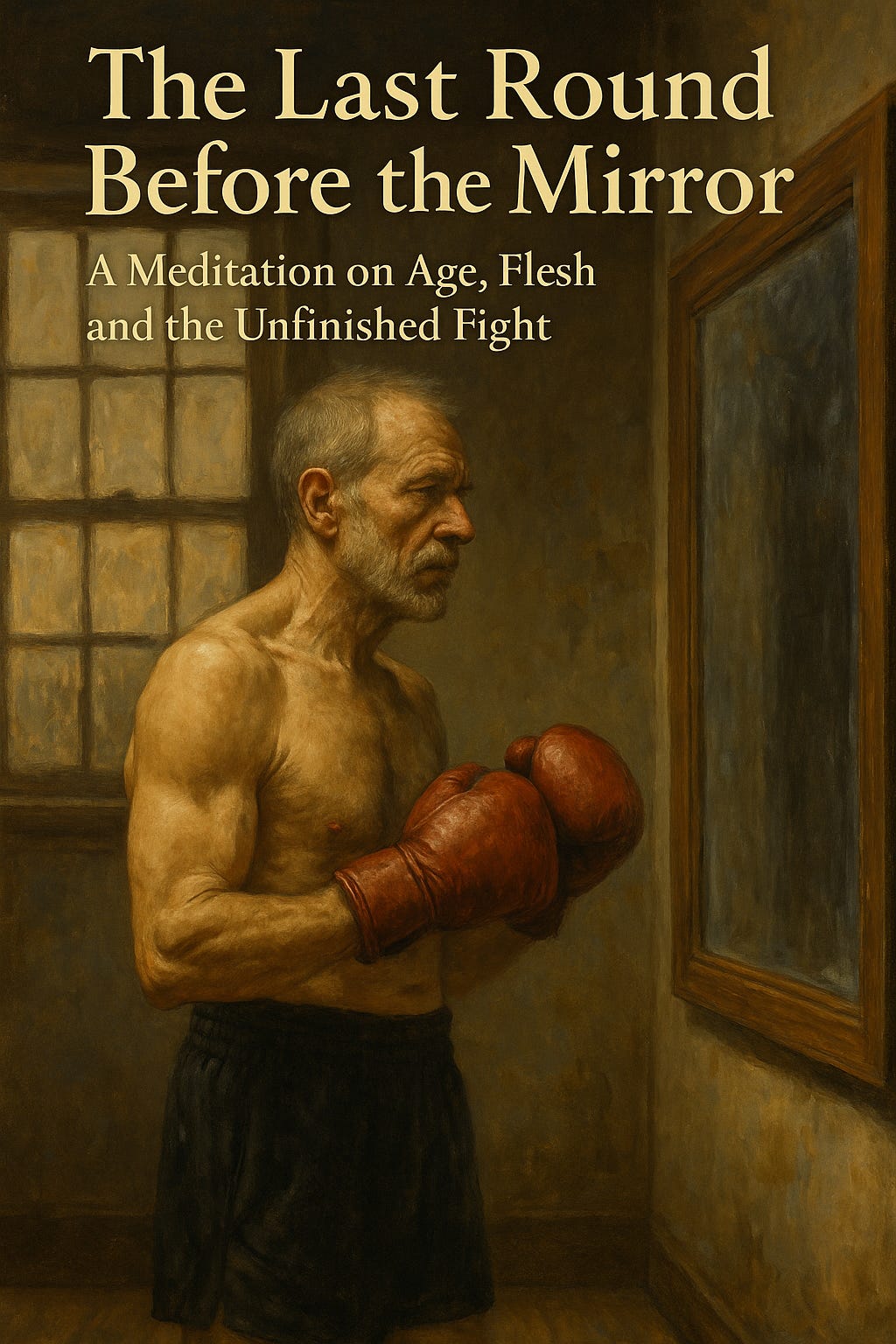
Section I: The Mirror at Fifty-Five
The calendar is a crueler judge than any referee I ever stood before. It doesn’t wave its arms, doesn’t count you out, doesn’t shout in your ear—it just marks the days, silent and merciless, until you wake up with fifty-five pressed against your chest like an unwanted medal. A few days to go, and the number already feels like a stone lodged in my ribs.
I stand before the mirror, that mocking accomplice, and it tells me what the doctors were too polite to: I am not the man I was, nor the man I pretended to be. The mirror doesn’t deal in kindness; it spits out verdicts written in crow’s feet and sagging skin, the small betrayals of gravity and years. I used to look into it with the arrogance of a fighter, the sort of animal who believed reflection was a second opponent he had already beaten. Now it looks back at me with the contempt of time itself, reminding me that flesh was never iron, only a leasehold on decay.
The eye—my cursed left eye—is the proof. A vitreous separation, the doctor said, like he was handing me a bill. A jelly detaching from the wall of vision, a curtain that could fall if I were foolish enough to take another punch to the head. A blow now is not just a bruise or a ringing ear; it is the possibility of darkness permanent and absolute. A retinal detachment waiting like a sniper in the shadows, ready to erase the lights forever.
I once thought of boxing as the ultimate honesty: two men, no excuses, no lies, the truth measured in flesh and endurance. But the truth, it seems, has a longer reach than the ring. It’s the body itself that calls the fight now, and it doesn’t matter how strong your arms are or how sharp your jab remains. When your own biology throws in the towel, you listen. Or you go blind.
The flesh remembers, though. It remembers the roar of the crowd in cheap venues where neon lights flickered like bad omens, where the air smelled of sweat, beer, and blood. It remembers hands lifted in victory, the feeling of being twenty-five and immortal, thirty-five and defiant, forty-five and still clawing victories from boys who thought time was on their side. The flesh remembers the rhythm of training, the pain that sharpened into triumph, the ecstasy of being more than ordinary.
But flesh also rebels. The joints ache like unpaid debts. The back stiffens in the morning as if nailed into place. The skin folds where it once stretched tight, as though mocking the memory of youth. Time is a parasite, eating away from the inside, and the mirror is the crime scene.
I watch myself, nearly fifty-five, and see both victories and the lie of them. Youth was a con artist and I fell for it. It told me there would always be another fight, another chance, another year to sharpen my teeth. It promised immortality in the sweat of the ring. And I believed, because belief was easier than honesty.
Now honesty stares back from the glass. It says: you can train, you can sweat, you can fight your shadow until the sun rises, but the ring no longer belongs to you. The gloves will stay, the body will move, but the war has shifted ground. The new opponent is time, and it will not be knocked out.
Section II: The Last Opponent is Time
Time never laces up gloves, never steps into the ring, never meets you face to face. It doesn’t have to. It waits in the silence between heartbeats, in the stiffness that creeps into the knees, in the faint blur of vision that once was sharp as a blade. It is the enemy that cannot be hit, cannot be dodged, cannot be worn down by endurance. A man can outlast another man, but no man outlasts the clock.
I used to believe opponents were flesh and bone. I used to think the measure of a life was how many you dropped, how many you outworked, how many you stood over while the referee counted. That was a child’s faith. Time shows you otherwise. Time teaches you that the greatest fighter is invisible, tireless, and pitiless. It doesn’t matter how many times you raise your hand in triumph; every victory is temporary, rented, stolen from the one who owns all endings.
The ring is a small world, a square of canvas where two men pretend to settle truth. But outside it, in the long hours after the crowd disperses, you begin to feel the larger ring closing in. Muscles that once snapped alive now drag their feet. A sprint turns into a jog, a jog into a shuffle. Recovery, once a matter of hours, becomes days, then weeks. You see the truth: time does not need to strike hard. It wins by accumulation, by attrition, by wearing down the body until resistance is impossible.
What a strange opponent, this eternity with its quiet cruelty. It fights dirty, hitting when you aren’t looking. It doesn’t throw jabs, it throws mornings when your back won’t straighten, nights when your eyes refuse focus, moments when the breath in your lungs feels thin and ragged. It doesn’t roar when it wins. It just waits until you notice you’ve already lost a little more.
There are no cheers when you score against it. No crowd, no neon lights, no referee. When you steal a day from time, when you drag yourself into the gym and move the iron, when you wrap the hands and shadowbox against your own decline, no one notices. The world keeps walking past. Yet those are the only victories that matter now: small, defiant, absurd wins against an enemy you cannot kill.
It is humiliating and noble at once. Humiliating because every round is lost in the end. Noble because you keep swinging anyway. Time will knock me down, break me piece by piece, but until the bell sounds for good, I will not stay on the canvas.
Time is the last opponent, the only one that cannot be beaten but must be faced. And the only honour left is to go the distance, bloody, broken, but standing.
Section III: The Eye as Metaphor and Warning
The left eye is a prophet, and it has spoken in the language of shadows and jelly. A vitreous separation, they called it, clinical words to describe betrayal. The gel peeling from the retina, pulling away like a curtain that threatens to fall. One punch, one careless headshot, and the darkness could roll in permanent. Blindness not as metaphor, but as sentence.
I’ve taken hundreds of blows to the head—leather, bone, the unkind kiss of fists meant to erase me—and none frightened me like this. A cut heals, a bruise fades, a rib knits back together. But the eye does not forgive. One wrong move and the world of form, colour, and light collapses into black. It is not the pain that terrifies. It is the silence after sight, the endless night behind the lids.
The eye becomes a tyrant. It dictates what I can no longer do, where I can no longer stand. Once I entered rings as if I owned them, now I step carefully in the world, measuring risk not by courage but by survival. I never thought vision could be a currency, but here it is, and the price of one more fight is too high.
And yet, there is irony in it. The eye, this soft jewel lodged in the skull, has saved me. It has forced honesty where pride would have demanded destruction. Left to myself, I would have kept swinging until there was nothing left. But the threat of blindness has drawn the line, clearer than any referee’s hand. It has told me: you have gone far enough.
I can curse it for weakness, but I know better. The eye is the warning shot. It spares me from the ultimate defeat, the spectacle of a man who could not stop until he was broken beyond repair. Pride kills men faster than fists, and the body, in its mutiny, has chosen to keep me alive.
There is philosophy in this: limits are not cages, but truths. They do not diminish a man; they define the borders within which his will must operate. To rage against them blindly is to dissolve into ruin. To accept them is to see that survival itself can be a victory.
The left eye whispers of mortality. It says: you are not untouchable, you are not eternal, you are not beyond the law of flesh. You are just another man whose organs keep score. And the choice is simple—sacrifice vanity or sacrifice vision.
I have made my choice. The ring is gone, the crowd is gone, but sight remains. And in the trade, I have learned something harsher than any punch: the body is not an ally or an enemy. It is a clock, and each tick brings you closer to the end.
Section IV: The Ring that Remains
The official ring is gone. No more bright lights, no more barked announcements, no more music that drowns out the sound of your own pulse. That theatre is closed to me now, and I accept it, though not with grace. But another ring remains, one without ropes or crowds, a circle traced by discipline and habit, drawn every day I choose to step back into training.
The body, even cracked and fading, still bends to will. It is slower, yes. It protests in the joints and groans under the weight of iron, but it moves, and when it moves, it remembers. The hands still wrap. The gloves still slip on. The bag still swings, waiting for the rhythm of fists. Each punch lands like an echo from another time, not as sharp, not as fast, but still carrying defiance.
There is no opponent now but the mirror. No judge but the sweat on the floor. No victory but the act itself. To train without promise of the ring is a form of madness, yet it is also the last rebellion a man can make against the encroaching tide of years. The bag does not care about age. The weights do not mock. The skipping rope whips the floor in the same tempo whether you are twenty or fifty-five. Discipline has no sympathy, but it has fairness.
I will not fight again, not in the sense the world measures. But I will train, because training is its own language of defiance. It is standing on the shore and spitting into the sea, knowing the waves will still come, but daring them to take you on. Each drill is a refusal. Each bead of sweat is an insult hurled at time itself.
The crowd is gone, and maybe that is for the best. Crowds demand spectacle, but there is a purity in the solitary ring. You don’t perform; you endure. You don’t seek applause; you demand nothing less than survival. And survival, stripped of vanity, has its own grandeur.
The ring that remains is invisible but unyielding. It is drawn each morning when I lace my shoes, when I choose sweat over surrender. It has no ropes, no canvas, no bell. Only the will inside the cage of my ribs, hammering out its stubborn rhythm. That is the fight that’s left, and it is enough.
Section V: Philosophy of Aging
Aging is the bill you cannot refuse to pay. Every hour spent in triumph carries its quiet surcharge, and the invoice arrives decades later, written across the skin, the bones, the eyes. I once thought it an insult, this process of decay. Now I see it for what it is: the only proof you ever lived long enough to matter. The young waste themselves believing in eternity; the old carry the privilege of truth.
There is no glamour in aging, no grace, no poetry in the stiff joints or the blurred edges of sight. But there is honesty, and honesty is rarer than beauty. Beauty is the carnival trick sold to fools in their twenties. Honesty is the clarity that comes when you can no longer pretend. When you reach the point where the flesh has stripped you of illusions, only the will remains. And will is the last fortress.
The vitreous separation has taught me this: survival is not weakness. It is its own form of victory. Pride demanded the ring, but vision demands caution, and in that caution lies endurance. To admit that you cannot fight is not surrender; it is the recognition that there are greater fights than men throwing fists at each other under lights. Time itself is the greater opponent, and against it, the only defence is persistence.
There is freedom here, a hard, bitter freedom. By giving up the ring, I am owned by nothing but time. And if time is the enemy, then each day I train, each morning I sweat, each evening I move the body despite its protests—that is my declaration of war.
And yet, the world is not only gloves and canvas. I still have the farm. The earth demands labour as stern and unyielding as any trainer. The soil will not forgive laziness, the animals will not wait. To walk the fields, to mend the fences, to turn the land with tired hands—that too is a kind of fight, slower, quieter, but no less real.
I still have work that keeps me alive. I still have tasks that pull me out of bed when the bones ache and the mirror laughs. The ring is gone, yes, but I am not left without weapons. The farm, the training, the endless motion of life itself—they will keep me active, keep me sharp, keep me standing.
Time gnaws at all men, but I will not be chewed easily.
"Don't try"
Great read. Godspeed on the ocularly front.
Deterioration is not an Aging factor but more of a corruption factor.