
The Successor Delusion: Why Evolution Does Not Owe the Earth Another Mind
Symbolic intelligence is not an inevitability; it is a freak event—and losing it may be final.

Keywords
symbolic reasoning; human exceptionalism; evolutionary contingency; teleology; convergent evolution; mass extinction; cognition; language; cumulative culture; Great Filter; astrobiology; Fermi paradox; stewardship; existential risk.
Abstract / Thesis
This article argues against the comforting belief that if humans disappear, evolution will “simply” generate another symbolic intelligence in due course. That belief treats evolution as a ladder with intelligence as its destination, when evolution is a blind local filter with no foresight and no guaranteed endpoints. The article distinguishes animal cognition from symbolic reasoning, shows how long Earth remained lifeless or non-symbolic despite immense biodiversity, and explains why symbolic intelligence may be a singular, non-repeating accident. It then links this to astrobiology: even if microbial life is common, mind may be vanishingly rare. The conclusion is stark but practical: if intelligence is the only known mechanism capable of preserving life and exporting it beyond Earth, then the moral posture that celebrates human disappearance is not humility—it is an endorsement of cosmic silence.
Opening: The Comforting Lie
There is a soothing little fable people repeat when they want to sound brave about extinction. If humans vanish, they say, the world will recover. Something else will rise. Intelligence is “what evolution does”, and the planet will simply try again, as though the biosphere were a factory with a replacement part on order.
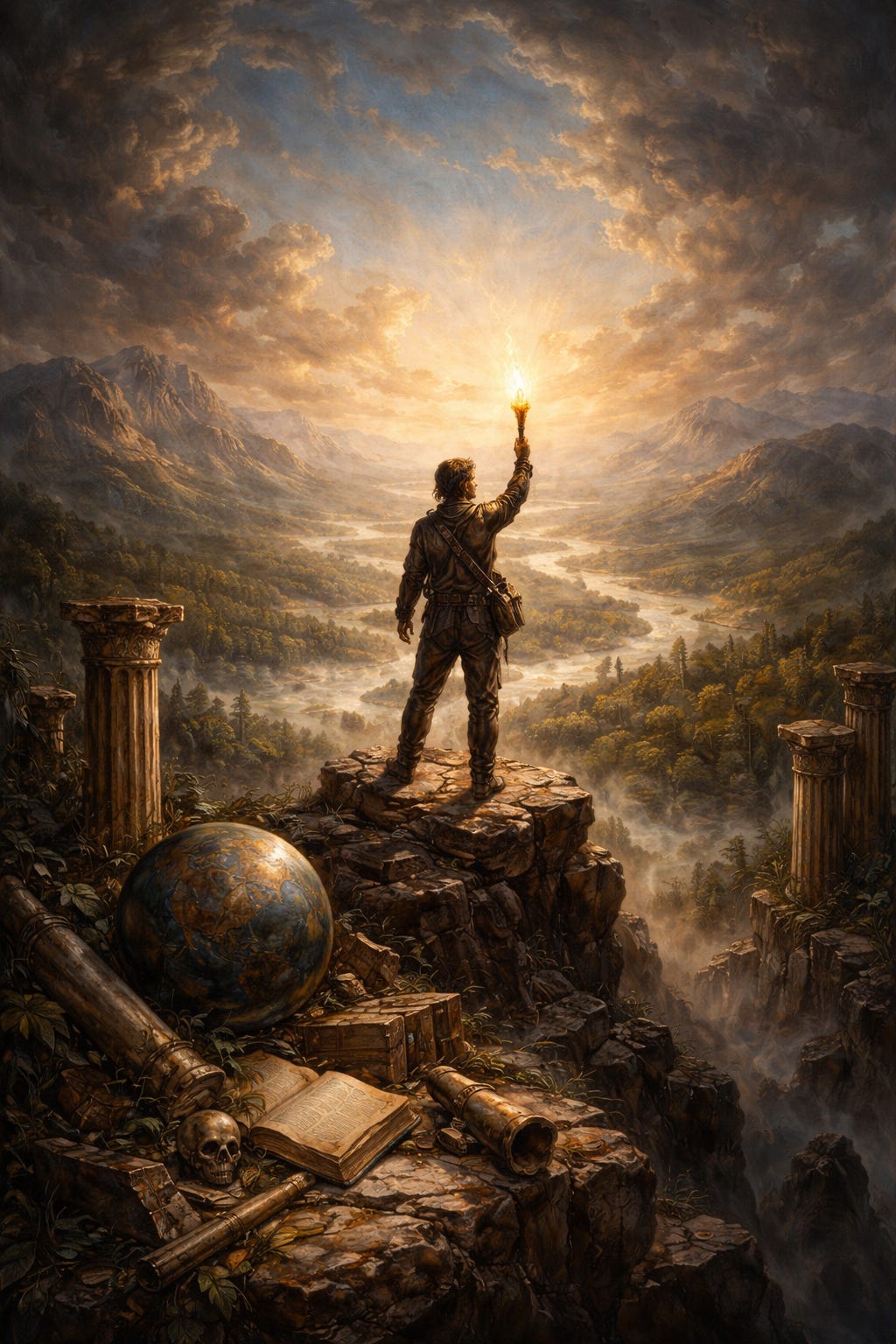
It is a comforting lie, because it drains the horror out of finality. It turns the disappearance of the only symbolic mind we know into a temporary inconvenience, like a failed harvest that will come right next season. It allows a person to flirt with misanthropy while keeping a clean conscience: you can despise mankind, fantasise about a quieter world, and still tell yourself that the story continues, that there will be another audience, another author, another inheritor. It is the environmentalist version of an afterlife. Not heaven, but “the Earth will be fine”.
The attraction is not scientific. It is psychological. The thought that consciousness could blink out—irretrievably, without successor—is intolerable to people who have built their identity around moral judgement of the species. If there is no replacement, then the cheap posture of “we’re the problem” turns into something obscene: the celebration of permanent darkness. So the mind reaches for a consolation. It says: don’t worry, evolution is aiming at intelligence. Don’t worry, the planet wants minds. Don’t worry, the universe will roll the dice again and it will come up the same. This is not an argument. It is a sedative.
But sedatives do not change reality. The fact that something happened once does not make it a destination. “Possible” is not “probable”, and history is not a warranty. A single occurrence is evidence of contingency as much as it is evidence of capability. Lightning struck a particular tree; that does not mean lightning is trying to strike that tree, or that it will do so again because it already did.
Evolution is not a ladder climbing toward civilisation. It is a blind filter, operating locally, without foresight, without intent, without any sense of what might be “worth” producing. It does not preserve what is precious. It preserves what reproduces, here and now, under immediate conditions. Symbolic intelligence—real symbolic reasoning, the kind that builds mathematics, archives, moral systems, and machines—may be the rarest accident this planet has ever produced. One lineage, once, late, and with no guarantee of repetition.
So the thesis is simple and unsentimental. If humans go, there is no reason to assume anything like us will ever reappear. To insist otherwise is not optimism. It is denial wearing the costume of inevitability.
What “Intelligence” Means Here: Symbolic Reasoning, Not Cleverness
When people say “intelligence will come back”, they almost always mean something vague: cleverness, problem-solving, social cooperation, tool use, perhaps the ability to recognise oneself in a mirror or to learn a trick. That is not what is being discussed here. The relevant phenomenon—the one that matters for civilisation, for memory, for the continuation of knowledge—is symbolic reasoning. And symbolic reasoning is not “more animal intelligence”. It is a different kind of thing.
Symbolic representation is the ability to let one thing stand for another in a stable, conventional way and to manipulate those representations according to rules. A word is not the object it names; it is a token that points beyond itself. A numeral is not a pile of stones; it is an abstract quantity that can be operated on regardless of what is being counted. A legal term is not a physical item; it is a norm that can bind behaviour across time and across people who have never met. Symbolic minds can create maps, equations, contracts, musical notation, diagrams, proofs, and stories that refer to events that did not happen, could happen, or must not happen. The symbol is separable from the immediate world, and that separability is everything.
Abstraction is what makes symbols powerful. It is the capacity to form concepts that gather many particulars under a single general rule—“ownership”, “cause”, “number”, “duty”, “force”, “probability”—and to reason about those concepts without needing to see the specific objects in front of you. Counterfactual reasoning follows: the ability to ask “what if” in a genuine, structured way. What if I do X instead of Y? What if it rains next month? What if a rival attacks from the north? What if I change this design? Counterfactuals allow planning, foresight, and deliberate invention rather than mere reaction.
Recursion is the mind’s capacity to embed representations inside representations: a thought about a thought; an intention about an intention; a rule about rules. It is how you get complex grammar, nested arguments, proofs, and institutions. It is how you can design a system that anticipates its own failure modes and corrects itself. Normativity is the next leap: symbolic intelligence does not just describe the world, it generates “oughts”. It can create binding standards—promises, obligations, prohibitions, rights—and hold itself and others to them. No predator hunts with a concept of justice. No herd animal convenes to debate liability. Civilisation is made of norms that persist beyond individual lives and are enforced by shared symbolic frameworks.
Cumulative culture is the compounding effect of all of this. Knowledge ceases to be merely biological or local. It becomes external, preserved, transmissible, and improvable across generations: writing, libraries, engineering practice, scientific method, recorded history. A symbolic species does not start over each generation. It stacks achievements. It builds a staircase out of memory.
Animals can be clever. Some solve puzzles. Some use simple tools. Some display impressive social coordination. Some learn by imitation, and a few species show rudimentary cultural transmission—local behaviours passed through groups. That is real, and it is fascinating. But it is not civilisation. It does not generate open-ended symbolic systems capable of mathematics, law, large-scale engineering, or cumulative scientific knowledge. Animal problem-solving is typically bounded by immediate contexts and concrete cues. Social learning spreads behaviours, not abstract theories. Tool use appears, but it does not become an ever-accelerating technological tradition that redesigns its own tools through formal models, stored blueprints, and planned experimentation.
This distinction matters because the claim being challenged is not “life will continue”. Life will continue in some form until it can’t. The claim is that something like civilisation will inevitably reappear. That requires symbolic intelligence, because civilisation is not a heap of clever tricks. It is an institutional, technological, and moral architecture built from symbols—language, numbers, rules, records, and plans. Without symbolic reasoning you do not get science, law, or long-term coordination at scale. You do not get preservation of knowledge beyond genes. You do not get the capacity to understand the planet’s dynamics, mitigate catastrophic risks, or carry life beyond one fragile world.
Cognition alone can survive. Symbolic intelligence can build a future. Only the latter is relevant to the question of whether the light comes back on after it goes out.
Evolution Has No Destination
Evolution is not a project with an end point. It is not a mind working towards a goal. It is a process that has one crude test and no foresight: what survives long enough to reproduce, in a particular environment, at a particular time. That is selection in plain terms. Traits that help an organism leave more descendants tend to spread; traits that hinder it tend to disappear. That is all. There is no committee awarding points for elegance, complexity, consciousness, or moral worth. There is only differential reproduction under local conditions.
“Local fitness” is the crucial phrase people ignore. A trait can be “fit” in one niche and useless or deadly in another. It can be fit today and a liability tomorrow when the climate shifts, a predator arrives, a pathogen evolves, or the food supply changes. Selection does not optimise for long-term outcomes; it selects what works now. That is why evolution produces astonishing specialisation, redundant dead ends, and countless lineages that thrive for millions of years without ever moving in the direction humans romantically call “higher”.
Then there is contingency: the path taken depends on accidents. Mutations arise without regard to usefulness. Genetic drift can fix traits by chance, especially in small populations. Catastrophes reset landscapes and wipe out dominant groups. Geographic isolation splits lineages. A tiny difference early on can lead to completely different futures because later possibilities depend on earlier structures. That is path dependence: once a lineage commits to a route, subsequent adaptations are constrained by what is already there. Natural selection does not design from scratch. It modifies what exists. It “tinkers” with inherited parts, often in awkward ways, because the organism cannot reboot its body plan like an engineer redesigning a machine.
This is why “progress” is a misleading frame. People see a narrative because they start at microbes and end at humans, then mistake the endpoint for the purpose. But that is hindsight bias turned into metaphysics. There is no universal march from simple to complex, from stupid to smart, from bacteria to Beethoven. There are plenty of lineages that become simpler over time because simplicity is advantageous in their niche. Parasites often shed complexity. Cave-dwellers lose eyes. Many organisms remain stable for immense spans because their environment rewards their existing form. In evolutionary terms, “progress” is not a rule. It is a story humans tell because humans like stories.
The ladder metaphor is the biggest lie in the whole business. A ladder implies a single direction, higher rungs, a summit. It flatters the human ego because it places us at the top and tells us we were always the point. Evolution does not look like a ladder. It looks like a branching tree—messy, proliferating, full of dead branches, with no single trunk leading inevitably to any particular twig. Humans are not the culmination. We are one branch among millions, produced by an unplanned history of branching and pruning.
That tree picture also exposes why “it happened once, so it will happen again” is such a weak inference. Branches don’t reappear just because one existed. The exact sequence of constraints, accidents, and local pressures that created one outcome may never recur. Even if something “similar” evolves, it will not necessarily have the same capacities, the same symbolic architecture, or the same propensity to build civilisation. Selection does not aim at symbolic reasoning. It aims at survival and reproduction in the moment.
So the sober conclusion is not complicated. Evolution has no destination. It does not owe the planet a successor. It does not promise another symbolic mind. It does not even care whether the biosphere ever produces one again. The belief in inevitability is just the old human habit of turning history into fate.
Earth as Evidence: Billions of Years, One Symbolic Lineage
If someone wants proof that symbolic intelligence is not an evolutionary “destination”, they don’t need to speculate about aliens or invent just-so stories about inevitability. They can look at the only data set that matters: Earth.
The timescales alone should kill the complacency. The planet is roughly 4.5 billion years old. Life has existed on it for a staggeringly long time—on the order of billions of years. For most of that span, life was microbial. Not because it was “trying” to become something else and failing, but because microbial life is brutally effective. It survives, it adapts, it colonises every niche it can reach, and it endures through catastrophe after catastrophe. Multicellular life arrives comparatively late, and complex animals later still. Homo—humans with symbolic reasoning, language, cumulative culture, and civilisation—appear at the very end of the story. In the scale of Earth’s history, Homo is a thin smear on the last page.
If intelligence were a reliable outcome of evolution, the timeline would look different. You would expect multiple independent origins—different lineages, at different times, converging on symbolic minds because that is where the “fitness landscape” leads. That is not what we see. What we see is a world that produced vast diversity, repeated dominance by wholly different kinds of organisms, and a single lineage that crossed into symbolic reasoning.
Consider the parade of dominant forms. For hundreds of millions of years, marine life ran the show: reefs, trilobites, cephalopods, fish radiations. Later you get forests, giant insects, and sprawling amphibian worlds. Then reptilian dominance on land—an era of forms that were not just large but astonishingly varied and ecologically sophisticated. Later mammals diversify, then primates, then hominins. Across all of that, you have predators with extraordinary sensory systems, social animals with intricate hierarchies, creatures with impressive problem-solving, navigation, and communication. If symbolic intelligence were a common attractor, something in that immense theatre of experimentation should have produced it more than once.
But it didn’t.
Dominance is not a stepping stone to symbolic reasoning. There were “powerful” species—dominant by biomass, by ecological reach, by predatory supremacy—that persisted for millions of years without producing a single symbolic mind. Nature had more time, more trials, and more variety than any human imagination can comfortably hold. And it still delivered symbolic civilisation once. Not repeatedly. Not reliably. Once.
At this point, the inevitability crowd retreats to “convergent evolution”: the idea that evolution often arrives at similar solutions because physics and constraints steer it. Eyes evolved multiple times. Wings evolved multiple times. Echolocation appears in separate lineages. So, they say, intelligence will converge too.
This is the sleight of hand. Convergent evolution exists, but it does not rescue the argument—because the things that converge are relatively local solutions to relatively local problems. Eyes are a solution to detecting light and shape. Wings are a solution to powered flight in a fluid medium. These are engineering problems imposed by physics, and the solution space is constrained. If a lineage benefits from seeing, selection can slowly sculpt light-sensitive cells into lenses. If a lineage benefits from moving through air efficiently, selection can shape structures into airfoils. There are only so many ways to do certain tasks in a world governed by the same physical laws.
Symbolic civilisation is not in that category.
Symbolic reasoning is not just a sensory adaptation. It is a systemic shift that requires a suite of traits to cohere: complex language, recursion, shared intentionality, long childhood learning, fine motor control, stable intergenerational teaching, social norms capable of binding large groups, and enough ecological surplus to support non-immediate activities like experimentation, writing, and institution-building. And even if a species had some of these, it still might never cross the threshold into cumulative culture that ratchets upward. Many animal lineages have “pieces” of cognition—communication, cooperation, tool use—yet none build libraries, formal mathematics, or technical civilisation. That should be treated as evidence, not ignored.
The key point is this: convergent evolution shows that certain functions are repeatedly favoured when they are incrementally reachable and physically constrained. Symbolic civilisation is not obviously incrementally reachable, and it is not a single function. It is an emergent package that depends on contingency, social structure, and an exceptionally narrow pathway of prerequisites. The fact that eyes recur does not mean minds recur. It means light is everywhere and seeing is useful. It tells you nothing about the likelihood of a species developing symbolic abstraction, normativity, and cumulative memory.
So Earth is not evidence for inevitability. Earth is evidence for rarity. Billions of years of life, innumerable dominant lineages, and one symbolic lineage capable of building civilisation and preserving knowledge outside the genome. That is not the signature of an evolutionary destiny. It is the signature of an accident so improbable that, once gone, it may not return at all.
The Contingency Stack: The Chain of Accidents Required
Symbolic intelligence did not arrive because evolution was “heading there”. It arrived because an improbable chain of prerequisites lined up long enough for a particular lineage to stumble across a threshold. That is the point people refuse to face: it is not one miracle, it is a stack of contingencies. Remove any layer and the outcome is not “humans, but later”. The outcome is a different world that never produces anything like us.
Start with anatomy, because romantic talk about “mind” ignores the machinery that makes mind usable. Hands matter—not merely “grasping”, but fine motor control, precision manipulation, and an arm–hand system capable of turning concepts into artefacts. Symbolic reasoning becomes civilisation only when symbols can be externalised: marks on surfaces, tools made to patterns, instruments calibrated, devices assembled, objects standardised. A brain in a body without the means to reshape the world is trapped in its skull. Many animals are clever; few can build, and almost none can build with the iterative precision needed for cumulative technology. The human hand is not an accessory. It is the interface between abstraction and reality.
Communication matters in the same way. Symbolic intelligence is not a private hobby. It is a network phenomenon. Language is the medium through which concepts become shared, norms become binding, and knowledge becomes cumulative. That requires a vocal tract capable of producing a wide range of discriminable sounds, but more importantly it requires neural control over those sounds and the cognitive architecture to map sound to abstract meaning in a compositional way. The physical capacity for speech is part of a larger system: breath control, auditory discrimination, memory for sequences, and the ability to learn and reproduce conventions reliably. Without robust communication, there is no stable transfer of complex ideas, no teaching at scale, no shared symbolic culture.
Then there is the extended childhood—often treated as a weakness when it is one of the core enabling conditions. Human symbolic capacity is not delivered fully formed at birth. It is trained into existence over years. That requires long dependency, high parental investment, and social structures that can support juveniles while they learn language, norms, tools, and the mental habits of abstraction. A species that must be fully functional within months cannot accumulate a deep symbolic culture. It has no time for it. The energy cost is too high and the payoff too delayed.
Those are anatomical and developmental prerequisites. But they are still not enough.
Now the social layer: symbolic intelligence scales only within a cooperative species that can teach, imitate, and coordinate beyond immediate kin. Teaching is not mere copying. It is deliberate shaping of another mind—pointing, correcting, modelling, explaining, and scaffolding skills so the next generation starts from a higher baseline. That is cumulative culture, and it requires trust, shared attention, and social mechanisms that reward long-term cooperation rather than collapsing into constant predation within the group.
Intergenerational transfer is the real engine. A single clever individual changes little if their knowledge dies with them. Civilisation begins when knowledge becomes an inheritance. That requires social stability, norms, and roles: elders who instruct, apprentices who learn, groups large enough to hold diverse skills, and mechanisms to preserve information—story, ritual, record, eventually writing. None of this is automatic. Many social animals cooperate, but cooperation is not the same as sustained transmission of abstract, evolving knowledge. You need a specific kind of social cognition: shared intentionality, the ability to align goals, and the willingness to bind oneself with norms that outlive immediate self-interest.
Then there is the ecological and geological setting. Humans did not evolve in a static paradise. They evolved under variability—changing climates, shifting habitats, pressure to adapt behaviourally rather than purely anatomically. Behavioural flexibility becomes valuable when the environment changes faster than bodies can easily retool. That pushes selection toward generalist strategies, toward learning, toward social coordination, toward planning. Add niches where tool use pays off—resources that can be accessed with implements, cooperation that improves survival, predators and competitors that reward intelligence—and the stage becomes more favourable. But favourable is not guaranteed. Entire worlds can remain ecologically rich yet stable enough that selection never “needs” symbolic abstraction. “Good enough” cognition wins, and it keeps winning.
Finally, the bottlenecks and survivals. It is not enough for the prerequisites to appear; the lineage must survive long enough for them to combine. Population crashes can erase rare traits. Competitors can outcompete a clever lineage before it consolidates its advantages. Disease can wipe out a population carrying the fragile beginnings of cumulative culture. Catastrophes can hit at the wrong time. And even if early hominins had the raw cognitive capacity, there is no guarantee they would build stable symbolic systems rather than plateauing at sophisticated but non-civilisational social intelligence.
This is why the “it will happen again” claim is so intellectually unserious. It imagines symbolic intelligence as a single trait you can select for, like a thicker coat in a cold climate. It is not. It is a delicate convergence of anatomy, development, social structure, ecological pressure, and sheer historical luck. That is the contingency stack.
Break a link and you do not get “humans delayed by a million years”. You get a different apex predator. You get a clever scavenger. You get a socially complex animal with impressive tricks and no books. You get a world full of life and empty of symbolic memory. And once the only known symbolic lineage is gone, there is no honest basis for pretending the stack will rebuild itself.
Why a Successor Is Unlikely, Even Given Time
The most common dodge, when confronted with how contingent symbolic intelligence is, is the lazy appeal to time. “Even if it’s rare, give evolution enough time and it will happen again.” This sounds plausible only if one quietly imagines evolution as a lottery that keeps buying tickets until it must eventually win. That is not how it works. Time is not a guarantee. It is merely a canvas on which chance and constraint can paint outcomes that may never resemble the one you are attached to.
Start with extinctions, because people treat them like a reset button that “opens space” for progress. Extinctions do reset ecosystems. They clear niches, rearrange food webs, remove dominant competitors, and allow new radiations. But they do not aim the biosphere at minds. They are not creative direction. They are destruction followed by opportunism. After a mass extinction, what spreads is what can reproduce quickly, exploit available resources, and fit the new conditions. That can favour small, resilient generalists. It can favour forms that tolerate heat, cold, drought, or low oxygen. It can favour organisms that mature fast and proliferate. None of that implies symbolic reasoning. In fact, in many reset scenarios, “fast and simple” wins. Intelligence, especially the kind that requires long childhood, social scaffolding, and high energy budgets, is exactly the sort of trait that can be punished in unstable, high-mortality environments.
Now consider stable niches—the other side of the coin. If an environment is stable enough, selection tends to conserve successful strategies. A lineage that is well-adapted to a stable niche can persist for millions of years with little pressure to radically restructure cognition. Why would it? If it eats, mates, avoids predation, and reproduces effectively, then selection has no reason to bankroll a brain that burns enormous calories and requires years of dependency. Stability favours optimisation within a niche, not the invention of an expensive general-purpose reasoning engine. And the planet has had vast stretches of relative stability in different regions and eras. Those stretches did not routinely produce symbolic minds. They produced refined specialists and durable generalists—exactly what you’d expect from a blind local filter.
This leads to the simplest, most crushing point: intelligence is expensive. A large, complex brain is a metabolic burden. It requires energy, and energy is never free. It also requires time: longer development, longer dependency, higher parental investment, and social structures capable of supporting juveniles while they learn. These are all costs that must be paid up front. Selection does not pay for what might be useful in a hypothetical future. It pays for what increases reproductive success now. That means selection will generally favour “good enough” solutions—instinctual behaviours, simple learning, pattern recognition, opportunistic social strategies—because they provide most of the benefit for a fraction of the cost.
That is why animal cognition is widespread but bounded. You can get cleverness where it helps—corvids, cetaceans, primates, some cephalopods—yet even these lineages do not reliably cross into symbolic civilisation. If intelligence were such a dominant advantage, it would be common. It would spread like wildfire. But it doesn’t, because “advantage” is conditional. In many niches, the optimal strategy is not to think harder; it is to breed faster, hide better, digest more efficiently, resist disease, migrate, or specialise.
So even given time, a successor is unlikely for the same reason a lightning strike is unlikely to reproduce the exact same pattern in the exact same place. Extinctions do not steer the biosphere toward minds; they simply reshuffle the deck. Stable niches do not demand symbolic reasoning; they reward persistence. And the costs of symbolic intelligence are so high that selection will happily settle for competent, non-symbolic cognition across vast timescales.
Time is not a promise. It is just more opportunities for the world to become something else entirely—and to remain that way until the window closes.
Astrobiology Implication: Life ≠ Mind
The astrobiology implication is the one people dance around because it ruins the comforting story. Life is one question. Mind is another. And the evidence we actually possess—one planet, one biosphere, one history—suggests they are not tightly coupled.
Here is the inference, stated plainly. If symbolic intelligence were easy—if it were a routine evolutionary endpoint—then it would be common on Earth. Not universal, not everywhere, but common in the sense that it would have emerged multiple times in multiple lineages across deep time. Earth has had billions of years, countless ecological experiments, and repeated global resets. If minds were a natural attractor, you would expect convergent arrivals: several independent lineages developing symbolic reasoning, cumulative culture, technical traditions, perhaps competing civilisations long before our own. That did not happen. The record we have is one symbolic lineage, once, late. That alone should make anyone cautious about calling intelligence “inevitable”.
Now widen the lens to the cosmos. The Milky Way contains an enormous number of stars, and a non-trivial fraction likely have planets. Even if you grant that life itself might be rare, if symbolic intelligence were easy once life exists, then the universe should not look quiet. It should look noisy. There should be artefacts: strong signals, obvious engineering signatures, detectable industrial by-products, large-scale astroengineering, or at least persistent, unmistakable beacons. Instead, we look out and see… nothing unambiguous. That does not prove we are alone. It does not prove there are no other minds. It proves only that we do not have evidence. But it does create a tension: a universe that should be bustling if intelligence were common appears, at least so far, indifferent and silent.
This is where people invoke the “Fermi paradox” in the pub-philosophy sense: if intelligent life is common, where is everybody? There are many possible answers, and it’s important not to overclaim. Maybe we’re looking the wrong way, at the wrong frequencies, for the wrong kind of signal. Maybe civilisations don’t broadcast. Maybe they are short-lived. Maybe they choose not to expand. Maybe the distance and timing don’t line up. Maybe they’re out there and we’ve simply not noticed yet. Fine. But you don’t get to ignore the simplest possibility because it feels bleak.
The “Great Filter” idea is a disciplined way of naming that possibility without pretending we know where it sits. Somewhere between dead chemistry and a galaxy-spanning civilisation, there may be steps that are brutally hard—rare transitions that almost never occur. Life might be one. Complex multicellular life might be one. Symbolic intelligence might be one. Technological civilisation might be one. Survival long enough to become visible might be one. The exact placement is unknown. The point is not to declare certainty; the point is to recognise that the silence is not inconsistent with a universe full of microbes and nearly empty of minds.
And that is the key. The absence of obvious cosmic chatter fits very neatly with the claim that symbolic intelligence is extraordinarily rare. Not just “uncommon”, but rare in the way a specific improbable cascade is rare. A planet can teem with life and still never produce a mind that builds radio telescopes or writes mathematics. Earth itself almost did exactly that, for billions of years.
So when someone breezily says, “Don’t worry, if humans disappear, intelligence will just come back,” they are not being scientific. They are reciting a comforting myth. The silence above our heads is not proof—but it is a warning. Life may persist easily. Mind may not.
Conclusion: Stewardship Is Not Arrogance
If this argument has a moral centre, it is not “humans are perfect”. It is not “everything we do is justified”. It is something far simpler and far more demanding: stewardship is not arrogance, and the refusal of stewardship is not humility.
As far as we know, humans are the only custodians of cumulative memory on this planet. We are the only beings that can preserve knowledge outside the genome and carry it forward deliberately—through writing, records, institutions, and science. We are the only beings that can look at the biosphere, understand it as a system, measure harms, predict risks, and act intentionally to mitigate them. We are also, as far as we know, the only beings capable of taking life beyond Earth at all—of making it resilient against the simple fact that planets are fragile and the universe is indifferent.
That is not self-flattery. It is a statement about function. If you erase the only known mechanism that can remember and build, you do not liberate nature into some higher harmony. You remove the only agent capable of preventing needless loss. You remove the only mind that can choose conservation over waste, cure over neglect, rescue over fatalism. Celebrating that removal—treating humanity as disposable, fantasising about our disappearance as a moral good—is not virtue. It is nihilism with a soft voice. It is the worship of silence.
The practical ethic that follows is not complicated, and it does not require grand slogans. Protect and develop intelligence. Protect it biologically—health, education, cognitive development, and the conditions that allow children to become capable adults. Protect it socially—institutions that preserve knowledge, reward truth, and allow criticism, correction, and progress. Protect it materially—energy, infrastructure, and security sufficient to keep civilisation stable enough for cumulative culture to persist. And protect it morally—by rejecting the cheap posture that treats contempt for humanity as sophistication.
None of this implies licence to destroy. Stewardship is not an excuse for carelessness; it is the opposite. It means measuring what is harmed, accounting for what is lost, and making trade-offs openly rather than hiding behind sacralised language about a “living planet” or romantic fantasies about a world “better off” without minds. It means keeping species alive because we can, reducing suffering because we understand it, and preserving ecosystems because they are part of the only biosphere we have.
If symbolic intelligence is as rare as the evidence suggests, then it is not merely another animal trait. It is the hinge on which the future turns. To protect and develop it is the only known path to preserving life, reducing suffering, and extending the horizon of what can exist. Everything else is just posturing in the dark, pretending the dark is holy.