
Tolerance, Meaning, and the Limits of Forbearance
Why “tolerance” is not approval, not indifference, and sometimes rationally must end

Abstract
Tolerance is routinely invoked as a moral virtue, yet public argument collapses it into approval, indifference, or coerced endorsement. This essay argues that toleration is a structured posture: reason-governed forbearance under objection, where interference is genuinely possible. Treating meaning as use exposes how “tolerance” drifts under political pressure, with definitional capture deleting the objection condition and dissolving the very paradoxes tolerance is meant to address. A minimal schema is defended: objection, power (ability to interfere), intentional non-interference, and reasons that distinguish principled restraint from whimsical neglect. On that basis, the paradox of tolerance is separated into a logical self-refutation problem and a practical vulnerability problem for institutions facing bad faith and asymmetric burdens. The essay then explains why tolerance fails semantically, epistemically, and institutionally, and why collective toleration policies can be unstable once preferences are other-regarding. Finally, it defends principled non-toleration as a consequence of the same reason-governed structure: when defeaters such as harm, coercion, rights-violation, or domination obtain, restraint ceases to be a virtue and becomes complicity. Tolerance is thus a limited but indispensable stability device, justified by reasons and bounded by conditions that preserve a framework of reciprocal liberty.
Keywords
toleration; tolerance; forbearance; objection; power; reasons; meaning-as-use; Wittgenstein; semantic drift; reciprocity; harm; principled intolerance; institutional stability; collective rationality
Thesis
Toleration is not approval, indifference, or compelled recognition; it is reason-governed forbearance under objection and power, and it is rationally limited by defeaters and stability constraints that sometimes make principled non-toleration required.
1. The problem: a virtue that collapses under its own misuse
Tolerance is praised as if it were a single, simple virtue: the civilised capacity to “let others be”. That slogan is precisely the trouble. It replaces an intellectually disciplined concept with a moral ornament. Once tolerance is treated as mere permissiveness, disagreement becomes a scandal and coercion becomes the cure. The word is then deployed as a weapon: one party demands tolerance as obedience, another rejects tolerance as weakness, and both talk past the structure that makes toleration what it is.
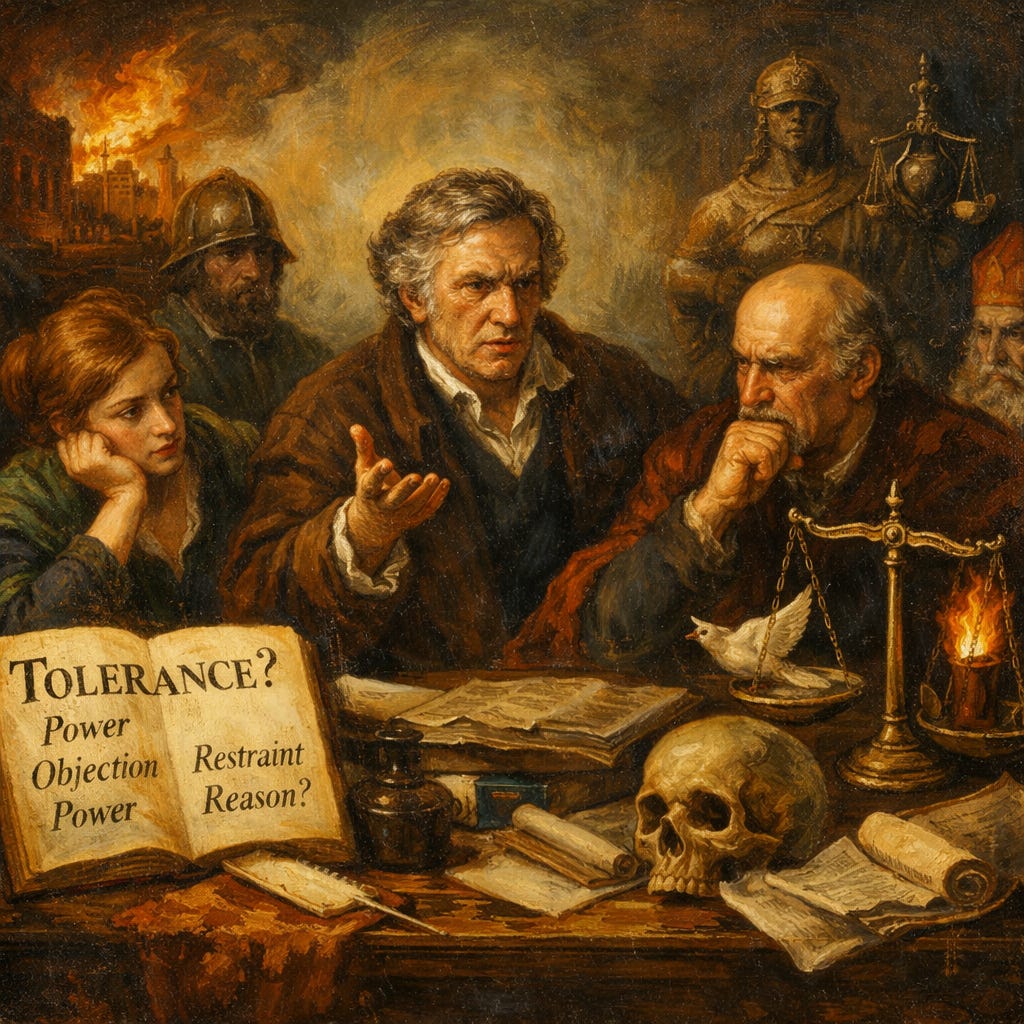
The central claim of this essay is that toleration is not a sentiment and not a form of endorsement. It is a structured posture: principled forbearance in the presence of objection, under conditions where interference is genuinely possible. Strip out any one of those elements—objection, power, forbearance, reasons—and the posture changes its type. It becomes approval, indifference, impotence, accident, or neglect. Those substitutions are not innocent. They generate the confusions that make tolerance “fail” in public life: semantic drift, manufactured paradoxes, and institutional vulnerability.
The second claim is sharper: toleration is not self-applying. You do not get a stable moral or political order by “tolerating everything”. If a society tries to treat tolerance as a universal solvent, it dissolves the very framework that makes toleration meaningful. In that sense, principled intolerance is not an embarrassment to toleration. It is part of what keeps toleration intelligible.
2. Meaning as use: why philosophers keep getting “tolerance” wrong
The temptation is to ask for the essence of toleration, as if a single definition could settle every dispute. That is not how important moral terms behave. The word “tolerance” does not function like a natural kind term. It operates across contexts: family life, religious conflict, speech disputes, professional associations, state power. Each context carries different stakes and different background norms. Demanding “one word, one theory” forces a false uniformity, and then the uniformity is treated as moral necessity.
A Wittgensteinian diagnostic helps here. Meaning is not a hidden object behind the word. Meaning is use: the role a word plays in practices of justification, criticism, permission, blame, and institutional decision. When tolerance-talk becomes confused, it is rarely because a definition is missing. It is because the word is being used to do different jobs at once—sometimes to describe a virtue, sometimes to impose compliance, sometimes to signal social membership, sometimes to purchase moral innocence.
Kripke’s presentation of rule-following intensifies the point. Rules do not interpret themselves. The application of a term depends upon shared standards of use. When those standards are destabilised—through propaganda, moral theatre, or strategic re-labelling—the term becomes a lever for shifting burdens. “Tolerance” becomes a floating signifier: whatever the powerful demand, the weak must provide. That is not merely rhetorical abuse. It is semantic failure. The word stops marking a norm-governed practice and starts functioning as a badge.
The result is a distinctive kind of moral corruption. Instead of arguing about what ought to be tolerated and why, people argue by definitional capture: “If you do not endorse this, you are intolerant.” The concept is thereby rewritten so that toleration requires agreement. But toleration without objection is not toleration. It is approval.
3. A minimal schema: what must be true for toleration to occur
Toleration begins where disapproval begins. If there is no objection, the language of toleration is misplaced. One does not tolerate what one celebrates; one does not “tolerate” one’s own commitments. Toleration is always asymmetrical in this way: it presupposes that the tolerator judges the tolerated act, practice, or belief to be in some respect wrong, bad, misguided, or objectionable.
But objection alone is not enough. There must also be power. The tolerator must be able to interfere—whether through law, institutional rule, social sanction, exclusion, coercion, or some other means of control. If interference is not possible, “tolerance” becomes a sentimental misdescription of impotence. A prisoner does not “tolerate” the cell. A bystander without standing does not “tolerate” what he cannot affect.
Third, there must be forbearance: intentional non-interference. Not merely the absence of action, but the decision not to use available power. Toleration is restraint. It is the exercise of agency in a negative mode: choosing not to do what one could do.
Fourth, and most commonly omitted, there must be reasons. Without a justificatory structure, non-interference could be laziness, distraction, cynicism, or indifference. Reasons distinguish principled toleration from whimsical neglect. A Scanlonian constraint belongs here: the relevant reasons must be reasons that can be offered as justifications—reasons that aspire to be more than private taste. Toleration, at its best, is not mere endurance. It is restraint for a reason that can be defended.
This schema has a consequence that many moralists resist. Toleration is not automatically virtuous. It can be admirable, but it can also be cowardly, complicit, or corrupt. Whether toleration is appropriate depends on the reasons and on the defeats those reasons may suffer.
4. The paradox of tolerance: logical and practical forms
The so-called paradox of tolerance is often treated as one argument. It is at least two.
The logical paradox is a self-refutation problem. If tolerance is defined as unconditional acceptance of all positions and practices, then it must include acceptance of intolerance. But accepting intolerance can destroy the conditions that make tolerance possible. Absolute tolerance defeats itself. The paradox is not that tolerance is inconsistent as such, but that a certain moralised definition of “absolute tolerance” cannot be stably maintained.
The practical paradox is strategic. Even if one avoids definitional absolutism, tolerant institutions face exploitation. Bad-faith actors can use a tolerant framework to weaken it: demanding procedural protections while intending to abolish them; invoking free speech as a method for organised intimidation; weaponising “pluralism” to entrench domination. Here the question is not logical consistency but institutional survival under asymmetric burdens.
The contemporary literature on the circumstances of toleration matters precisely because toleration is demanded most urgently where it is most difficult: deep disagreement, cultural conflict, moral disgust, incompatible conceptions of life, and contested authority. Toleration is called for when objection is real and power is present. That is why it is both valuable and unstable. It is not a warm feeling; it is a political and moral posture under strain.
5. Why tolerance fails in practice: semantic, epistemic, institutional breakdown
Tolerance fails semantically when its boundary conditions are manipulated. The most common manipulation is to collapse toleration into recognition or respect in the sense of endorsement. Once recognition is treated as an obligation to affirm, the objection condition is erased. The term then ceases to describe restraint under disagreement and becomes a demand for agreement. That move “solves” the paradox of tolerance by definition: if toleration means approval, there is nothing left to tolerate. The concept has been replaced.
Tolerance fails epistemically when the evidence burdens are asymmetric. Manufactured doubt, selective outrage, and strategic ambiguity can make it impossible for a public to distinguish tolerable disagreement from organised sabotage. A Condorcet-style insight is relevant: collective competence depends on independent, truth-tracking judgments. When information channels are captured and incentives reward conformity or panic, the conditions for reliable collective discrimination collapse. Under those conditions, tolerance becomes either paralysed or indiscriminate—both of which invite exploitation.
Tolerance fails institutionally when enforcement is weak or captured. Laws, policies, and norms cannot survive on abstract virtue alone. They require procedures, sanctions, and credible commitments. A tolerant institution that cannot distinguish dissent from subversion, or disagreement from coercion, will be pushed into either selective repression or impotent permissiveness. In both cases it loses legitimacy.
Tolerance fails at the boundary of reciprocity. Toleration is not owed to those who treat it as a one-way duty. A stable toleration regime presupposes something like good faith: willingness to accept the rules of the shared framework, willingness to offer reasons, willingness to be constrained by the same limits one demands of others. When reciprocity collapses, tolerance becomes a mechanism for domination.
6. The deeper problem: collective incoherence
Even if individuals can be tolerant, collective toleration policies can become incoherent. This is not a moral accusation; it is a structural fact about aggregation. If individuals have rights or protected spheres concerning what they will permit or forbid, those local liberties can clash with the preferences of others. Once preferences are other-regarding—once people care about what others are allowed to do—the combination of minimal liberty and Pareto-style rationality constraints can generate cycles. The collective “policy ranking” becomes unstable: it cannot consistently select among competing regimes without violating either someone’s protected sphere or some minimal rationality condition.
The lesson is not that liberty or toleration is impossible. The lesson is that toleration is not a free lunch. The moment it becomes an institutional policy rather than a private virtue, it must face constraints that keep collective choice coherent. A society that refuses to specify such constraints ends up enforcing them implicitly through power and panic.
7. Principled intolerance: when restraint must end
If toleration is reason-governed forbearance, then it is defeasible. Reasons can be defeated. Harm is the obvious defeater, but not the only one. Coercion, rights-violation, domination, and systematic sabotage are not merely “views we dislike”. They attack the conditions of agency and reciprocity that make toleration intelligible.
The crucial distinction is between repression and principled non-toleration. Repression is arbitrary power against disfavoured persons or viewpoints. Principled non-toleration is constraint justified by publicly defensible reasons that preserve a framework of liberty. The difference is not rhetorical; it is structural. If toleration presupposes power and restraint, then non-toleration is sometimes the rational requirement of the same framework—because restraint that preserves sabotage is not virtue but self-destruction.
A workable way to make this explicit is to give lexical priority to the preservation of the system of liberty. Not everything is traded off against everything else. If a policy undermines the background conditions of equal agency and reciprocal constraint, it cannot be justified by appealing to tolerance. Tolerance is a limited virtue. It operates inside a framework; it cannot be invoked to dissolve the framework.
8. Conclusion: tolerance as a limited virtue and a stability device
Tolerance matters because power is real and disagreement is durable. It is a discipline imposed on power by reasons, not a demand for moral approval. It is a way of living with objection without converting objection into coercion. But the concept is fragile. It fails when it is redefined as endorsement, when epistemic conditions collapse, when institutions are captured, and when reciprocity is treated as optional.
A mature theory of toleration does not promise that everything can be tolerated. It promises something harder and more valuable: that restraint can be principled, that disagreement need not become domination, and that the limits of tolerance can be justified without semantic tricks. In that sense, toleration is not a blanket permission. It is a stability device—one that works only when its structure is respected and when its defeaters are named.
The reality is that "toleration" is primarily a tool of institutional subversion used by the Left; of course, once control is achieved then intoleration becomes the norm. I suspect the only practical solution that could be accepted by both Left and Right is through extreme localism (allowing different types of toleration for different states and municipalities).