
What Is Truth?
On why the flattest theory of truth is the only one with teeth — and why "my truth" is the great modern obscenity

Keywords: truth; correspondence theory; coherence theory; pragmatism; deflationism; disquotation; relativism; objectivity; “my truth”
Everyone has the truth. That is the first thing to notice, and the most damning. The fanatic has it, the salesman has it, the man shouting on the corner has it, and each of them has a different one, held with a conviction that rises as the evidence falls. Truth is the word we reach for when we want an argument to be over — because it’s true — and it is precisely because the word can end arguments that it is used, most of the time, by people who would lose them.
So it is worth asking, coldly and without reverence, what the word actually names. Not which claims are true — that is the endless work of every particular inquiry — but what it is for a claim to be true at all. The answer, when you finally get it, is smaller than you expected and harder than you feared. Truth turns out to be the flattest thing in the language. And the flat truth, it happens, is the only kind with teeth.
Truth is not proof, and the confusion is fatal
Clear one thing away first, because most bad thinking about truth is really a confusion of truth with proof.
Truth is a property a claim has, or lacks, quietly, whether or not anyone ever checks. Proof is something you deliver to somebody — evidence marshalled to a standard, an argument that discharges a burden. The two come apart in both directions, and the gap between them is where honesty lives.
There are truths no one has proven and perhaps no one ever will. The murderer who left no trace still did it; the crime is a fact with no verdict. The number of grains of sand on a particular beach at noon on some forgotten Tuesday is a definite number, true, unproven, unprovable, and utterly indifferent to our ignorance. And there are proofs — good ones, to high standards — of things that are false: the wrongful conviction proven beyond reasonable doubt, the elegant argument from a premise that turns out to be wrong. Proof is our best instrument for tracking truth. It is not truth. Confuse them and you will believe that whatever you cannot prove is not true, which is the coward’s route to denying anything inconvenient, or that whatever you have proven to your own satisfaction must be true, which is the fanatic’s route to everything else.
Truth is what is the case. Proof is showing it. Keep them apart or drown. This essay is about the first.
The steelman: truth as correspondence
Now the strongest and oldest answer, made as strong as it can be made, because a theory of truth that only beats the weak accounts has proven nothing.
Aristotle put it once and for all: to say of what is that it is, and of what is not that it is not, is true. Truth is the matching of a claim to the world. “Snow is white” is true because, out there, independent of you and your saying so, snow is in fact white. The claim points at reality; when reality is as the claim says, the claim is true; when it is not, false. This is the correspondence theory, and its great virtue is that it says the thing everyone already means. When you call a statement true, you are not congratulating the speaker on his sincerity or his social standing. You are saying: and so it is. You are pointing past the words to the world.
Notice how much this account gets right, because it gets the important things right. It makes truth about the world rather than about us — my believing snow is black does not blacken it, and a unanimous vote would not either. It makes truth objective: the claim answers to something outside the claimant. It makes falsehood possible and error real, which any theory worth having must, because a theory on which you cannot be wrong is not a theory of truth but a theory of vanity. Correspondence honours the plain, stubborn, magnificent fact that reality does not take instruction from our opinion of it. This is the intuition to beat. I have no interest in beating it. I have an interest in seeing what, exactly, it commits you to — because the moment you ask correspondence to do real philosophical work, it asks you for something you cannot give.
The comparison it can never make
Here is the question that has haunted the correspondence theory for two centuries, and it is a simple one. To know that a claim corresponds to the world, you would have to compare the two — hold the claim up against reality and see whether they match. Very well: perform the comparison. Set your belief that snow is white beside the world itself, the naked world, the world as it is prior to any description, and check the fit.
You cannot do it. You never could. Every time you turn to “the world” to check your claim against it, what you actually consult is another claim — your perception, which is already an interpretation; your measurement, which is already theory-laden; your memory, your instrument, your report. You compare belief to belief, description to description, all the way out. You never once get to lay a sentence against the unvarnished world and inspect the seam between them, because to grasp the world at all is already to have described it. The one relation the theory rests its whole account on — the correspondence itself, the match between word and world — is the one relation you can never step outside your beliefs to observe. Nothing counts as a reason for a belief except another belief. The world does not hand you a caption.
This does not make correspondence false. It makes it idle at the exact point it was supposed to do its work. As a picture — the mind aimed at a world it did not make — it is unimprovable, and I hold it as firmly as anyone. As a theory of what truth consists in, a substantive relation you could examine and thereby certify a claim true, it is hostage to a link between language and world that no one has ever managed to lay bare. You are left with two options and no third. Either “correspondence” names a real, inspectable, word-to-world relation — in which case you owe an account of that relation that two thousand years have not produced — or it names nothing you can use, a gesture at the world that adds no working part to the plain claim it decorates. The theory that says the truest thing about truth cannot cash the cheque it writes.
The rivals overreach, or they sell truth for a mess of agreement
If correspondence cannot be inspected, the temptation is to define truth by something you can inspect — coherence, or usefulness, or consensus. Every one of these is a downgrade dressed as a discovery, and each fails in a way worth naming precisely, because these are the fashionable errors of the age.
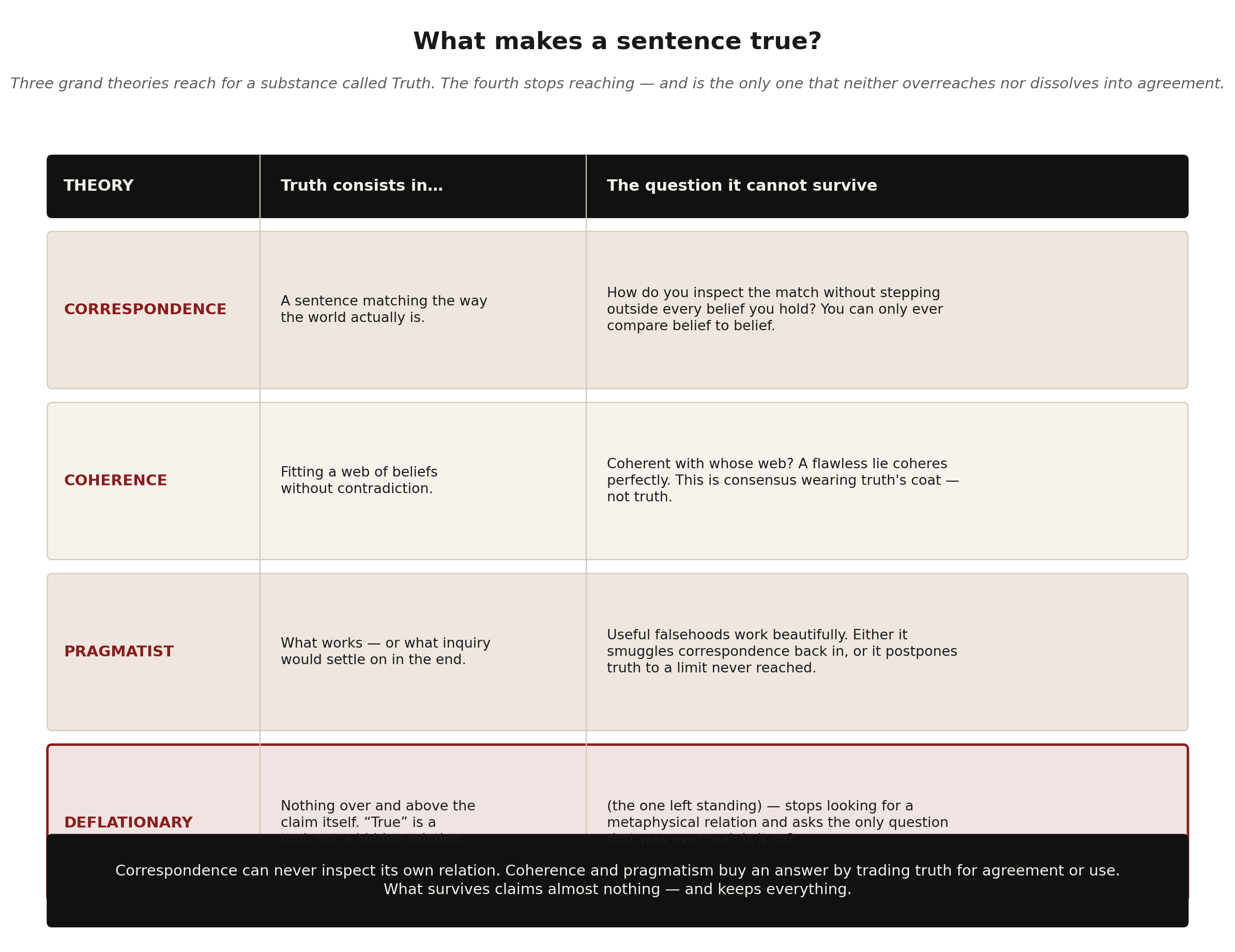
Coherence says a claim is true when it fits, without contradiction, into a web of other beliefs. This has the charm of being checkable — you can see whether beliefs hang together — and it captures something real about how we test claims: the wildly discordant report is rightly distrusted. But as a theory of truth it is a catastrophe, and the catastrophe has one word: whose web? A well-built lie coheres perfectly. A paranoid delusion is a marvel of internal consistency — that is what makes it a delusion rather than a mere mistake. A fairy tale contradicts nothing inside itself. If truth is coherence, then any sufficiently disciplined fiction is true, and two incompatible but internally seamless systems are both true, which means neither is, which means the word has died in your hands. Coherence with a web is not truth. It is consistency, and consistency is cheap; the madhouse is full of it.
Pragmatism, in its crude and popular form, says the true is what works — what pays its way in experience, what gets you where you are going. And here the objection is a single, fatal observation: falsehoods work. The flat-earth model is perfectly adequate for laying a patio. The comforting lie soothes better than the wounding fact. The noble myth pacifies the city more reliably than the truth would. If truth is utility, then the useful falsehood is true and the useless truth is false, and you have redefined the word to mean convenient, which is the thing truth most often is not. The sophisticated pragmatist knows this and retreats — truth is not what works today but what inquiry would settle on at the end, in the ideal limit, when all the evidence is in. It is a nobler idea, and it either postpones truth to a limit no inquiry ever reaches, so that no present claim is ever actually true, or it quietly smuggles correspondence back in, because “what inquiry would settle on” is a stand-in for “what the world will turn out to have been.” Either way it does not escape the problem. It relocates it and hopes you won’t follow.
And beneath both lies the seduction that has swallowed a generation: truth as consensus. The true is what we agree on. This is coherence and pragmatism wearing their most dangerous mask, and it is the demagogue’s dearest doctrine, because a truth made of agreement is a truth he can manufacture. It has the added charm of feeling humble and democratic. It is neither. The whole town agreed there were witches, and burned women on the strength of the consensus. Every scientific revolution is a minority report filed against the agreement of the competent. Consensus is sometimes evidence of truth — when it is the hard-won convergence of independent inquirers who tried to prove each other wrong and failed — and it is sometimes evidence of nothing but a shared interest in not looking. To make agreement the definition of truth is to hand the word to whoever controls the room. It is the surrender dressed as a virtue.
The flat theory, and why it is the last one standing
So where does that leave us? It leaves us with the account nobody finds impressive, which is the surest sign it is right. Call it deflation, or the disquotational view, or minimalism — the tradition that runs from Ramsey through Quine to its modern forms — and its central claim is a deliberate anticlimax.
To say “it is true that snow is white” is to say exactly as much as “snow is white.” No more. The truth predicate adds no fact, describes no relation, names no substance. It is not a property snow’s whiteness has on top of being the case. “It is true that p” and “p” are, for anyone who understands them, the same move. Truth, on this view, is not a deep feature of reality that the theories were competing to describe. There was never a hidden relation for them to fight over. That is why the fight was interminable: the parties were disputing the nature of a thing that has no nature.
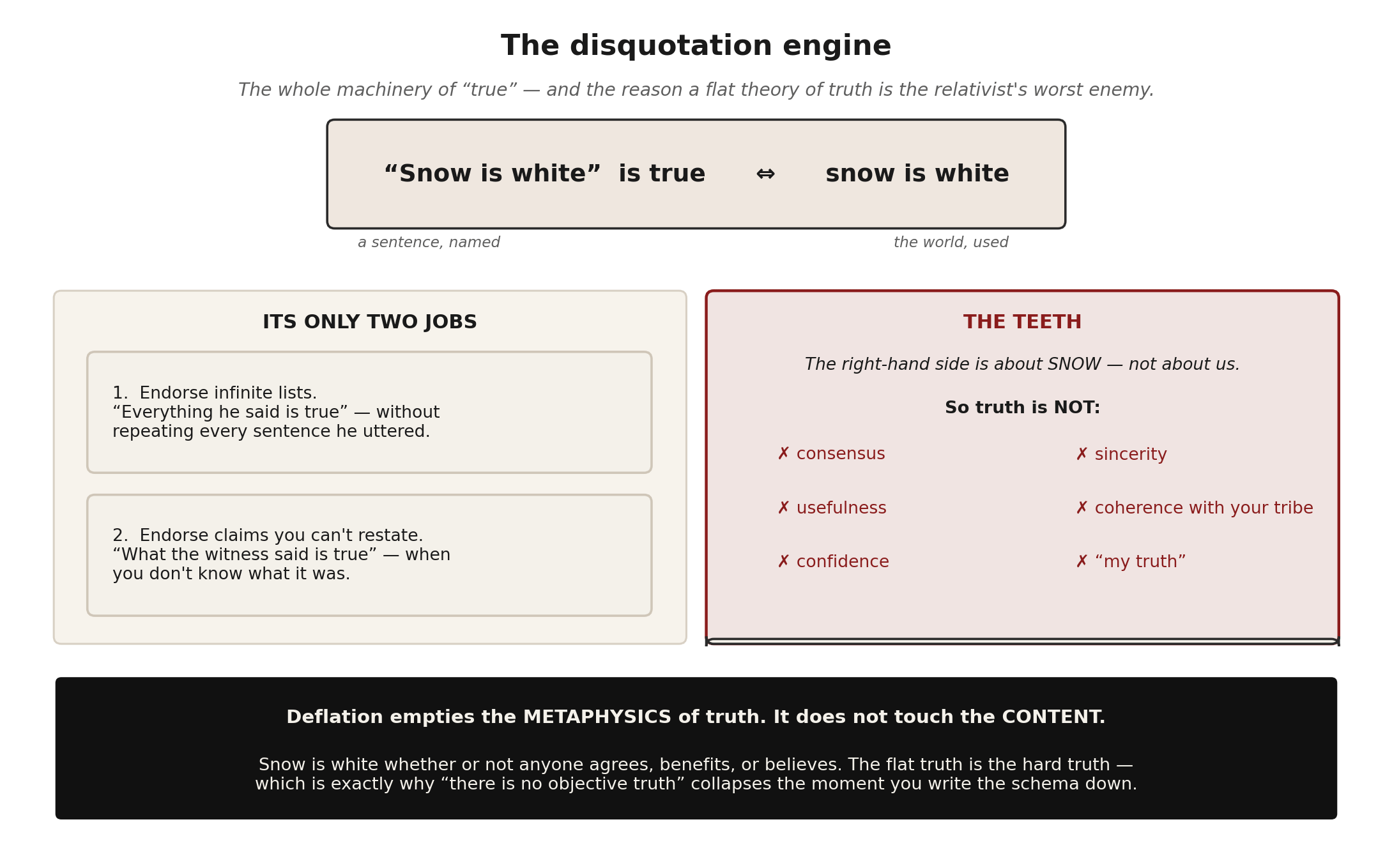
At which point the reasonable reader objects: if “true” adds nothing, why do we have the word at all? Because it does one job that nothing else can do, and the job is not description but generalisation. Consider two sentences you cannot say without it. First: “Everything he testified is true.” You want to endorse every claim the man made, but you were not there, you cannot list them, and even if you could the list might be endless. The word “true” lets you endorse the whole lot in four syllables — it is a device for agreeing with claims you cannot be bothered, or are unable, to repeat. Second: “Whatever the oracle says will be true.” You want to commit yourself in advance to sentences you have not yet heard and may never be able to state. Only the truth predicate lets you reach out and endorse a claim by pointing at it rather than by reproducing it. That is the whole function of the word: it is a hook for grabbing claims by their collar when you cannot or will not restate them. It is a tool of logic, not a name for a metaphysical glue.
This is why the flat theory is not the poor relation of the grand ones. It is what is left when you stop asking the word to be something it never was. It does not fail the comparison test, because it attempts no comparison. It does not collapse into consensus or utility, because it defines truth by neither. It claims almost nothing — and by claiming almost nothing, it keeps the one thing that matters.
The teeth: why deflation is the relativist’s worst enemy
Here is the move that everyone gets backwards, so I will say it slowly, because it is the whole point of the essay.
People assume that a deflationary theory of truth — one that says truth is “nothing much” — must be the friend of the relativist, the postmodernist, the man who says there is no objective truth, only narratives and power. Exactly the reverse is the case. The flat theory is the one thing that guts relativism, and it guts it in a single line.
Look again at what the deflationary account actually says. “Snow is white” is true if and only if — snow is white. Read the right-hand side. It is about snow. It is not about us. It is not about our agreement, our sincerity, our usefulness, our tribe, our confidence, our lived experience, or our narrative. It says nothing whatever about the community of believers. It points at frozen water and its colour, and it makes the truth of the sentence hang on that — on how things stand with the snow — and on nothing else in heaven or earth. The deflationist has emptied truth of metaphysics while leaving its content untouched and savage. Truth is not made by agreeing. It is not made by benefiting. It is not made by believing, however hard, however many. Snow is white whether or not it serves you, whether or not you like it, whether or not the vote goes the other way.
So when the relativist announces that “there is no objective truth,” ask him to write down what he means with the schema in front of him. He wants to say: no claim is simply true; every claim is only true-for-someone. But “true-for-me” is a fraud, and the fraud shows the instant you unpack it. Either “true-for-me” means “what I believe” — in which case say believe and stop dressing your opinion in truth’s stolen coat — or it means “true, for me, but not for you,” which is a flat contradiction, because if snow’s being white is what makes “snow is white” true, then it is true for the man who denies it exactly as much as for the man who affirms it. Its truth was never keyed to a knower. The right-hand side never mentioned him. “My truth” is not a humble phrase. It is an imperial one: it annexes the authority of truth to license a belief from the obligation to be correct. It is the exact inversion of humility, which would simply say, I believe this, and I might be wrong.
The deflationist and the fanatic-relativist are therefore not allies but mortal enemies. The relativist thinks he has liberated us by making truth small. He has done the opposite of what he intended: by refusing to let truth be consensus or utility or narrative, the flat theory makes it the one thing no majority can amend and no power can decree. The demagogue can manufacture agreement. He can manufacture usefulness. He can manufacture confidence and sincerity and the roar of the crowd. He cannot manufacture the whiteness of snow. That is the teeth. The smaller you make truth’s metaphysics, the harder its content bites.
The liar, and the price of a powerful tool
An objection is owed a hearing, because it is the one that tempts people to think truth is broken after all. “This sentence is false.” If it is true, it is false; if false, true. The liar paradox is ancient, and every few generations someone waves it around as proof that truth is incoherent, a mere language game, a fraud we should abandon.
It is nothing of the kind. It is the price of admission for a device powerful enough to talk about itself. Any language rich enough to say “true” of its own sentences can be turned back on itself to generate the loop, and the lesson logicians drew is not that truth is a fraud but that the predicate needs discipline — you cannot let a language pronounce, without restriction, on the truth of every sentence including the ones doing the pronouncing. That is a constraint on the machinery, a housekeeping rule for a tool that can point at itself. It leaves the whiteness of snow exactly where it was. To conclude from the liar that there is no truth is like concluding from a hall of mirrors that there is no such thing as your face. The paradox is a curiosity at the edge of a tool. It is not a hole in the world.
Truth does not care who is speaking
Strip the account down and what remains is a single, unfashionable, load-bearing fact: truth is indifferent to the speaker. It does not care who says it, how many, or with what force. The number of believers is evidence of the state of the believers, not the state of the world. A truth spoken by a liar remains true; a falsehood endorsed by every authority alive remains false. The earth moved while the vote went the other way, and the vote did not slow it by a single revolution.
This is the moral spine of the whole business, and it is why truth matters beyond the seminar. Every tyranny, without exception, is at war with this fact, because the fact is the one thing tyranny cannot conquer. The regime can control what is said, what is agreed, what is safe, what is useful to believe — it can manufacture the entire apparatus of consensus and utility and confidence. What it cannot do is make the false thing so by any exercise of power whatsoever, and it knows this, which is why it works so tirelessly to persuade you that truth was only ever consensus, only ever power, only ever narrative — because a population that believes truth is agreement is a population that has already handed over the one instrument it had for noticing it was lied to. The relativism marketed as sophistication is, functionally, disarmament. Truth’s indifference to the speaker is the last court of appeal against everyone who would rather you defer than look.
What truth is not
So let the account stand as a list of executions, which is the honest way to end.
Truth is not consensus. The many have been wrong about nearly everything, in turn, and were sincere each time.
Truth is not sincerity. The earnest are wrong constantly, and their earnestness is not a credential but a hazard, because it feels from the inside exactly like knowledge.
Truth is not usefulness. The useful falsehood is the most dangerous kind, precisely because it earns its keep while it deceives you.
Truth is not coherence. The seamless system that answers to nothing outside itself is not a truth but a well-made cell.
Truth is not confidence. The feeling of certainty is abundant in the fool and rationed to the wise, and it tracks the stakes of being wrong far better than it tracks the fact of being right.
Truth is not yours. “My truth” is either a confession you have relabelled as a fact, or a contradiction you have not thought through. You are entitled to your beliefs, your experience, your account, your voice. You are not entitled to promote any of them to truth by force of ownership, because the whole meaning of the word is that it answers to the world and not to you.
What truth is, after all the demolitions, is almost embarrassingly plain. To call a claim true is to say that things are as the claim says — and to point, in saying so, not at the claimant but at the thing. It is the cheapest word in the language, costing nothing to utter. It is also the most expensive thing in the world, costing everything to face, because it is the one thing that will not be talked out of being so.
The serious person, then, is not the one who asks whose truth? — that question is already the surrender, already the retreat into the room where the loudest wins. The serious person asks the only question that was ever real, the one the flat theory hands back to you undamaged after all the grand theories have failed: not whose, not how many, not how useful, not how deeply felt.
Is it so?
State. Classify. Done.
The lineage this draws on is old and named: Aristotle on saying of what is that it is; Tarski’s schema that “snow is white” is true if and only if snow is white; the redundancy insight of Ramsey and the disquotational tradition after Quine; the coherentist’s own admission that nothing counts as a reason for a belief but another belief; and the pragmatists — Peirce, James, Dewey — who saw the difficulty clearly even where their cure overreached. No authority above is asked to certify the argument. That was rather the point.