
What Politics Does
On the vote as a machine for one job, the majority as a crowd that can stampede, and the republic that keeps the crowd from destroying itself

Keywords: democracy; republic; the vote; majority tyranny; Madison; constitution; legitimacy; separation of powers
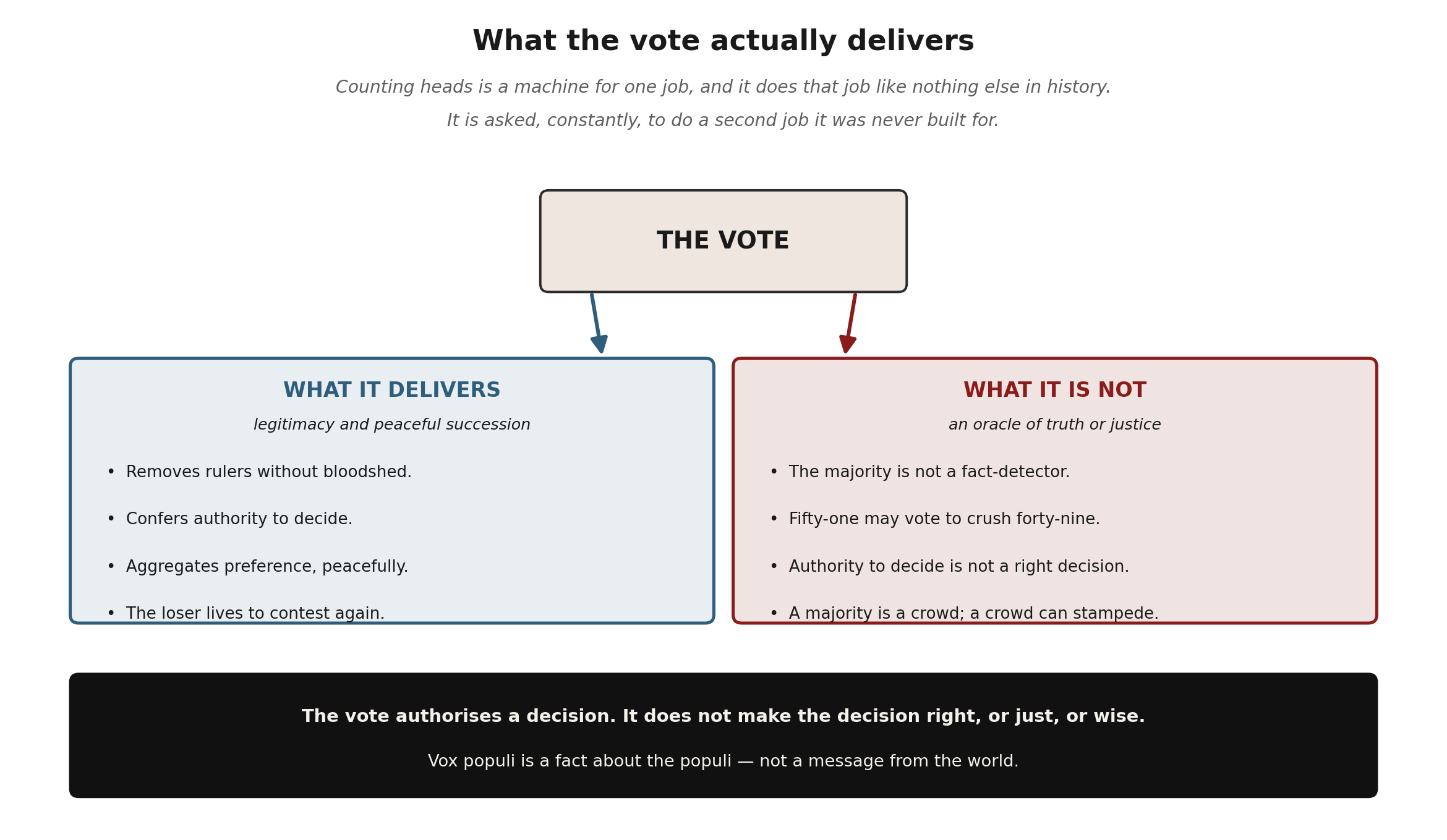
Strip politics down to the bone and it is the answer to a single, permanent, murderous problem: how a group of people who disagree can decide what to do together, and change their minds later, without killing each other over it. Everything else — the speeches, the parties, the pageantry — is decoration on that one load-bearing question. And the vote is the best answer humanity has ever found to it, which is worth saying plainly before saying anything critical, because the criticism only makes sense once you have seen what the thing does right. A vote is a machine for substituting the counting of heads for the breaking of them. That is its glory, and it is a glory so large that we have almost stopped noticing it.
But the vote, like the price in a market, does one job superbly and is asked, constantly, to do a second job it was never built for — and the confusion between the two jobs is where politics goes mad. The vote produces legitimacy and peaceful succession. It is then mistaken for a producer of truth and justice. And that mistake — treating the tally as an oracle rather than a mechanism — is the engine of every democratic catastrophe from the cup of hemlock to the strongman carried into power on a wave of perfectly counted ballots. So let me separate the two jobs, because keeping them apart is the whole of political wisdom, and running them together is the whole of political ruin.
What the vote does right: the peaceful transfer of power
The deepest thing a vote does is not what people think. It is not that it finds the wise policy, or expresses the general will, or discovers the truth of what should be done. It does none of those reliably. What it does — the miracle, the thing worth dying for and, more to the point, the thing that lets you not die for it — is that it allows a people to remove its rulers without bloodshed.
Consider the problem it solves. Through nearly all of human history, the only way to be rid of a bad ruler was to kill him, and killing him meant civil war, and civil war meant that power passed to whoever survived the slaughter, who then could be removed only by the next slaughter. Succession was the great unsolved problem of politics, and it drowned the world in blood — every king’s death a potential war, every transfer of power a throw of the dice with corpses for stakes. The vote solves this, and the solution is so elegant it looks like nothing. You count the heads instead of breaking them. The side with fewer heads accepts the result — not because it agrees, but because it will get to count again next time, and because the alternative is the sword. The loser lives. That is the entire achievement, and it is colossal: a mechanism by which power changes hands and the losers walk away alive and try again, rather than reaching for weapons. Democracy’s genius is not that the majority is wise. It is that the majority can be removed when it proves unwise, peacefully, on a schedule, by the next majority — and so no error need be permanent and no ruler need be murdered.
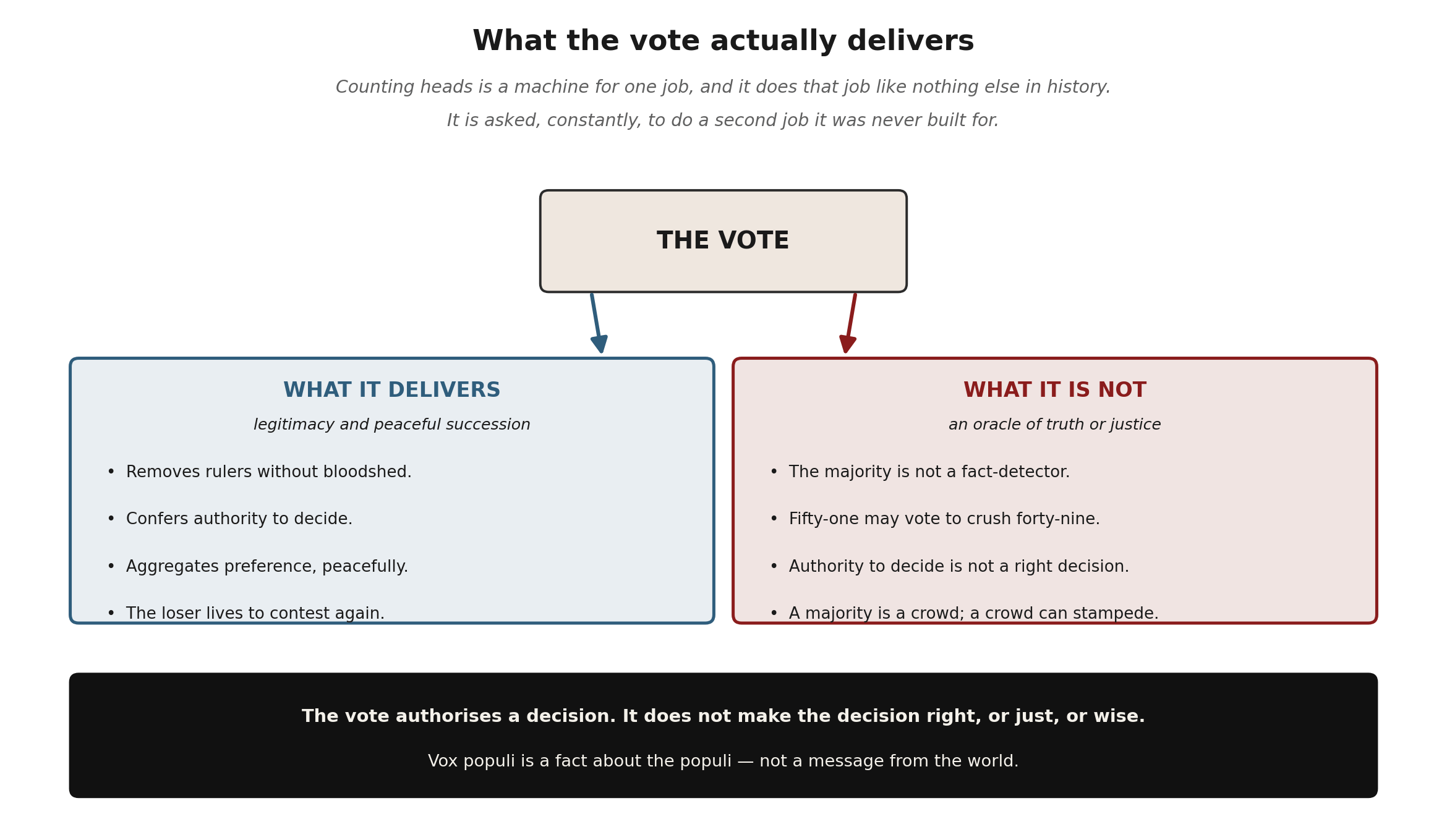
This is worth holding onto because it tells you what the vote is for, and therefore what it is good at. It aggregates preference — what people want — and converts a mess of conflicting wants into a single authorised decision that everyone has reason to accept, at least until the next round. It manufactures legitimacy: the decision binds not because it is correct but because it was reached by a procedure everyone agreed to be bound by. And it does this peacefully, repeatedly, reversibly. Ask the vote to tell you who should govern and how power should pass, and it gives you the best answer in the history of the species. That is what politics does right.
What the vote does wrong: the majority is a crowd
Now the second job, the one it cannot do, and the disasters that follow from pretending it can.
The fatal move is to hear in the phrase “the people have spoken” the further claim “and therefore they are right.” They are not therefore right. The vote counts what people want, and what people want is not the same as what is true or what is just, and no amount of counting converts the one into the other. A majority is not a fact-detector; fifty-one per cent of a nation can be as wrong about a matter of fact as any single fool, and more dangerous, because it is a fool with a mandate. And a majority is not a justice-detector either — this is the darker point — because a majority can vote, with perfect procedural legitimacy, to do monstrous things to the minority. Fifty-one people can lawfully vote to rob, disenfranchise, expel, or enslave the other forty-nine, and the vote’s legitimacy attaches to the act as neatly as it would to a road tax. The tally does not know the difference. The machine that peacefully transfers power will just as peacefully transfer it to the persecution of whoever is outnumbered.
This is the tyranny of the majority, and it is not a rare malfunction of democracy but a standing temptation built into its logic, because the same mechanism that legitimises the removal of a bad ruler legitimises the oppression of a small group by a large one, and nothing in the counting distinguishes the two. Worse, the majority is not merely capable of injustice; it is a crowd, and a crowd can stampede. It is subject to panic, to fashion, to the bandwagon — to the same positive-feedback madness that turns a market into a bubble. A demagogue who can make himself the voice of the crowd’s momentary passion can be handed, by an impeccable vote, the power to dismantle the very mechanism that produced him, and history is a long parade of men who climbed to absolute power on a perfectly legitimate majority and then kicked away the ladder. The vote, mistaken for an oracle, becomes the instrument of its own destruction — because a crowd persuaded that its will is not merely powerful but right will not tolerate the limits that a crowd most needs.
So the vote does wrong exactly what a market does wrong: it aggregates a crowd, and a crowd mistakes its own momentum for a message from the world. Vox populi is a fact about the populi. It is not a message from heaven, and treating it as one has cost more lives than treating it as nothing.
The republic: putting some things beyond the vote
The answer to this is old, and it is the most important political invention after the vote itself, and it is called a republic. Not “republic” as a team name or a partisan slogan, but the genuine thing the word denotes: a system in which the people are sovereign and rule through the vote, but under a constitution that fixes certain things beyond the reach of any majority.
The founders of the American system understood this with a clarity that is bracing to read, precisely because they did not trust the thing they were building. They feared pure, direct democracy — the unmediated rule of the momentary majority — and they said so, at length, because they had studied what it did: it inflamed factions, it oppressed minorities, it lurched with the passions of the hour, and it tended to burn itself down and deliver the ashes to a strongman. Their solution was not to distrust the people and hand power to an elite; that is the opposite error, and they feared it too. Their solution was structural. Build a machine, they reasoned, that assumes neither the wisdom nor the virtue of anyone — not the rulers, not the majority — and that channels the popular will through structures that slow it, divide it, filter it, and forbid it certain acts entirely. Representation, so the passions of the moment must pass through deliberation. Separation of powers, so no single organ can hold the whole. Checks and balances, so ambition counters ambition. And, above all, a set of rights placed in a founding document and put beyond the ordinary vote, so that some things — your speech, your worship, your life, your property without due process — cannot be taken from you by any majority, however large, however sincere, however legitimately assembled.
The genius of this is that it holds certain things fixed precisely so that the vote can keep working. If the majority could vote to abolish the next election, or to strip the losers of the right to contest it, then the first majority would be the last, and democracy would eat itself in a single sitting. The constitution forbids exactly this. It removes from the ballot the handful of things that, if they were on the ballot, would let one vote end all future votes. The limit is not the enemy of self-government. The limit is what makes self-government survive contact with its own passions. Madison put the premise with a candour no one has improved on: if men were angels, no government would be necessary — and if angels governed men, no limits on government would be necessary. Men are not angels, and neither are majorities, and the republic is the machine you build once you have accepted that.
The steelman: the dead hand and the counter-majoritarian objection
Now I must make the case against the constraining layer at full strength, because it has a serious case, and a defence of the republic that has not felt the force of the objection is worth nothing.
The objection is this: a constitution is the dead binding the living. It is a document written by men long in their graves, imposing their choices on generations who never consented to it, and enforced — this is the sharp part — by unelected judges who can strike down the freely chosen laws of a living majority by pointing to a parchment. Call it what it is: the constraining layer is counter-majoritarian. It exists to let a few override the many, and the few who wield it are not accountable to anyone at the ballot box. And “rights,” the very things placed beyond the vote, can become a weapon of the powerful against the people: a privileged minority can wrap its interests in the language of constitutional right and use the courts to block every reform the majority demands, so that “the constitution forbids it” becomes the permanent answer to every attempt of the many to govern themselves. Seen this way, the republic’s celebrated limits are not a protection of the people but a cage around them — the living will of the nation held hostage by dead men and unelected judges and the clever lawyers of the entrenched. The mob’s defenders are not simply wrong; there is a real tyranny on the other side too, the tyranny of a constraining layer that has slipped its leash and now serves the few against the many.
This is a strong objection, and much of it is true, and any honest defender of the republic has to hold it without flinching. The constraining layer can be captured. Rights can be weaponised. The dead hand can strangle the living. These are not paranoid fantasies; they are recurring facts of constitutional history.
The crack: the answer to both tyrannies is the same
But notice what the objection establishes and what it does not. It establishes that the constraining layer can fail toward tyranny — the tyranny of the few, the entrenched, the unremovable. It does not establish that you should therefore abolish the constraining layer, because abolishing it returns you directly to the other tyranny, the tyranny of the many, which is exactly the thing the layer was built to prevent. You have not escaped tyranny by tearing down the constitution. You have merely chosen which tyranny to suffer. And this is the key to the whole matter: there are two ways a free society dies, and they are opposite, and the objection to each is the argument for the other. All vote and no limits is the mob — the fifty-one enslaving the forty-nine. All limits and no vote is the oligarchy — the wise, or those who call themselves wise, ruling under fixed rules and answerable to no one. A free society is the narrow, difficult, permanently unstable middle between these two abysses, and both edges are tyranny.
So the answer to the dead-hand objection is not to demolish the constraining layer but to build it correctly, and the design principle is the same one that governs a healthy fixed point anywhere: the constitution must be hard to change, but not impossible. It must be a hinge, not a weld — revisable, through a deliberate and difficult process, but not by the simple passion of a momentary majority. A constitution that can be changed by an ordinary vote is no constraint at all; it is just another law, and the mob will amend away your rights on the afternoon it decides it wants to. But a constitution that cannot be changed at all is the dead hand the objection rightly fears — the living generation imprisoned by the dead. The whole craft is in the middle setting: amendable, but only through a process demanding enough that it forces the nation to be sure, and sober, and broad, and patient, before it moves the ground everyone stands on. Make the constraining layer too soft and you get the mob. Make it too hard and you get the dead hand. Get the difficulty right and you get a republic — self-government that can correct even its own foundations, but slowly, deliberately, and never in a passion.
The teeth: the vote is not an oracle, and the wise are not a substitute for it
Two errors bracket this subject, mirror images, both false.
The first is the majoritarian’s: the people voted, therefore it is not only legitimate but right, and to place anything beyond the vote is to insult the sovereignty of the people. This conflates the vote’s real and magnificent product — a peaceful, authorised, reversible decision — with a product it cannot deliver, the correctness or justice of the decision. The vote authorises; it does not sanctify. A majority is a crowd, and the whole history of crowds is available to anyone who wishes to know what happens when a crowd is told that its will is also wisdom and its power also virtue. Vox populi, vox dei is the most dangerous four words in politics, because it takes the one thing the vote genuinely produces — legitimacy — and forges from it a licence to do anything at all.
The second is the anti-democrat’s, and it is the same error inverted: because the mob is dangerous and the majority can be wrong, rule should pass to the wise, the expert, the enlightened few who will govern well without the mess of counting heads. This throws away the one thing democracy uniquely provides — the peaceful removal of bad rulers — in exchange for rule by people who, being unelected, cannot be removed at all except by the sword the vote was invented to sheath. And it never delivers the wisdom it promises, because “rule by the wise” has no mechanism for identifying the wise and every mechanism for entrenching those who merely claim to be, so that it collapses, always, into rule by a self-appointed few who are now unremovable. The cure for the diseases of democracy is not less democracy. It is a better republic — more structure, better-designed limits, a sounder constitution — not a philosopher-king, who is merely the mob’s tyranny traded for the oligarch’s, with the added defect that you can no longer vote him out.
Both errors want a single layer to do everything. The majoritarian wants the vote to be aggregator and oracle at once — to decide and to be right. The elitist wants to replace the aggregator with an oracle — to be right instead of deciding by count. Neither works, because the job genuinely has two parts that no single mechanism can perform: you need a way to aggregate preference and transfer power peacefully, which is the vote, and you need a way to hold certain things beyond that aggregation so it cannot destroy itself or its minorities, which is the constitution. A free society is not one of these. It is both, in tension, forever — the fast layer and the slow layer, the will of the moment and the rules beyond the moment, the vote and the limits on the vote.
That is what politics does. Counting heads instead of breaking them is the miracle, and it is not enough by itself, because a majority is a crowd and a crowd can stampede — into the persecution of the few, or into the arms of the man who promises to be its will made flesh. The republic is the discipline that lets the crowd govern without letting it stampede: it keeps the vote for what only a vote can do, and it puts some things beyond the vote for what a vote must never be allowed to do. This turns out to be the same discipline a market needs, for the same reason, against the same failure — but that is the last essay.
Ask not only what the people have decided. Ask whether what they have decided is so, and whether it is just, and whether the machine still forbids them the one thing no majority may ever be allowed to do.
Is it so?
State. Classify. Done.
The scaffolding is standard and checkable: Popper’s argument that democracy’s essential virtue is the peaceful removal of rulers rather than the wisdom of the majority; Madison’s analysis of faction and of institutional checks, including the observation that a government of men rather than angels requires both the power to govern and limits on that power; Tocqueville’s and Mill’s warnings about the tyranny of the majority; the founders’ explicit preference for a representative republic over a pure democracy; and the counter-majoritarian difficulty — the tension of unelected judges overturning the acts of elected majorities. Nothing here endorses a party or a programme; the claims are meant to answer to the structure of the thing, not to anyone’s side of it.